Systems Of Equations Worksheet Substitution is a cornerstone skill that empowers students to solve real-life problems with confidence and precision. Whether you are a student preparing for exams, a teacher seeking engaging practice materials, or a parent guiding a child through algebra, this method offers a clear, step-by-step pathway to finding solutions. In the following article, we will explore the substitution technique in depth, provide actionable strategies, and share practical examples that resonate with everyday scenarios—all while maintaining an engaging tone that reflects a gentle, mindful Asian teaching philosophy.
Understanding the Substitution Method
The substitution method, often taught alongside elimination, is a systematic approach that involves expressing one variable in terms of another and then substituting that expression into a second equation. This technique reduces a system of two equations to a single-variable equation, simplifying the solution process. By mastering substitution, you can handle linear systems, quadratic systems, and even systems that involve parameters with ease.
Key Benefits of Substitution
- Clarity: Each step is explicit, reducing ambiguity.
- Flexibility: Works well with fractions and mixed numbers.
- Scalable: Extends to higher-dimensional systems when paired with matrix algebra.
Step‑by‑Step Guide to Solving a Two‑Variable System
Let’s walk through the classic example that many learners encounter: solving the system
3x + 4y = 12
5x - 2y = 8
We will illustrate the process in a format that is easy to follow.
Step 1: Isolate a Variable
Choose the equation that offers the simplest path to isolation. In this case, the second equation can be rearranged to express x:
5x = 8 + 2y
x = (8 + 2y) / 5
Step 2: Substitute the Expression
Insert the expression for x into the first equation:
3((8 + 2y) / 5) + 4y = 12
(24 + 6y)/5 + 4y = 12
Step 3: Solve for the Remaining Variable
Clear the denominator by multiplying every term by 5:
24 + 6y + 20y = 60
26y = 36
y = 36 / 26
y = 18 / 13 ≈ 1.385
Step 4: Back‑Substitute
Return to the expression for x:
x = (8 + 2(18/13)) / 5
x = (8 + 36/13) / 5
x = (104/13 + 36/13) / 5
x = 140/13 / 5
x = 140/65 = 28/13 ≈ 2.154
Step 5: Verify the Solution
Substitute both values back into the original equations to ensure they satisfy both conditions. If both equations hold true, you have successfully solved the system.
Common Mistakes and How to Avoid Them
- Arithmetic Errors: Small miscalculations, especially with fractions, can derail the entire solution. Double-check each arithmetic step.
- Incorrect Isolation: Forgetting to adjust the sign when moving terms across the equals sign leads to wrong expressions.
- Overlooking Simplification: Simplify fractions early to keep numbers manageable.
- Skipping Verification: Always re‑plug the solution back into both equations. It confirms accuracy and builds confidence.
Real‑World Applications of Substitution
Substitution is not just a textbook exercise; it reflects decision-making processes in everyday life. Consider these scenarios that align with the substitution technique.
1. Budget Allocation
A family plans to distribute a monthly budget between groceries and entertainment. They set up equations based on total spending and a desired savings ratio. Solving these with substitution reveals the exact amount to allocate to each category.
2. Inventory Management
A retailer must decide how many units of two products to order so that total cost and demand constraints are satisfied. By writing constraints as equations, the retailer can use substitution to find an optimal order quantity.
3. Health & Fitness Planning
Imagine calculating daily calorie intake: one equation might link total calories to protein and fat, while the second sets a target protein amount. Substitution helps find the exact balance needed for a balanced diet.
Designing Effective Worksheets for Mastery
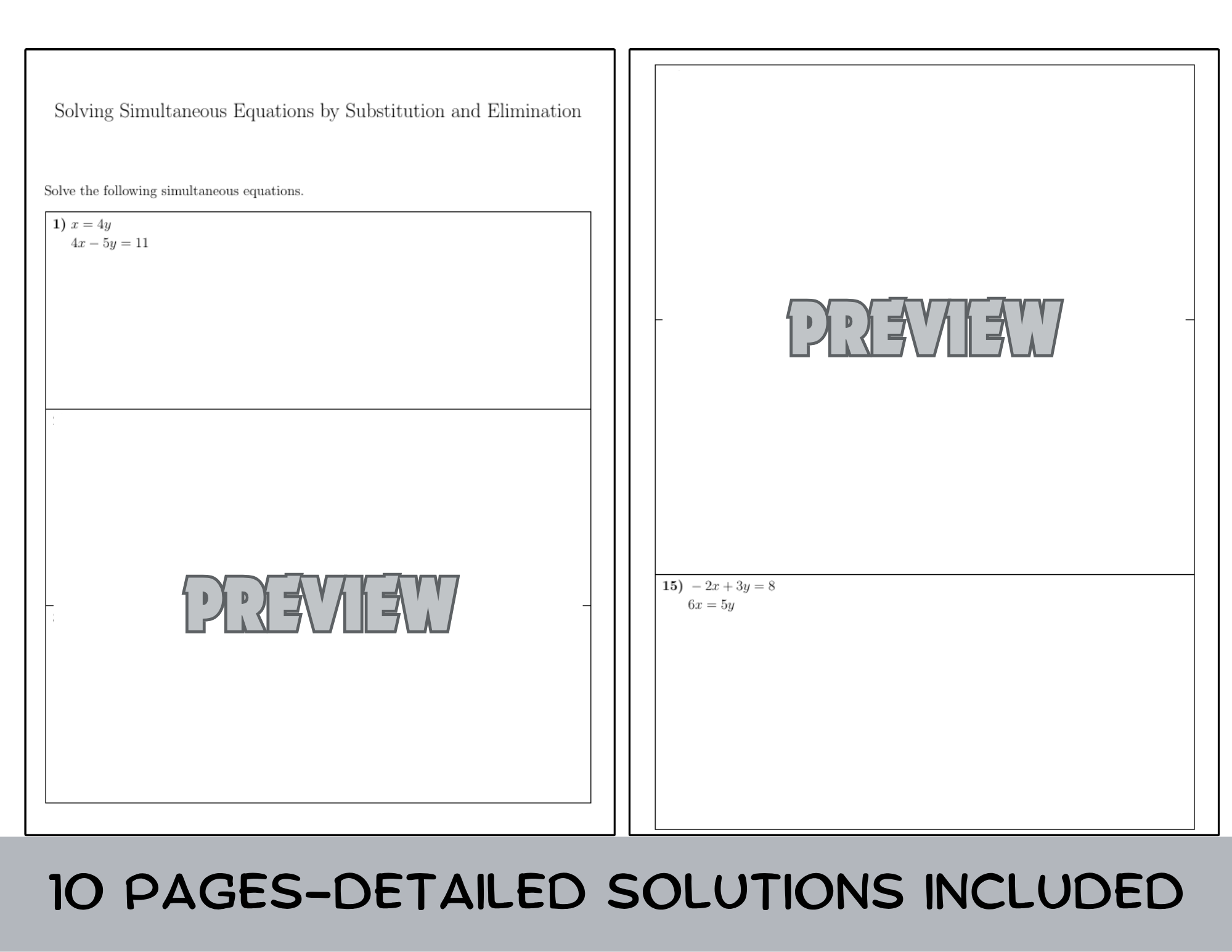
High-quality worksheets should guide learners from basic to advanced concepts. Here’s a framework for crafting engaging substitution exercises.
Section 1: Guided Practice
- Begin with simple systems where one variable can be isolated easily.
- Include step-by-step prompts to reinforce the method.
- Provide answer keys with detailed solutions.
Section 2: Progressive Challenge
- Introduce equations with fractions, mixed numbers, or parameters.
- Encourage students to solve for both variables and verify their results.
- Offer optional hints to maintain engagement without giving away answers.
Section 3: Real-Life Scenarios
- Translate mathematical problems into contexts like budgeting, cooking recipes, or travel planning.
- Ask students to write their own systems based on personal data, enhancing ownership.
- Include word problems that require careful translation into equations.
Section 4: Assessment & Reflection
- Provide a mixture of multiple‑choice, short answer, and open‑ended questions.
- Ask reflective questions such as: “What did you find most challenging?” or “How does substitution help simplify complex problems?”
- Offer a brief discussion prompt for class or online forums.
Techniques to Enhance Learning Efficiency
Visual Aids and Graphing
Plotting each equation on a coordinate plane before substitution can provide visual confirmation. Seeing the intersection point reinforces the algebraic solution and aids memory retention.
Mnemonic Devices
- “I‑S‑S” (Isolate, Substitute, Solve) helps students recall the sequence.
- “Swap and Re‑Plug” reminds learners to insert the expression back into the original equations for verification.
Pairing with Technology
Interactive tools like graphing calculators or algebra software let students experiment with variables instantly, offering instant feedback. Encourage students to cross‑check manual solutions with digital verification.
Common Misconceptions in Substitution
- “It’s only for linear equations.” While substitution is most straightforward with linear systems, it can also solve nonlinear systems, such as one equation being quadratic. Adjust the algebraic manipulation accordingly.
- “One wrong step invalidates everything.” A small mistake can be corrected by revisiting the isolated expression. Teaching a culture of double-checking keeps mistakes from propagating.
- “You must solve for x first.” The choice of variable depends on which equation offers simpler isolation. Flexibility in choice often leads to faster solutions.
Integrating Cultural Context and Mindfulness
In many Asian educational traditions, problem solving is viewed as a collaborative, contemplative process. Applying this mindset to substitution can transform a rote procedure into a meaningful exploration:
- Encourage students to pause and reflect after each step, noting why the operation is valid.
- Use group discussions to share alternative approaches, fostering collective learning.
- Incorporate short moments of mindfulness, such as a 30‑second breathing exercise before tackling complex calculations, to calm the mind and improve focus.
Tips for Teachers to Maximize Engagement
- Use Real Data: Pull numbers from local markets or community events to make equations tangible.
- Flipped Classroom: Assign a short video explanation of substitution before class, then dedicate classroom time to practice and troubleshooting.
- Peer Review: Have students exchange worksheets and critique each other’s solutions, promoting deeper understanding.
- Gamification: Create a leaderboard for quick problem solving, turning mastery into a friendly competition.
Conclusion: Mastery Through Practice and Mindful Insight
Systems Of Equations Worksheet Substitution serves as a powerful tool that bridges abstract algebra with everyday decision making. By following a clear, step‑by‑step process, avoiding common pitfalls, and enriching practice with real-world examples, learners can develop both accuracy and confidence. Incorporating a mindful, culturally sensitive approach not only improves comprehension but also nurtures a lifelong love of mathematics. Whether you’re a student, teacher, or enthusiast, remember that each substitution is a small step toward mastering the intricate dance of numbers that shapes our world.








Related posts of "Systems Of Equations Worksheet Substitution"
