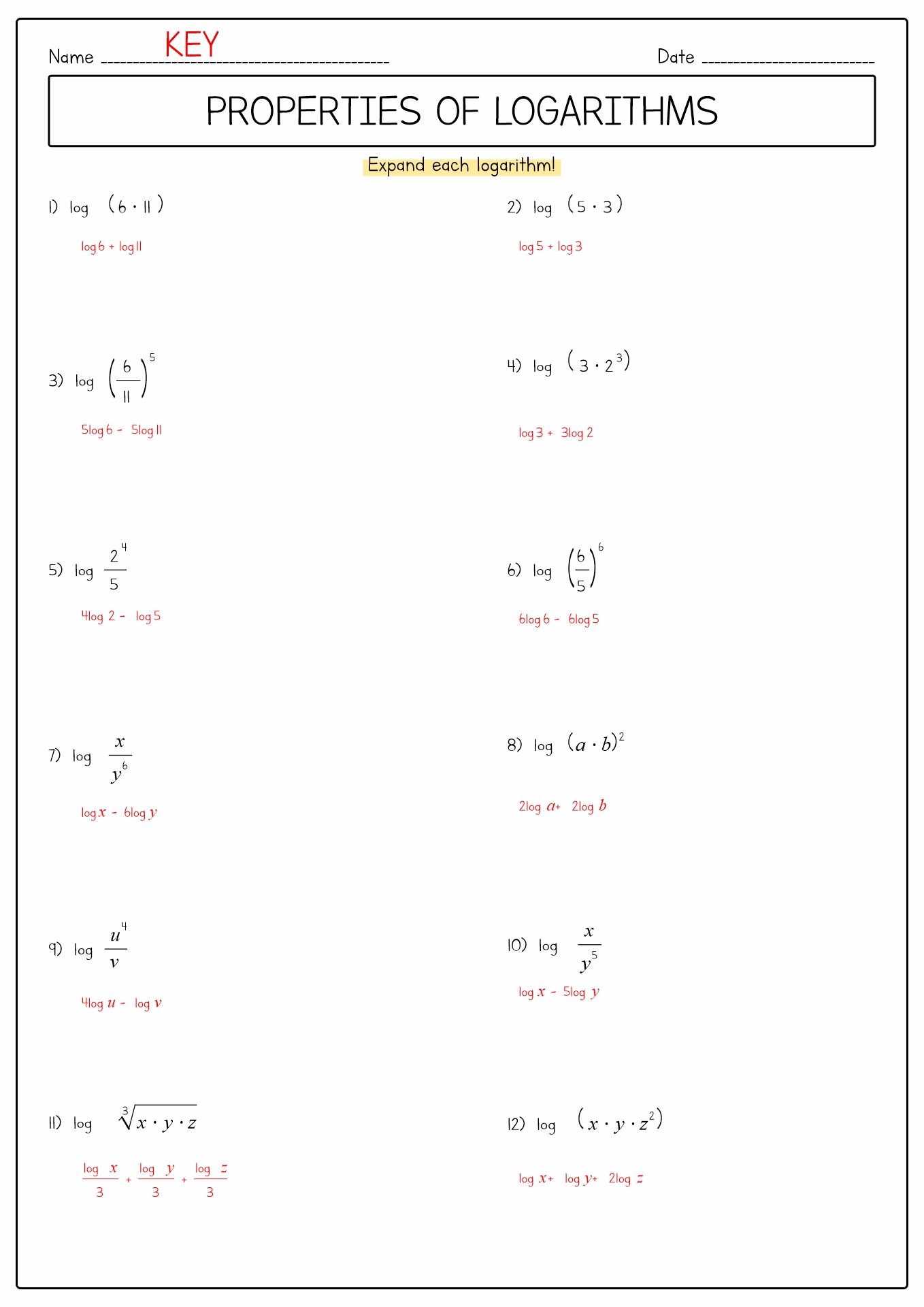
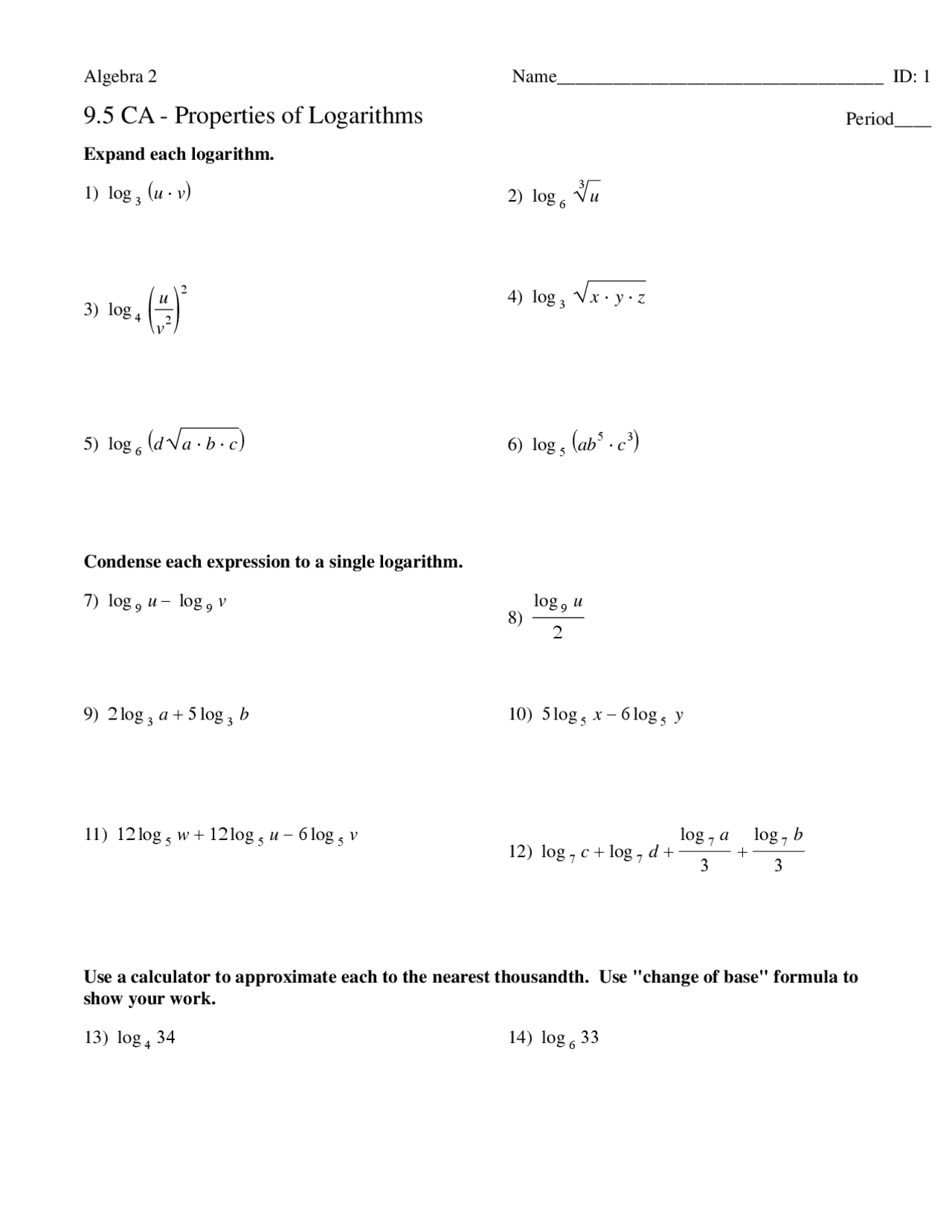
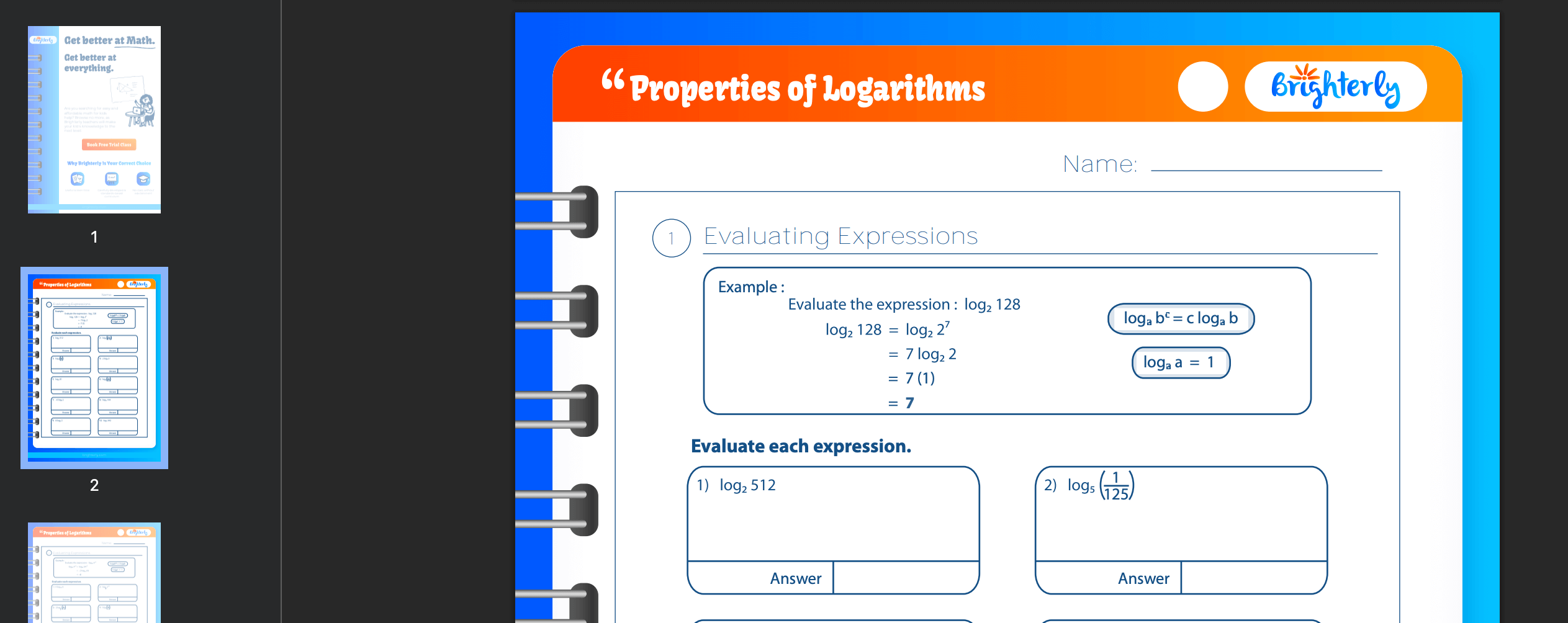
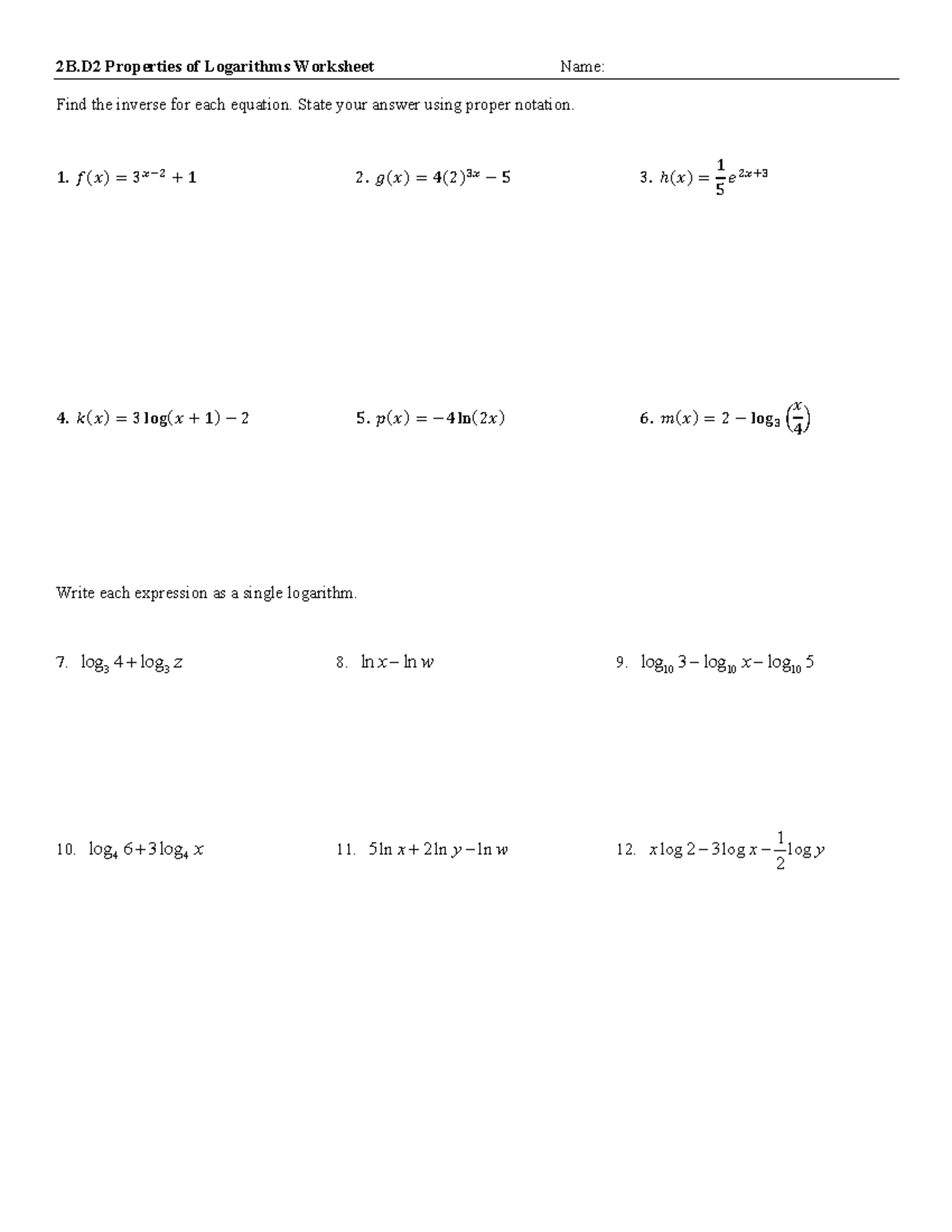
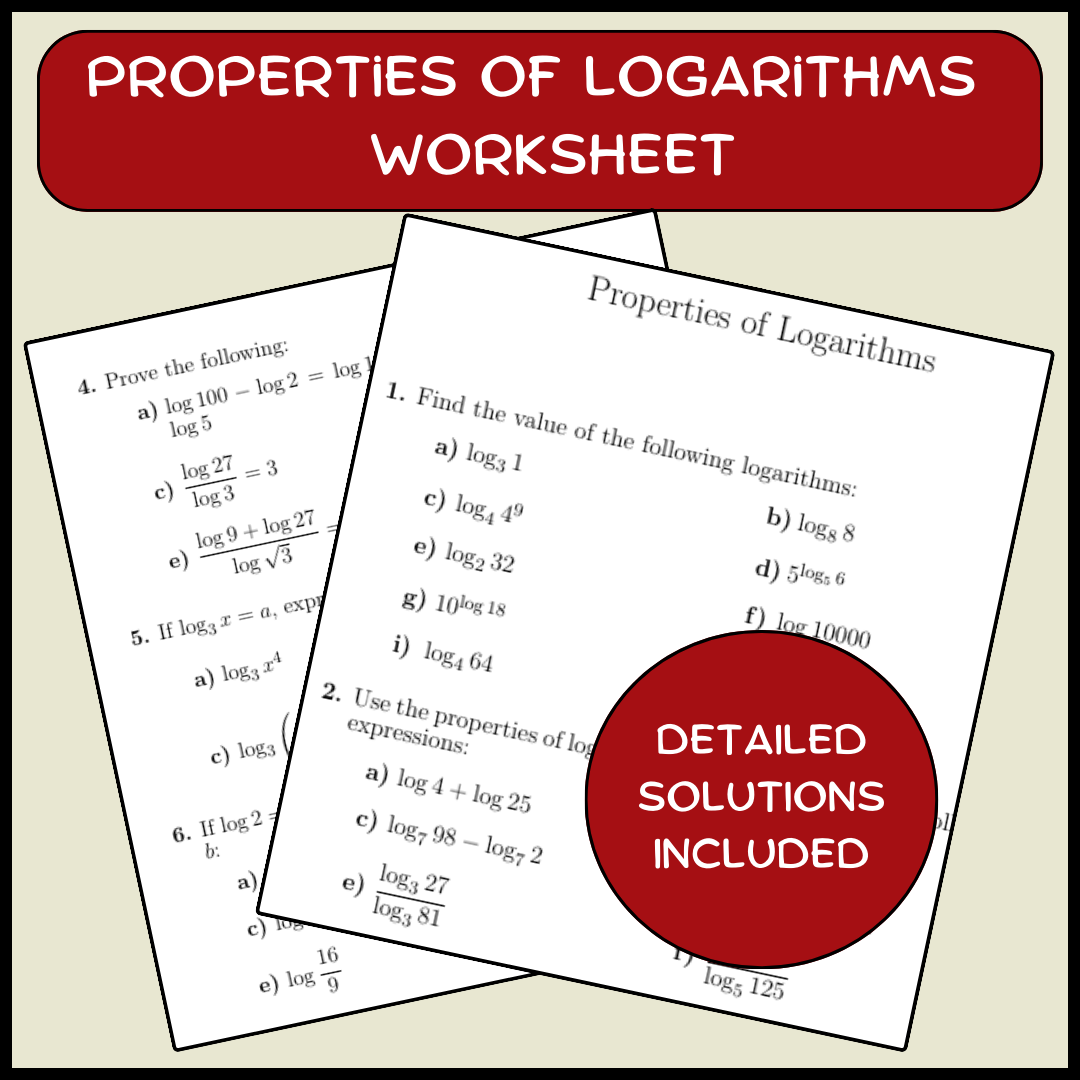
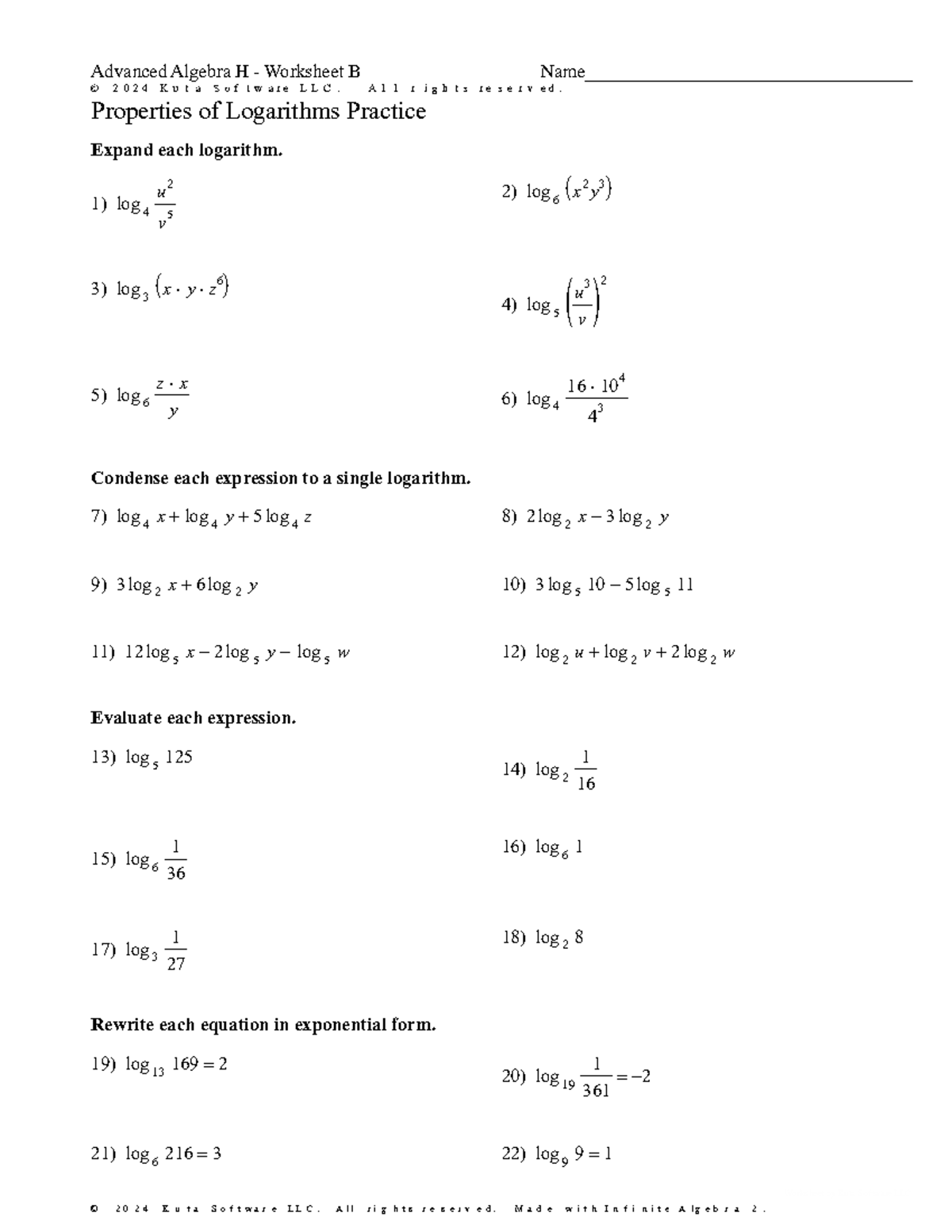
The Worksheet On Properties Of Logarithms provides a structured pathway for students to explore, practice, and internalize the fundamental laws that govern logarithmic functions. By systematically working through carefully designed problems, learners not only reinforce their algebraic foundation but also gain confidence in applying these rules to complex mathematical scenarios.
Understanding Logarithmic Properties
Before diving into the worksheet, it’s essential to grasp the core principles that logarithms obey. These properties simplify calculations, solve equations, and unlock the connection between exponential and logarithmic expressions.
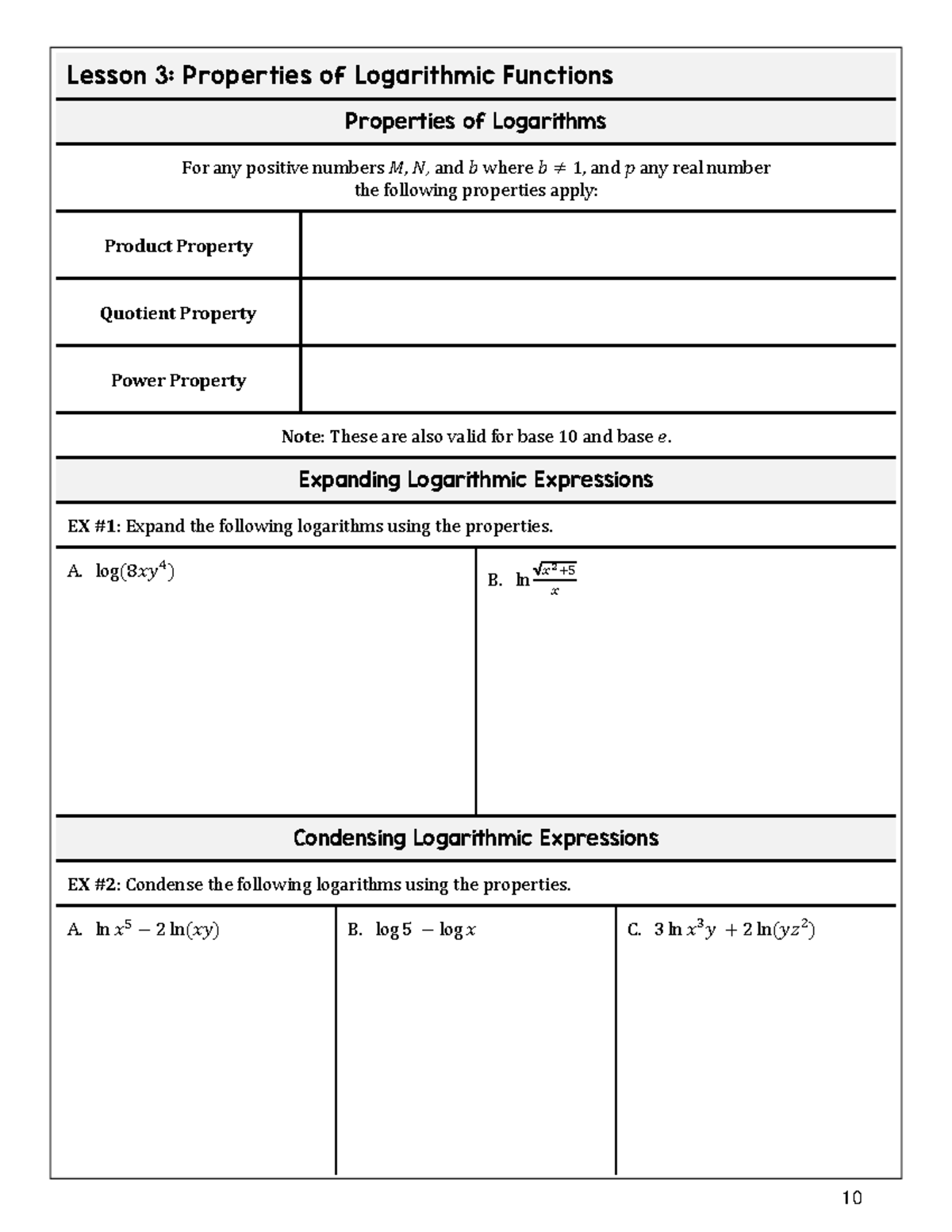
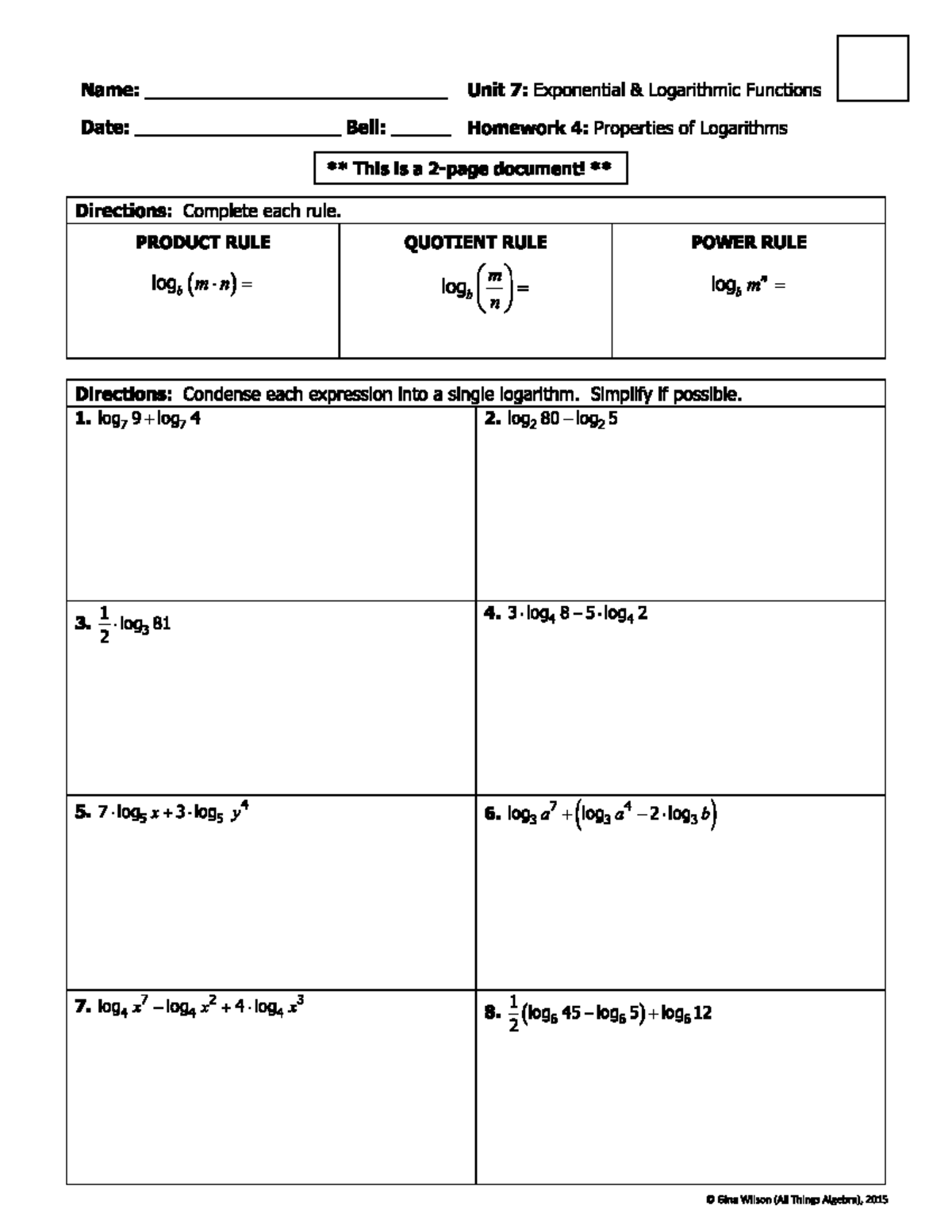
Product Rule
When the logarithm of a product appears, it can be decomposed into the sum of two logarithms: logb(xy) = logb(x) + logb(y). This rule allows the separation of multiplicative terms into additive components, which is especially useful when dealing with large numbers.
Quotient Rule
The logarithm of a quotient transforms into the difference of logarithms: logb(x/y) = logb(x) – logb(y). This property streamlines the manipulation of fractions within logarithmic expressions.
Power Rule
If a logarithmic argument is raised to a power, it can be moved outside the logarithm: logb(xk) = k · logb(x). This rule is critical when simplifying expressions with exponents.
Change of Base Formula
To evaluate logarithms with different bases, use: logb(x) = logc(x) / logc(b). This allows for flexibility when calculators or tables only provide natural or common logarithms.
Why Worksheet On Properties Of Logarithms Matters
Mastery of logarithmic rules is a gateway to advanced mathematics. A focused worksheet provides repetitive, contextual practice that helps solidify these rules in a way that theory alone cannot achieve. Key benefits include:
- Enhanced problem‑solving speed by reducing complex expressions to simpler forms.
- Improved accuracy in algebraic manipulation, especially when preparing for standardized tests.
- Deeper conceptual understanding of how logarithms relate to exponential growth and decay.
- Strengthened foundational skills that support calculus, differential equations, and data science applications.
Core Logarithmic Rules Covered in the Worksheet
The worksheet is designed to cover every major property, offering a balanced mix of theory, calculation, and real‑world context.
- Product Rule Exercises – Pairing numbers, variables, and constants.
- Quotient Rule Problems – Including fractions and algebraic expressions.
- Power Rule Tasks – Tackling exponentiation in both integer and fractional exponents.
- Change of Base Conversions – Applying natural, base‑10, and custom bases.
- Composite Logarithmic Equations – Combining multiple properties in a single problem.
- Proofs and Derivations – Short derivations to reinforce reasoning.
Step‑by‑Step Guide to Completing the Worksheet
Approaching the worksheet systematically ensures a thorough review and reduces errors. Follow this routine:
1. Read Each Problem Carefully
Identify which property or combination of properties applies. Highlight the key terms: product, quotient, or power.
2. Apply the Appropriate Rule
Use the rule that matches the structure of the expression. For instance, if you see a product inside a log, employ the product rule.
3. Simplify Intermediate Steps
Break down complex expressions into smaller pieces. This reduces the chance of arithmetic errors and makes the solution easier to verify.
4. Verify the Final Result
Cross‑check by converting back to exponential form. For example, if you find log2(8) = 3, verify that 23 = 8.
5. Reflect on Common Mistakes
Keep a log of errors such as sign mistakes in quotient rules or misapplying the power rule. Reviewing these points can prevent repetition in future problem sets.
Real‑World Applications of Logarithmic Properties
Logarithms transcend pure mathematics; they appear in science, engineering, finance, and everyday technology. Understanding these properties equips students to navigate real scenarios with confidence.
Earthquake Intensity: The Richter Scale
The Richter magnitude is calculated using a logarithmic scale: M = log10(A/A0), where A is seismic wave amplitude. The product and power rules help interpret how small changes in amplitude translate to larger changes in magnitude.
Sound Decibels
Sound intensity in decibels employs: D = 10 · log10(I/I0). Applying the power rule allows quick conversion when intensity doubles or halves.
Population Growth and Radioactive Decay
Exponential models describe growth or decay, and their inverses use logarithms. For example, solving for time in N(t) = N0e−kt requires taking the natural log of both sides and utilizing the change of base formula to accommodate different computational tools.
Computer Science: Algorithm Complexity
Logarithmic time complexity, such as O(log n), appears in binary search and tree operations. Grasping log properties aids in analyzing and comparing algorithmic efficiency.
Tips for Teachers and Students
Effective use of the worksheet hinges on thoughtful instruction and diligent practice.
For Teachers
- Begin with a brief recap of each property before handing out the worksheet.
- Encourage students to explain their reasoning in written form, not just the final answer.
- Use group work to foster collaborative problem solving, especially for composite equations.
- Incorporate technology, such as graphing calculators, to visualize logarithmic graphs and confirm results.
- Schedule a review session after a week to address common misconceptions.
For Students
- Practice with flashcards that prompt you to recall which rule applies to a given expression.
- Record your steps in a math notebook; this habit reduces careless mistakes.
- Apply the rules to everyday calculations, like converting between temperature scales or measuring file sizes in powers of 2.
- Use online graphing tools to see how changes in the base affect the shape of a logarithmic curve.
- Seek peer discussion; explaining a concept reinforces your own understanding.
Creating Custom Worksheets
Teachers and curriculum designers can tailor the worksheet to fit specific learning objectives. Here’s a quick guide to crafting effective problems:
1. Define Learning Goals
Decide whether the focus is on algebraic manipulation, application to real problems, or proof construction.
2. Choose Base Values Strategically
Use a mix of base‑10, base‑e, and arbitrary bases (e.g., 3 or 7) to expose students to the change‑of‑base formula.
3. Incorporate Contextual Questions
Embed problems from physics, biology, or economics to illustrate relevance.
4. Vary Difficulty Levels
Start with single‑property exercises, then progress to multi‑step problems that combine several rules.
5. Provide Answer Keys and Detailed Solutions
Include step‑by‑step explanations so students can self‑correct and learn from mistakes.
Frequently Asked Questions
Why do logarithms require positive arguments?
Because the logarithmic function maps only positive real numbers to real outputs; negative or zero values would violate the definition of exponents.
Can I use negative bases for logarithms?
In real-number contexts, negative bases are not defined for logarithms. Complex number bases exist but are beyond typical high‑school curriculum.
How do logarithmic properties aid in solving equations?
By converting multiplicative relationships into additive ones, the properties reduce complex equations to solvable linear forms.
What is the difference between natural logs and common logs?
Natural logs use base e (~2.718) and appear in continuous growth models; common logs use base 10 and are common in engineering and everyday calculations.
Conclusion
Mastering the Worksheet On Properties Of Logarithms equips learners with a versatile toolkit for navigating both academic challenges and practical problems across science and technology. By systematically applying product, quotient, power, and change‑of‑base rules, students transform complex logarithmic expressions into manageable forms, build confidence in algebraic manipulation, and gain a deeper appreciation for the elegance of logarithmic relationships. Whether used as a classroom resource, a self‑study aid, or a foundation for advanced coursework, this worksheet stands as an indispensable bridge from theoretical knowledge to real‑world application.










Related posts of "Worksheet On Properties Of Logarithms"
