Worksheet On Function Notation offers a focused, hands‑on approach for students to internalize the language of functions, an essential component of algebra and higher mathematics, and it does so while aligning with classroom standards and real‑world applications.
Why Function Notation Matters in Modern Mathematics
Function notation is more than a symbolic shortcut; it is a concise way to describe relationships between variables, enabling students to model real‑life situations such as population growth, financial interest, and physics equations. Mastery of this notation paves the way for smoother transitions into topics like linear equations, quadratic functions, and calculus. When learners see the notation repeatedly in a worksheet format, they develop procedural fluency and conceptual confidence that supports long‑term academic success.
Key Features of an Effective Function Notation Worksheet
Clear Learning Objectives
Each worksheet should begin with a brief statement of goals, for example: “Students will be able to evaluate f(x) for given values of x and translate verbal descriptions into functional form.” Clear objectives help both teachers and students stay focused and measure progress.
Progressive Difficulty Levels
A well‑designed worksheet moves from simple to complex. Initial items might ask learners to read a function table and write the corresponding expression, while later problems require interpreting piecewise definitions or composing functions. This scaffolding respects cognitive development and keeps motivation high.
Varied Question Types
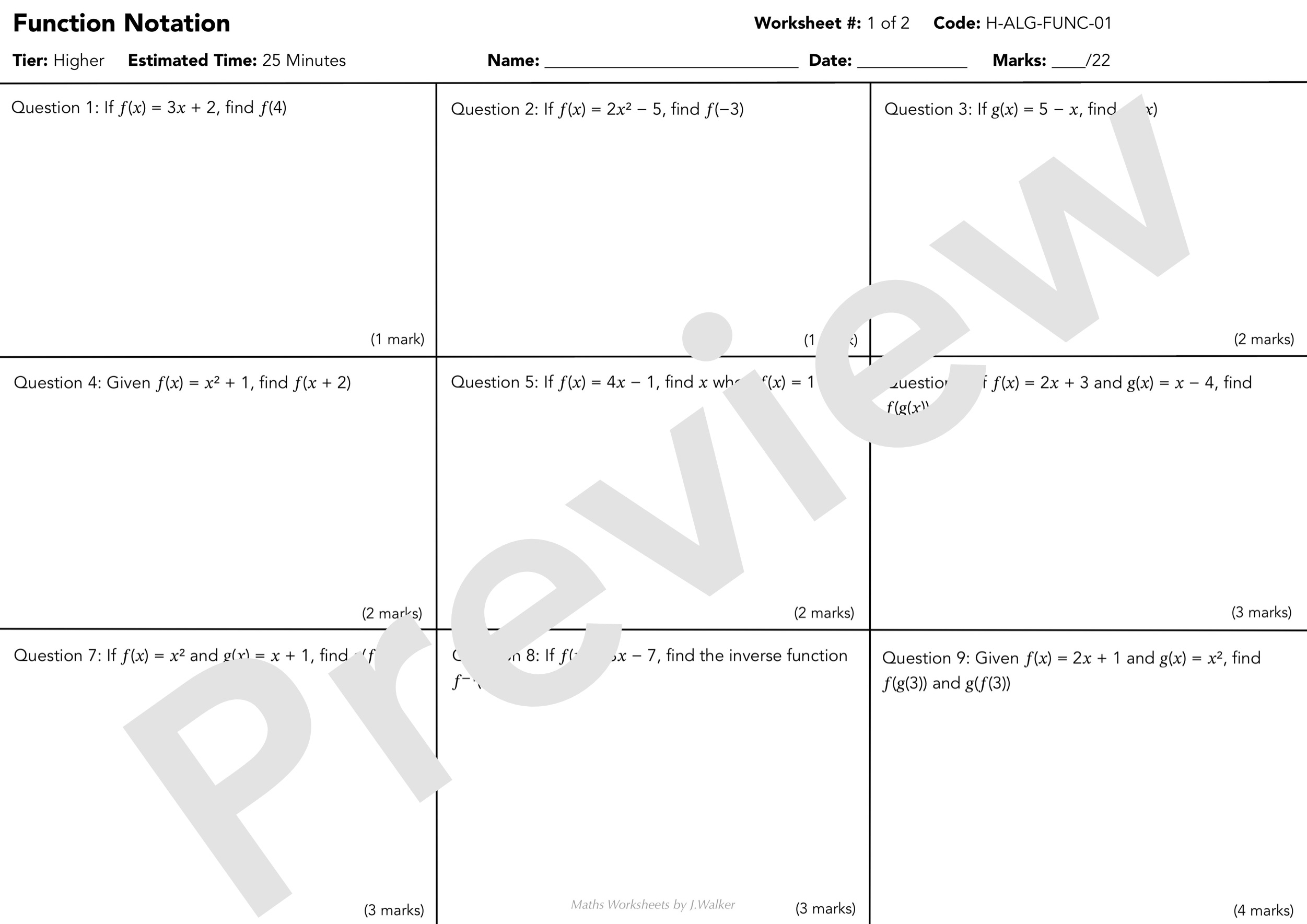
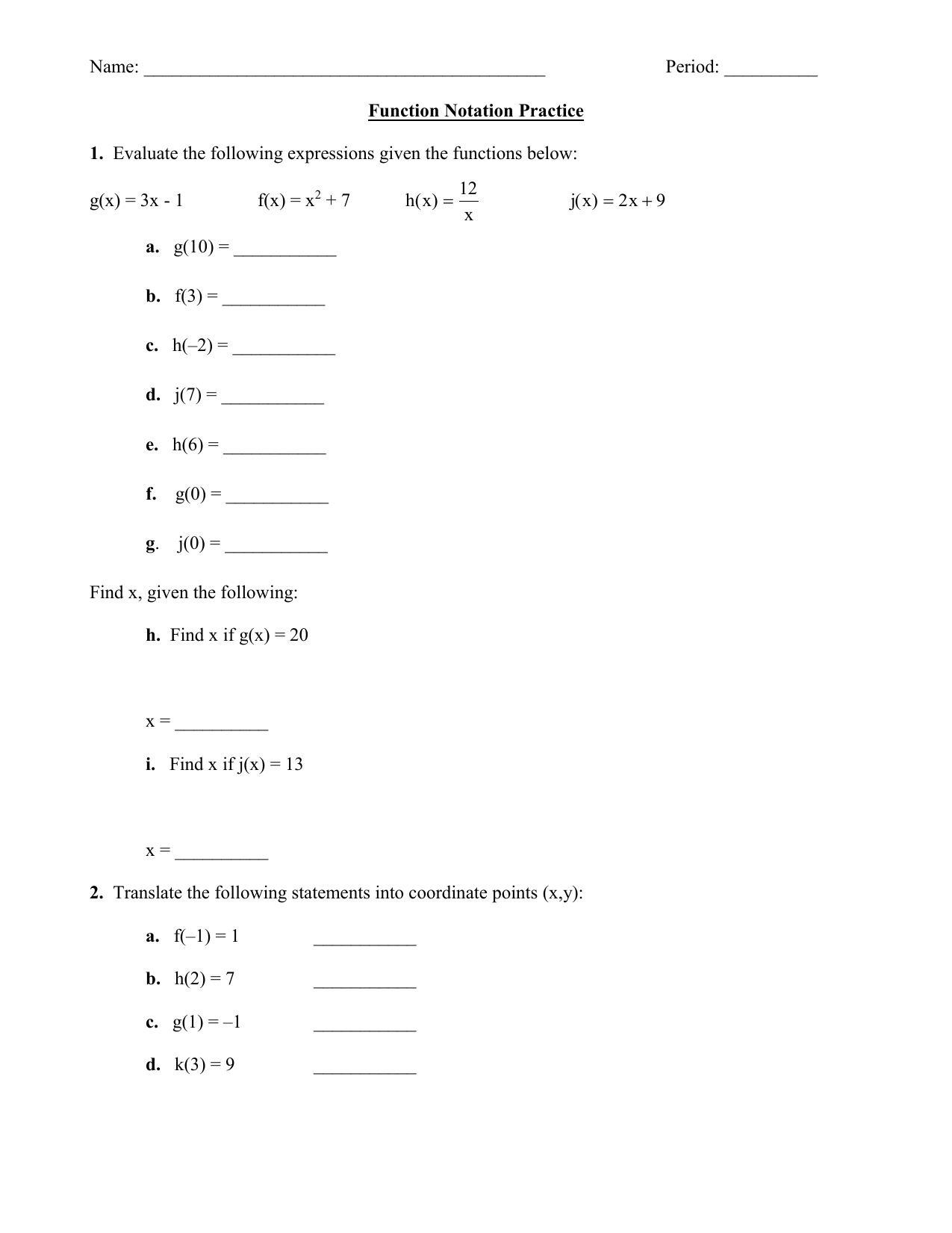
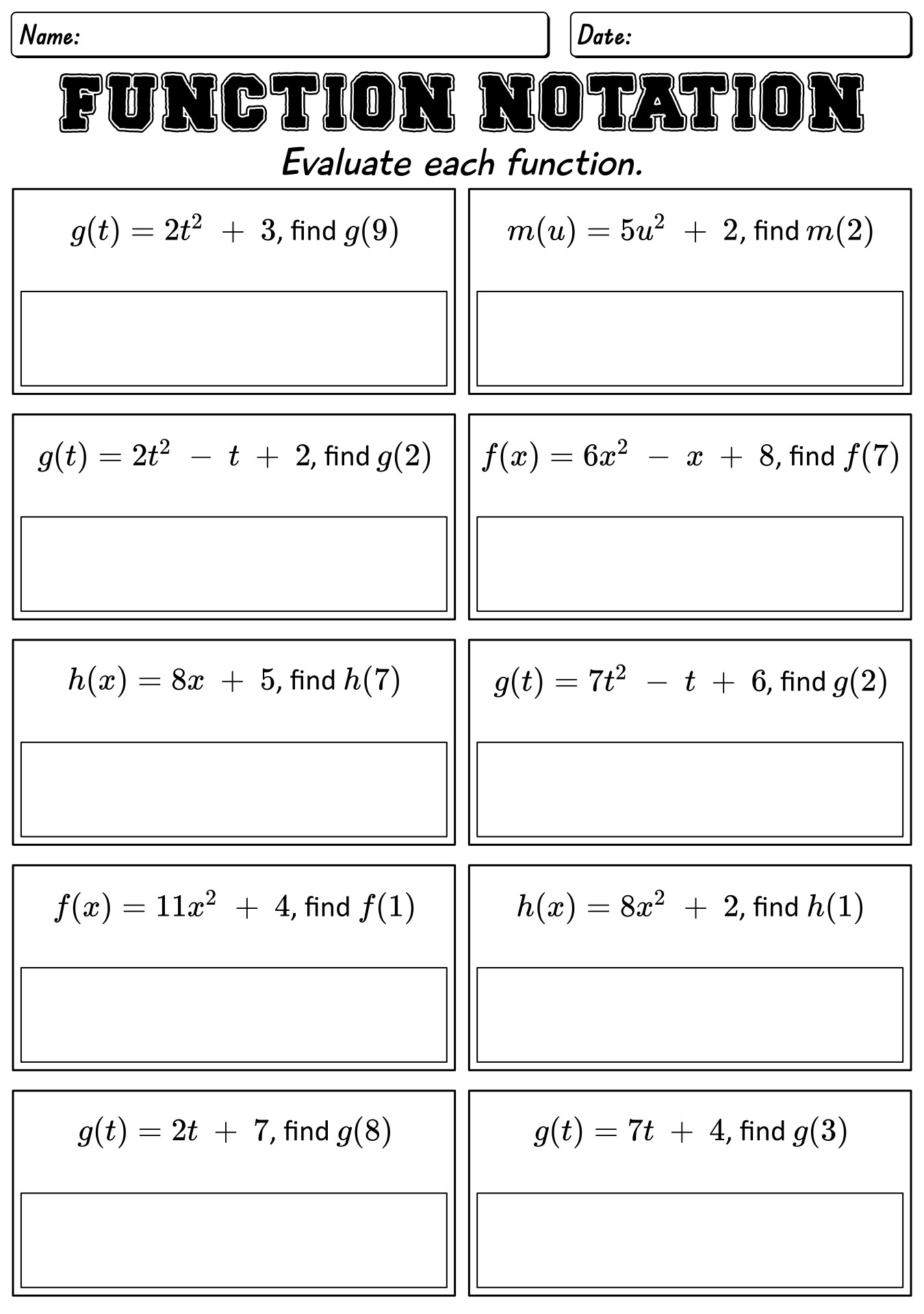
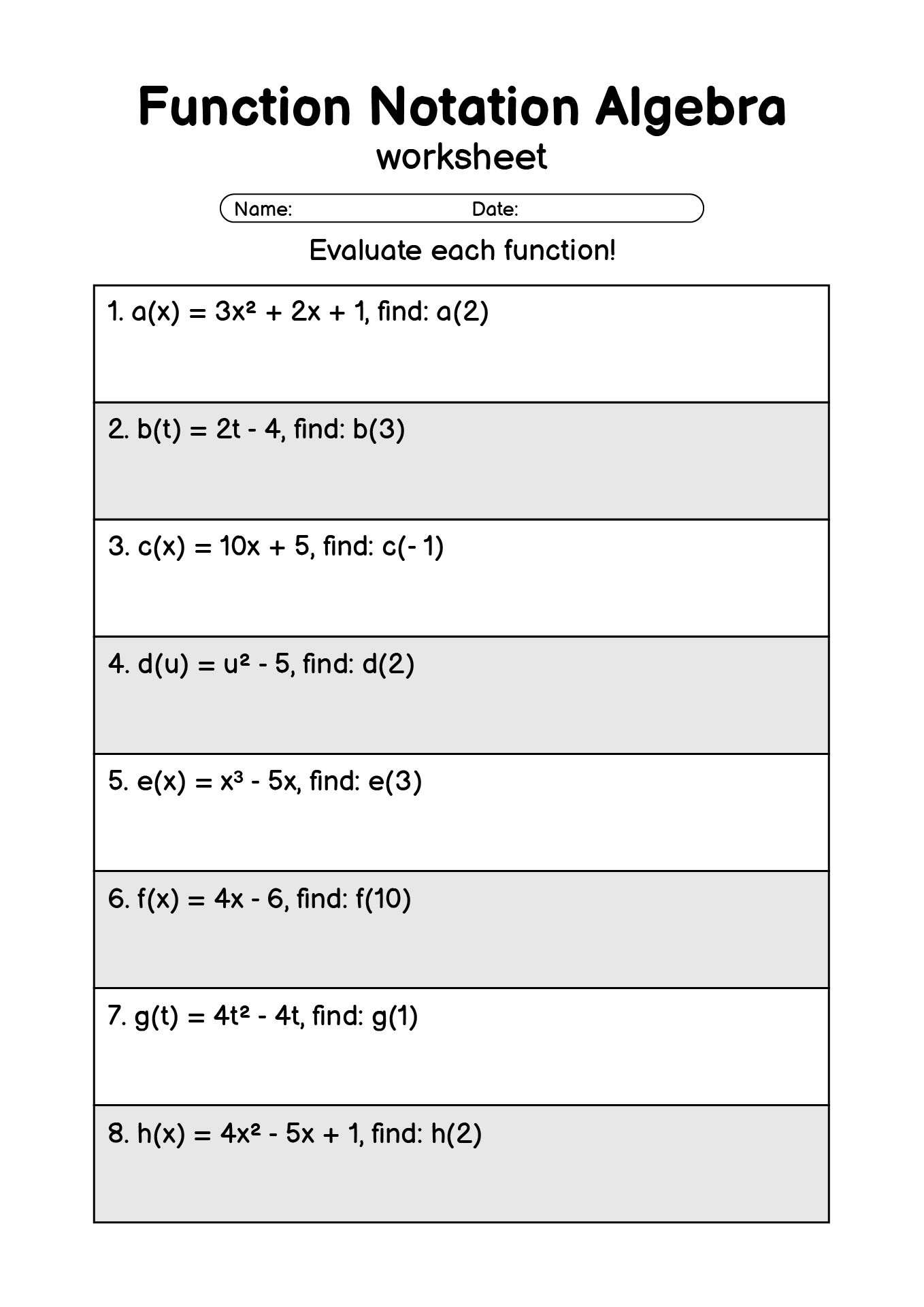
- Evaluation Tasks: Provide a function and ask for f(3), f(−2), etc.
- Transformation Prompts: Convert verbal statements into function notation, such as “The cost C of a taxi ride is $2.50 plus $0.75 per mile.”
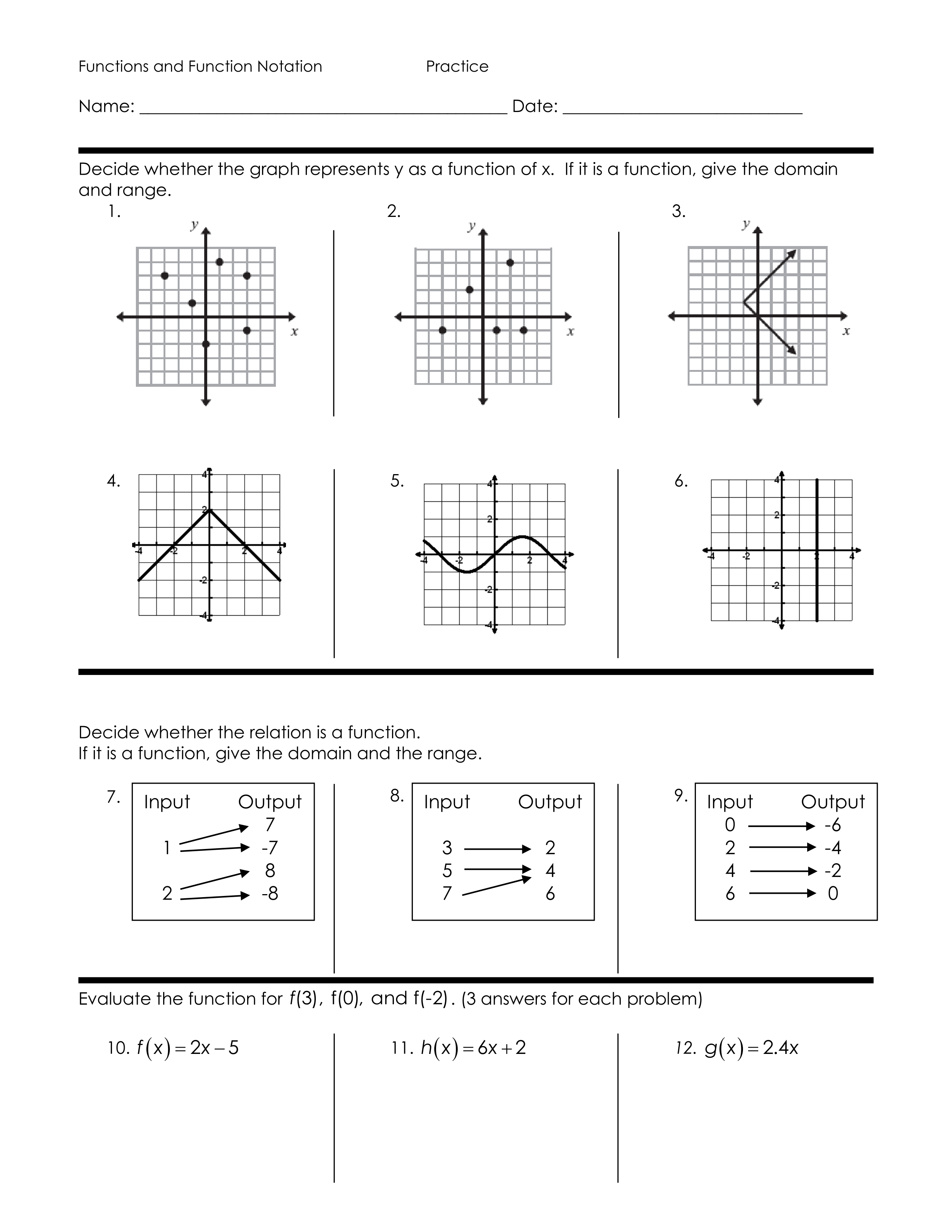
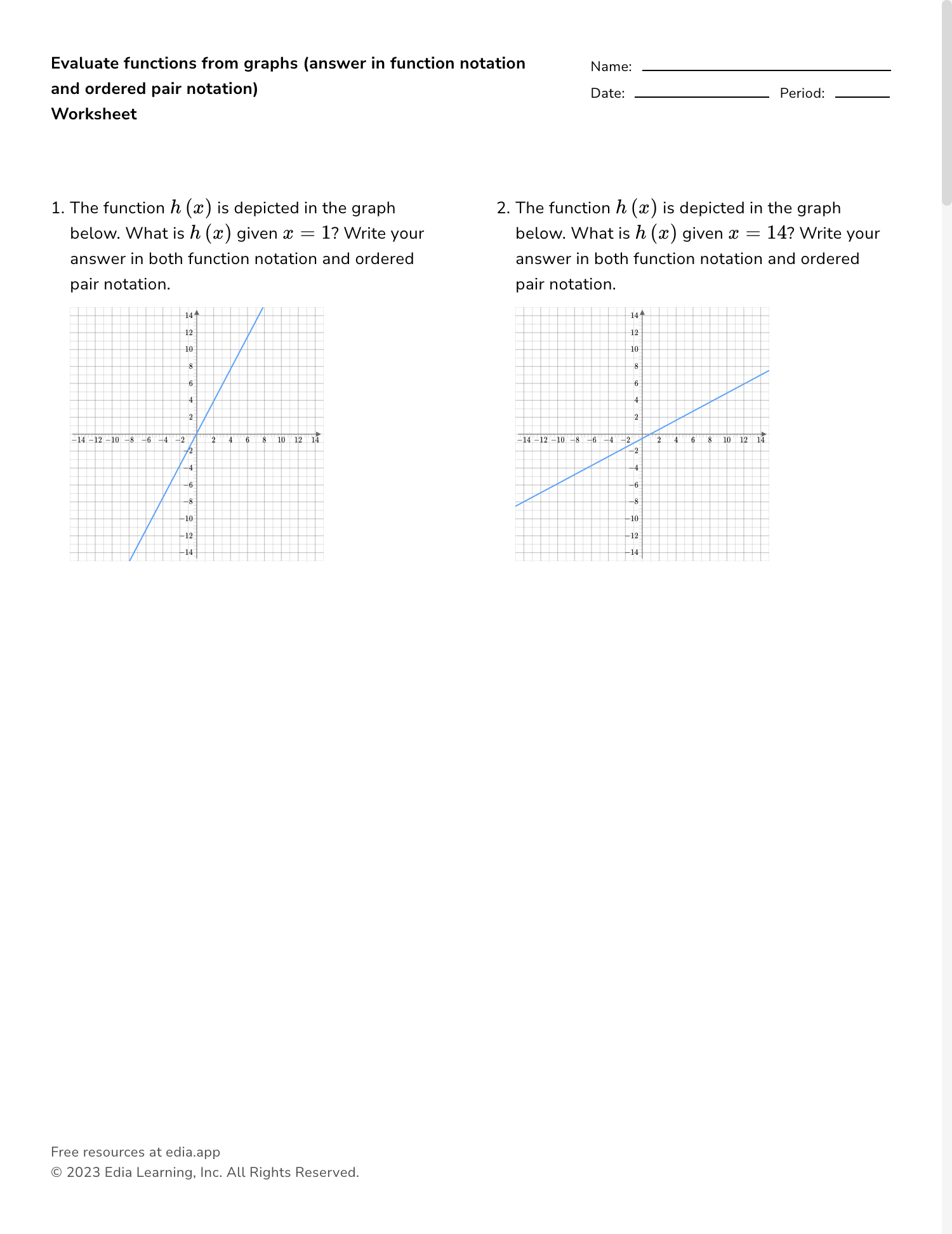
- Graphical Interpretation: Present a graph and request the function value at a specific x‑coordinate.
- Composition Challenges: Combine two given functions and evaluate the composition at a particular input.
Real‑World Contexts
Embedding everyday scenarios—like calculating total earnings based on hourly wages or determining the temperature change over time—makes abstract symbols relatable. When students see function notation as a tool for solving authentic problems, their intrinsic interest rises.
Step‑by‑Step Guide to Using the Worksheet in the Classroom
1. Pre‑Lesson Warm‑Up
Start with a quick mental‑math activity that reviews basic concepts: variables, expressions, and the idea of a rule that assigns inputs to outputs. This primes students for the notation they will encounter.
2. Introduce the Notation Explicitly
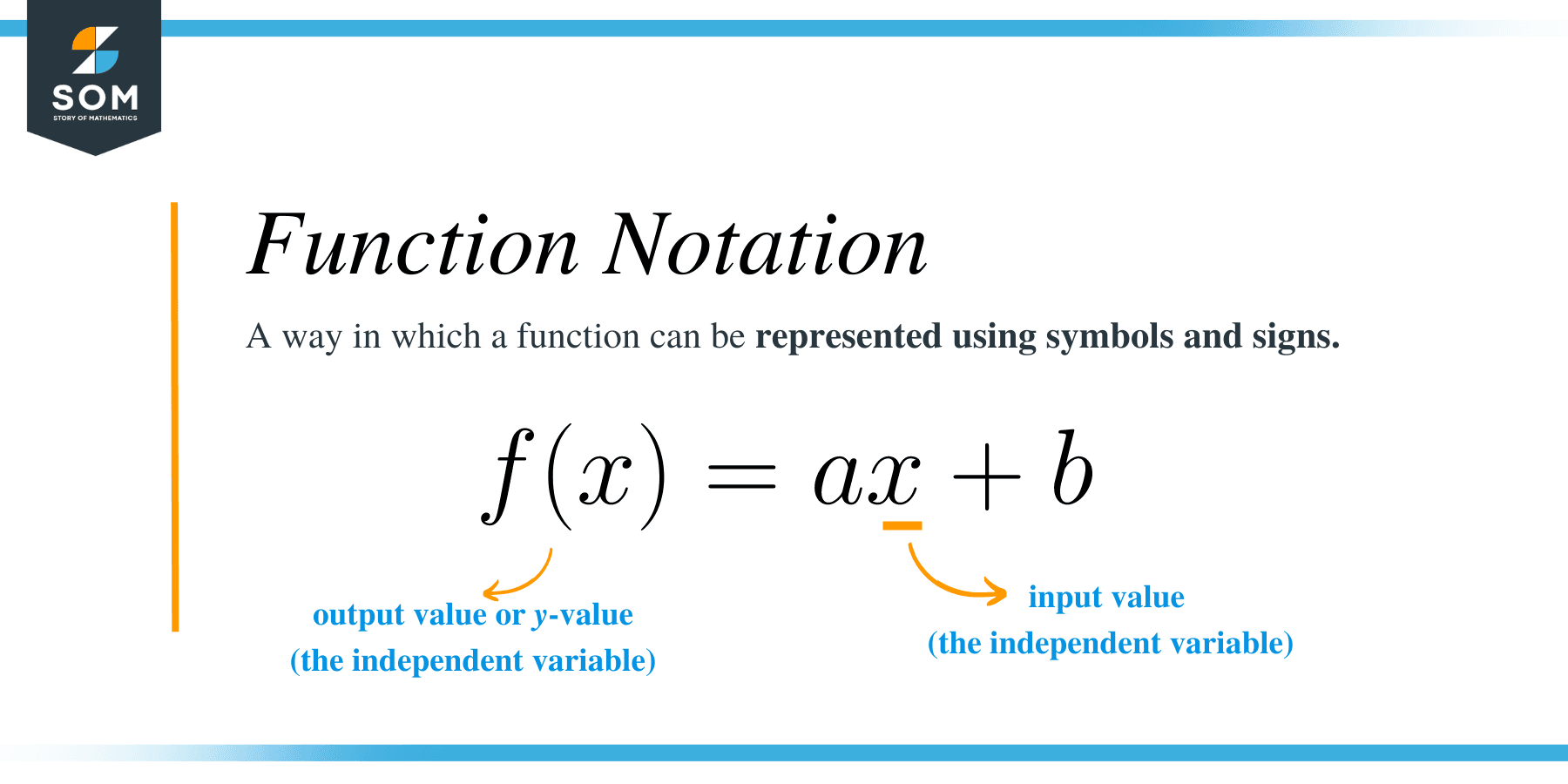
Write the generic form f(x) on the board and explain each component: “f” denotes the function name, “x” is the independent variable, and “f(x)” represents the output. Highlight that the same function can be written with different letters (g(t), h(y)) without changing its meaning.
3. Guided Practice with Sample Problems
Work through the first few worksheet items together. Model the thought process: read the problem, identify the given function, substitute the appropriate value, and simplify. Encourage students to verbalize each step, reinforcing metacognition.
4. Independent Work Phase
Allow learners to complete the remaining problems individually or in small groups. Circulate to provide immediate feedback, correcting misconceptions such as confusing the input variable with the output or misreading parentheses.
5. Review and Reflect
Conclude the session by revisiting challenging items. Ask students to explain why a particular answer is correct, and invite alternative solution strategies. This reflection solidifies understanding and highlights the versatility of function notation.
Common Mistakes and How to Address Them
Confusing Input and Output
Students often substitute the wrong variable, especially when functions are defined with a different letter (e.g., g(t) = 2t + 5). Emphasize the substitution process: replace the independent variable with the given number, then simplify.
Ignoring Parentheses
Neglecting parentheses leads to arithmetic errors, such as interpreting f(2) = 3x + 1 as 3·2 + 1 = 7 versus the correct 3·(2) + 1 = 7. Use visual cues—color‑coded brackets in the worksheet—to remind learners to treat the entire expression inside the parentheses as a single unit.
Mistaking Function Names for Variables
When a problem involves multiple functions, students may mistakenly treat “f” as a variable. Clarify that the function name stays constant while the input changes; the output is what varies.
Overlooking Domain Restrictions
Some functions, like f(x) = 1/(x‑3), are undefined for certain inputs. Include a brief reminder on the worksheet to check for division by zero or square‑root of negative numbers, reinforcing domain awareness.
Adapting the Worksheet for Diverse Learners
For Struggling Students
Provide a simplified version with fewer steps and concrete manipulatives, such as number cards that students can physically replace in the function. Offer a “cheat sheet” that lists common algebraic rules (e.g., distributive property) for quick reference.
For Advanced Learners
Introduce extensions like piecewise functions, inverse functions, or function composition. Challenge them to create their own real‑world problem, write it in function notation, and solve it on the worksheet.
English Language Learners (ELL)
Pair visual symbols with clear verbal explanations. Use bilingual glossaries for terms like “output” and “input.” Encourage peer tutoring where a more fluent student can model the reasoning process.
Integrating Technology with Traditional Worksheets
While paper worksheets remain valuable, digital platforms amplify engagement. Teachers can upload the worksheet to learning management systems, embed interactive fields that automatically check answers, and provide instant feedback. Tools such as Google Slides or educational apps allow students to drag and drop values into function boxes, reinforcing the substitution concept in a kinetic way.
Benefits of a Hybrid Approach
- Immediate Assessment: Automatic grading saves time and highlights patterns of misunderstanding.
- Data Tracking: Teachers can monitor individual progress over multiple worksheets, tailoring instruction accordingly.
- Accessibility Features: Text‑to‑speech and adjustable font sizes support students with diverse needs.
Assessment Strategies Using Function Notation Worksheets
Formative Checks
After students complete the worksheet, use quick exit tickets that ask for a single evaluation (e.g., “What is f(4) for the function f(x) = 2x‑3?”). This snapshot informs whether the lesson objectives were met.
Summative Evaluation
Incorporate a portion of the worksheet into a larger test, ensuring that items assess both procedural fluency and conceptual understanding. Include open‑ended prompts where students must explain their reasoning, demonstrating depth of comprehension.
Rubric Development
Design a rubric that rewards accuracy, methodical work, and clear notation. Allocate points for correct substitution, proper simplification, and neat presentation. Such transparent criteria motivate students to focus on each step of the process.
Practical Tips for Teachers When Designing Their Own Worksheets
Start with Real‑World Scenarios
Choose contexts that resonate with your students’ interests—sports statistics, video game scores, or budgeting for a school event. This relevance sparks curiosity and encourages deeper engagement.
Use Consistent Formatting
Maintain uniform spacing, clear headings, and legible fonts. Consistency reduces cognitive load, allowing learners to concentrate on the mathematics rather than deciphering the layout.
Include Answer Keys and Explanation Sections
Providing a detailed answer key helps teachers verify solutions quickly and offers students a reference for self‑correction. Include brief explanations that highlight the key step, such as “Substituted x = 5 into f(x) = 3x‑2 to obtain 13.”
Pilot Test the Worksheet
Run a short trial with a small group of students. Observe where they hesitate, note common errors, and refine the wording or difficulty level accordingly before full deployment.
Real‑World Examples Demonstrating Function Notation
Example 1: Ride‑Sharing Cost
Suppose a ride‑sharing service charges a base fee of $1.75 plus $0.85 per mile. The cost function can be written as C(m) = 1.75 + 0.85m, where m represents miles traveled. Using the worksheet, students evaluate C(10) to find the cost for a 10‑mile trip, reinforcing the substitution process.
Example 2: Temperature Conversion
The conversion from Celsius to Fahrenheit is given by F(c) = (9/5)c + 32. A worksheet problem might ask: “What is the Fahrenheit temperature when c = 25°C?” Students replace c with 25, compute (9/5)·25 = 45, then add 32 to obtain 77°F.
Example 3: Population Growth Model
A simple exponential growth model uses P(t) = P₀·e^kt, where P₀ is the initial population, k is the growth rate, and t is time in years. By providing specific values (e.g., P₀ = 5000, k = 0.04), the worksheet asks for P(5). Students calculate e^0.04·5 ≈ e^0.20 ≈ 1.221, then multiply by 5000 to estimate a population of about 6,105 after five years.
Conclusion
Incorporating a thoughtfully crafted Worksheet On Function Notation into mathematics instruction bridges the gap between abstract symbolic language and tangible problem‑solving skills. By emphasizing clear objectives, progressive difficulty, real‑world relevance, and diverse instructional strategies, teachers can empower all learners to master function notation with confidence. Whether delivered on paper or through interactive digital tools, the worksheet serves as a versatile resource that supports formative assessment, reinforces conceptual understanding, and prepares students for the advanced mathematical challenges that lie ahead.










Related posts of "Worksheet On Function Notation"
