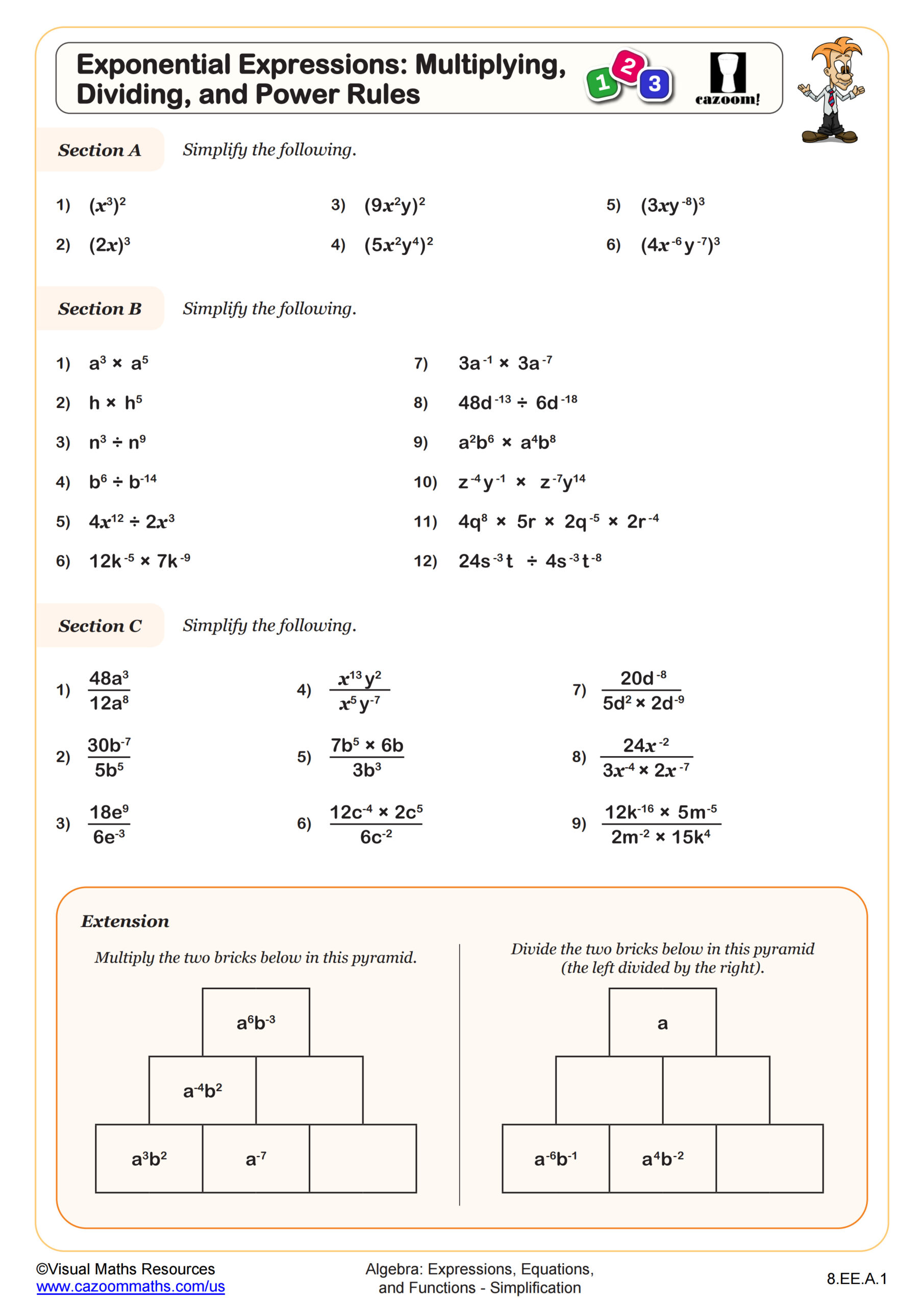
Worksheet On Exponent Rules isn’t just another math drill; it’s a battlefield where algebraic confidence is forged, broken, and reforged. In a world that rewards precision and speed, mastering exponent rules transforms vague anxiety into cold, calculated power. This article strips away the classroom fluff, exposing the raw mechanics you need to dominate every exponent worksheet that crosses your desk. Expect gritty explanations, real‑world analogies that cut to the bone, and actionable strategies that will make your next practice session feel like a tactical operation rather than a chore.
Understanding the Core Exponent Rules
Exponents are shorthand for repeated multiplication, but the rules governing them are more than mnemonic tricks—they’re the algebraic equivalents of a well‑oiled engine. When you write aⁿ, you’re telling the universe to multiply a by itself n times. This simple definition spawns four foundational rules that any competent worksheet warrior must internalize.
The Product Rule
When two powers share the same base, you add their exponents: aᵐ · aⁿ = aᵐ⁺ⁿ. Think of it as merging two squads of the same unit; the total force is the sum of the individual strengths.
The Quotient Rule
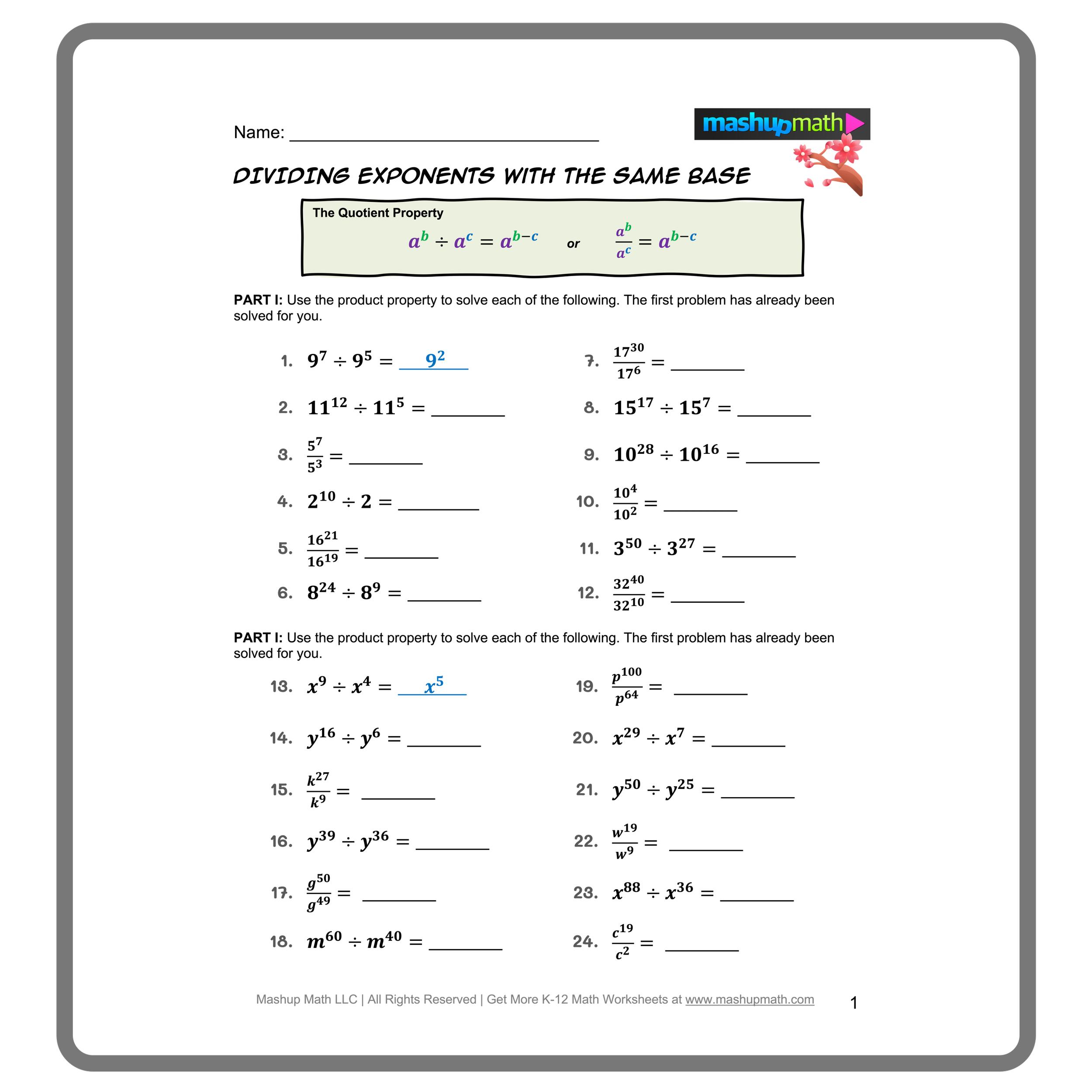
Dividing like‑based powers subtracts the exponent of the denominator from the numerator: aᵐ / aⁿ = aᵐ⁻ⁿ. This is the algebraic equivalent of a retreat—your force diminishes by the amount you pull back.
The Power‑of‑a‑Power Rule
Raising a power to another power multiplies the exponents: (aᵐ)ⁿ = aᵐ·ⁿ. Visualize a chain of command: each level amplifies the previous one, so the total effect compounds.
The Zero‑Exponent Rule
Any non‑zero base raised to the zero power equals one: a⁰ = 1. This rule is the ultimate wildcard—no matter how massive the base, strip away the exponent and you’re left with a neutral element.
Applying the Power‑of‑a‑Power Rule
Many students stumble when a nested exponent appears, such as (2³)⁴. The temptation is to multiply the bases, but the correct move is to multiply the exponents: (2³)⁴ = 2³·⁴ = 2¹². This rule shines in worksheet problems that layer multiple exponent operations.
Step‑by‑Step Breakdown
- Identify the innermost exponent.
- Multiply that exponent by the outer exponent.
- Rewrite the expression with the new, single exponent.
- Simplify if possible.
For example, simplify ((5²)³)ⁿ. First, combine the inner two: (5²)³ = 5⁶. Then apply the outer exponent ⁿ: (5⁶)ⁿ = 5⁶·ⁿ. The final expression is 5⁶ⁿ. No need to calculate the massive number; keep it in exponential form for the worksheet.
Navigating the Product and Quotient Rules
The product and quotient rules are the workhorses of exponent manipulation. They appear in virtually every worksheet question that involves simplifying algebraic fractions or combining like terms with powers.
Combining Multiple Bases
When the bases differ, you cannot directly add or subtract exponents. Instead, factor the expression to isolate like bases. For instance, simplify 3²·4³ / 3¹·4². Separate the product and quotient steps:
- Apply the product rule to the numerator: 3²·4³ stays as is because the bases differ.
- Apply the quotient rule separately for each base: 3² / 3¹ = 3¹ and 4³ / 4² = 4¹.
- Combine the results: 3¹·4¹ = 12.
This systematic approach prevents the common mistake of mixing bases.
Dealing with Negative Exponents in Quotients
Negative exponents often hide in the denominator. Remember that a⁻ⁿ = 1 / aⁿ. When a negative exponent appears in the denominator, it flips to the numerator, turning a division problem into a multiplication one. For example, simplify 5 / 2⁻³. The denominator becomes 1 / 2³ = 1 / 8, so the expression rewrites as 5 · 8 = 40. This conversion is a lifesaver on timed worksheets.
Mastering the Zero and Negative Exponents
Zero and negative exponents are the dark alleys of exponent algebra—easy to overlook, but they control the flow of many worksheet problems. Understanding them not only boosts your score but also sharpens your logical reasoning.
Zero Exponent in Context
Consider the expression (x² + y²)⁰. Regardless of the complexity inside the parentheses, the whole expression collapses to 1. This rule can simplify seemingly intimidating problems instantly.
Negative Exponents as Reciprocal Powers
Take (3⁻²)·(3⁴). Apply the product rule first: 3⁻²⁺⁴ = 3² = 9. The negative exponent is absorbed, turning a potential fraction into a clean integer. In worksheet practice, always convert negatives to reciprocals early; it keeps the algebra tidy and reduces errors.
Real‑World Analogy
Think of a negative exponent as a debt. Owing 3⁻² means you’re “in the red” by a factor of 3². Paying it off (multiplying by a positive exponent) brings you back to a positive balance.
Real‑World Scenarios That Demand Exponent Mastery
Exponents aren’t confined to abstract algebra; they power real‑world calculations in finance, physics, and technology. Translating worksheet skills to everyday problems cements the knowledge and makes practice feel purposeful.
Compound Interest
The formula A = P(1 + r/n)ⁿᵗ relies on exponent rules. When simplifying, you often need to combine powers of the same base, especially when adjusting the compounding frequency. A solid grasp of the product and power‑of‑a‑power rules lets you rearrange the formula quickly, saving time on worksheets that ask you to solve for P or t.
Population Growth Models
Exponential growth follows P(t) = P₀e^kt. When converting between natural exponentials and base‑10 representations, the power‑of‑a‑power rule is essential. For instance, rewriting (e³)² as e⁶ eliminates confusion and keeps calculations clean.
Computer Science: Algorithmic Complexity
Big‑O notation frequently uses exponents to describe runtime, such as O(n²) versus O(2ⁿ). Understanding how to manipulate these expressions helps you compare algorithms on worksheets that ask which is more efficient for large n.
Common Pitfalls and How to Avoid Them
Even seasoned students fall into traps. Identifying these pitfalls early can dramatically improve worksheet accuracy.
Mixing Up Bases
Never add exponents when the bases differ. A quick visual check—if the bases are not identical, the exponents stay separate. Write the bases explicitly on your paper before proceeding.
Ignoring Parentheses
Parentheses dictate the order of operations. Misreading (a²)³ / a⁶ as a²·³ / a⁶ leads to an incorrect result. Always simplify the innermost expression first, then apply the exponent rules outward.
Overlooking the Zero‑Exponent Rule
Students often forget that any non‑zero base raised to zero is one, especially when the base is a complicated expression. Treat the entire base as a single unit before applying the rule.
Sign Errors with Negative Exponents
When a negative exponent appears, remember it flips the fraction. Forgetting this leads to inverses being placed incorrectly, flipping the final answer.
Effective Practice Strategies with Worksheets
Worksheet practice isn’t about mindless repetition; it’s a strategic workout. Below are proven methods to turn each worksheet into a high‑intensity training session.
Timed Drills with Incremental Difficulty
Start with a 5‑minute warm‑up using simple product and quotient problems. Increase the difficulty every two minutes by adding nested exponents or negative exponents. This pacing mirrors test conditions and builds stamina.
Reverse Engineering
Take a solved worksheet problem and work backward. Begin with the final simplified expression and reconstruct the original problem. This technique forces you to understand each rule’s role in the simplification process.
Peer Review Sessions
Partner up and exchange worksheets. Explain each step aloud while your partner watches. Teaching the rules reinforces your own mastery and uncovers hidden gaps.
Error Log Book
Maintain a log of every mistake you make—whether it’s a sign error, a base mix‑up, or a misapplied rule. Review the log weekly and rewrite each error correctly. This habit converts errors into long‑term memory.
Conclusion
Mastering Worksheet On Exponent Rules demands more than rote memorization; it requires a disciplined approach to each rule, an awareness of common traps, and a practice regimen that mimics real‑world pressure. By internalizing the product, quotient, power‑of‑a‑power, zero, and negative exponent rules, you’ll transform every worksheet into a battlefield you’re equipped to win. Apply the strategies outlined above, and watch your confidence—and your scores—rise like an exponential function.






Related posts of "Worksheet On Exponent Rules"
