Worksheet Factoring By Grouping is a powerful tool that transforms abstract algebraic concepts into concrete learning experiences, allowing students to see patterns, build confidence, and master the skill of simplifying expressions with ease.
What Is Factoring By Grouping?
Factoring by grouping is a method for factoring polynomials that have four or more terms. It relies on first grouping the terms into pairs, then extracting common factors from each pair, and finally spotting a shared binomial factor that can be factored out once more. This systematic approach turns seemingly complicated expressions into products of simpler factors, making algebra more approachable.
Why It Matters in Algebra
When students learn algebra, they often encounter quartic equations, trinomials, and more. Factoring by grouping offers an intuitive pathway that complements other factoring techniques like the Greatest Common Factor (GCF) and difference of squares. Mastery of this strategy opens doors to solving higher‑degree equations, simplifying rational expressions, and preparing for calculus topics that require polynomial factorization.
Why Worksheets Are Essential
Hands‑on practice is the backbone of mathematical learning. Worksheets dedicated to factoring by grouping provide:
- Repetition of core steps to solidify muscle memory.
- Varied difficulty that lets learners progress from basic to challenging problems.
- Immediate feedback opportunities when solutions are paired or hidden for self‑check.
- Contextual framing so students see how the technique applies to real‑world scenarios, such as simplifying profit formulas or solving quadratic‑like relationships in physics.
In essence, worksheets act as bridges between theory and application, turning abstract rules into tangible skills.
Key Steps to Mastering the Technique
To excel with factoring by grouping, students should internalize each stage. Below is a streamlined framework that can be taught on worksheets, whiteboard lessons, or digital apps.
Step 1: Arrange the Polynomial Strategically
Before grouping, rearrange the terms so that like terms or those sharing a common factor appear together. For example, transform 3x^3 + 6x^2 + 5x + 10 into 3x^3 + 6x^2 + 5x + 10 (already grouped) or 3x^3 + 5x + 6x^2 + 10 (less convenient). This pre‑processing often reveals a hidden common factor.
Step 2: Form Two Groups of Two Terms
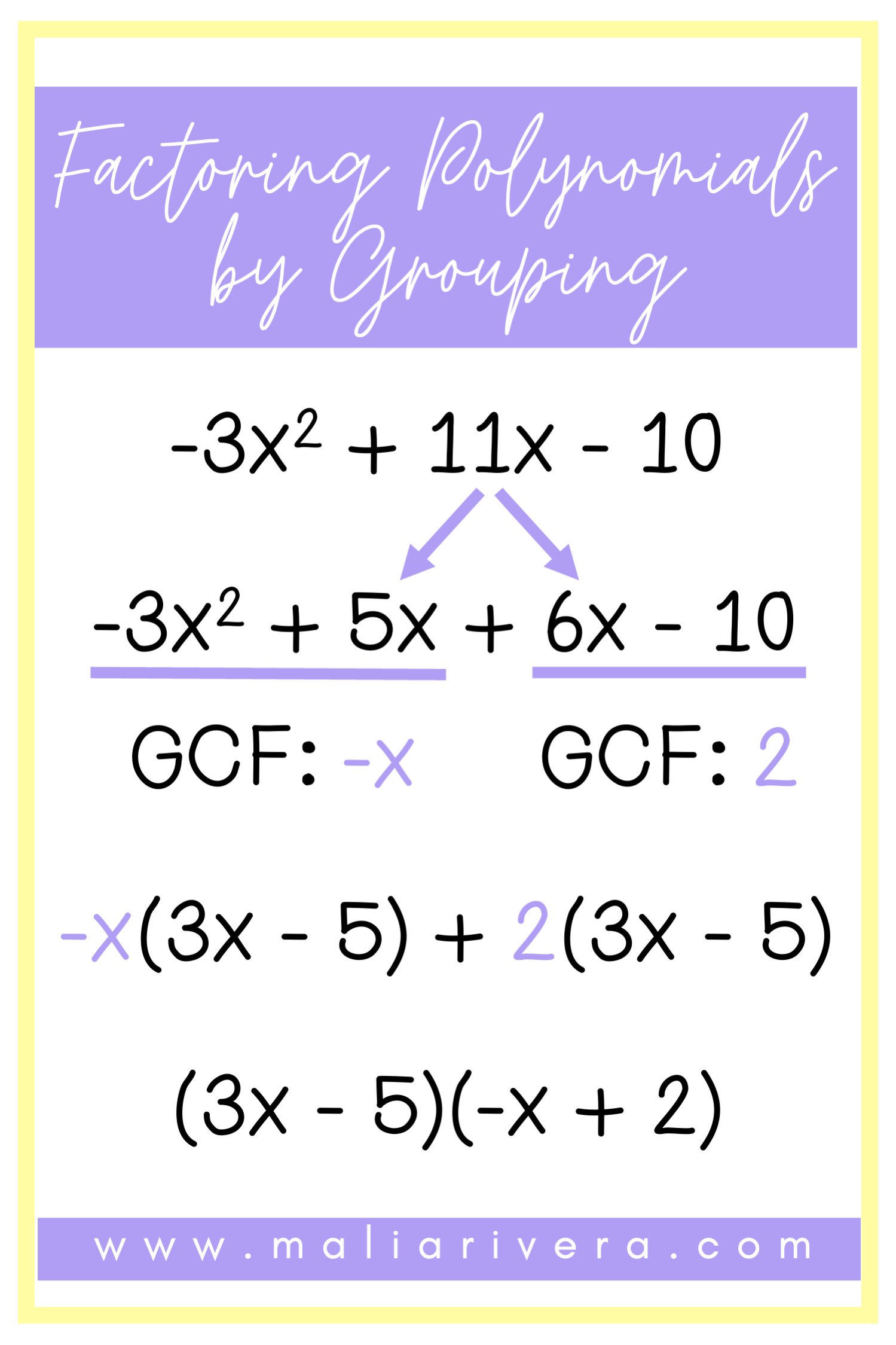
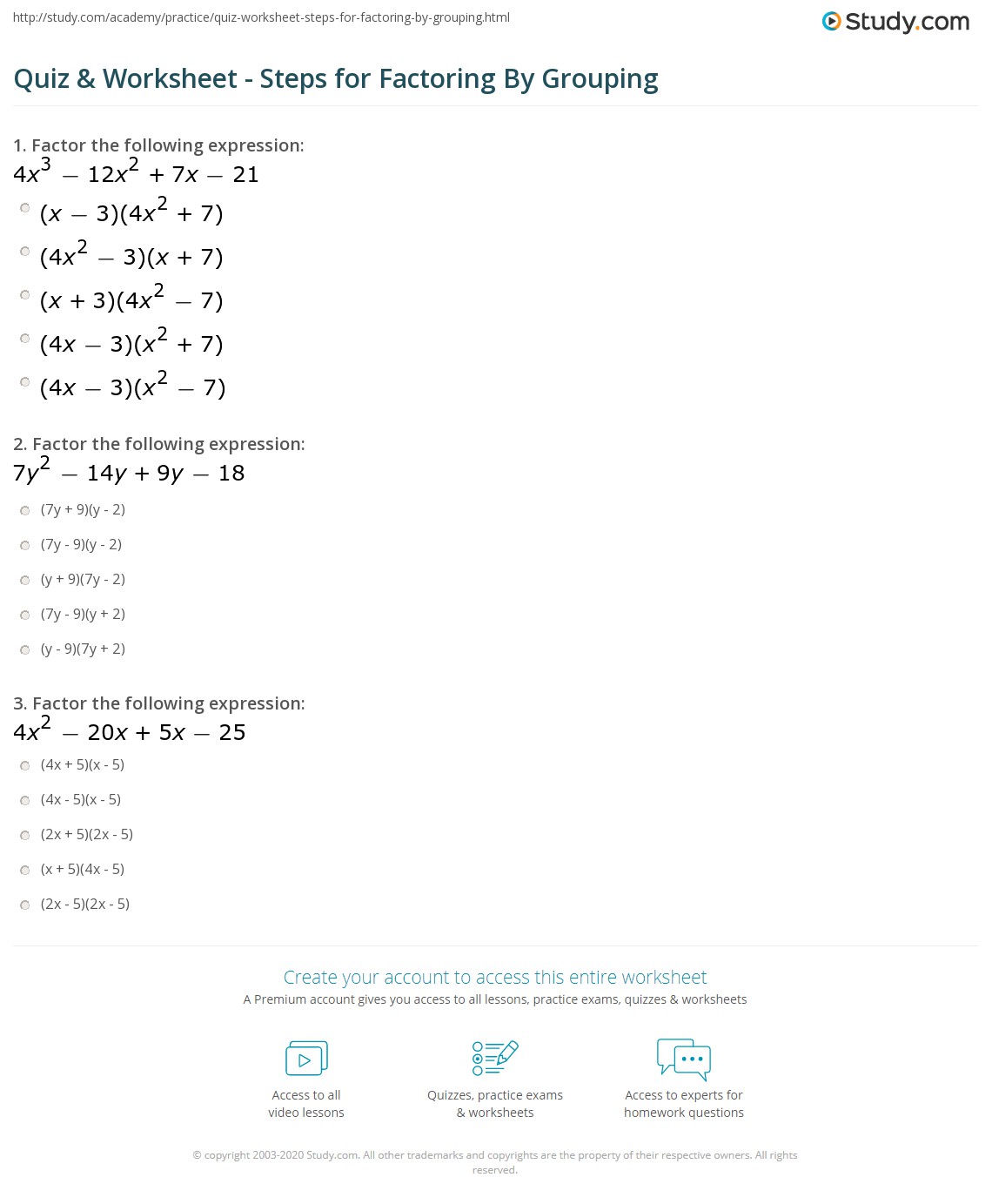
Split the polynomial into two groups of two terms each. For a four‑term expression, this is straightforward. In longer polynomials, split after the second term to keep group sizes balanced. Example: 4x^3 + 12x^2 + 5x + 15 becomes (4x^3 + 12x^2) + (5x + 15).
Step 3: Extract the Greatest Common Factor in Each Group
Factor each group separately. In the example, the first group yields 4x^2(x + 3), and the second yields 5(x + 3). Notice the shared binomial factor (x + 3).
Step 4: Factor Out the Common Binomial
Remove the shared binomial to finalize the factorization: (x + 3)(4x^2 + 5). Verify by distributing to ensure the original expression is recovered.
Step 5: Verify the Result
Distribute the factors to confirm that no mistakes were made. If the product differs, revisit the earlier steps, particularly the grouping and factor extraction phases.
Common Mistakes and How to Avoid Them
Even seasoned students can fall into traps when factoring by grouping. Addressing these pitfalls early in worksheet design helps prevent frustration.
Misidentifying the Correct Grouping
Choosing the wrong pairs can lead to a situation where no common binomial emerges. Encourage students to experiment with different pairings until a clear common factor appears.
Forgetting to Factor Completely
After extracting the common binomial, some learners stop prematurely, missing an opportunity to factor further. Teach them to check whether the remaining polynomial still contains a factorable structure, especially if it contains quadratic components.
Ignoring Coefficient Signs
Sign errors are common when dealing with negative coefficients. Use color‑coded worksheets or bold signs to keep track of plus and minus values.
Creating Effective Worksheets for Students
Designing worksheets that promote engagement and mastery involves thoughtful organization and clear guidance.
Start with Guided Examples
Include fully worked‑out examples that walk through each step, annotated with explanations. These serve as templates for students before they tackle unsolved problems.
Progressively Increase Complexity
Begin with simple quartic polynomials having obvious common factors, then move to expressions that require rearrangement, and finally present problems with hidden factors that challenge deeper analytical thinking.
Use Real‑World Contexts
Embed word problems that naturally translate into polynomials needing grouping, such as calculating the combined cost of multiple items, optimizing area with variable dimensions, or simplifying growth formulas.
Incorporate Visual Aids
Add factor trees or color‑coded brackets to help visual learners see the structure of the expression. Highlight the common factors in each group with distinct colors.
Include a Self‑Check Section
Provide a solution key or a step‑by‑step answer sheet that students can cross‑check after completing each exercise. This reinforces learning and fosters independent problem‑solving.
Integrating Worksheets into Classroom Activities
Effective use of worksheets extends beyond individual practice. Here are ways to blend them into dynamic lessons.
Collaborative Group Work
Assign students to pairs or trios to solve a set of problems together. Encourage them to discuss strategies, compare grouping choices, and justify their reasoning.
Peer‑Teaching Sessions
Have students present their solutions to the class, explaining each step. This reinforces their understanding and develops communication skills.
Flipped Classroom Homework
Distribute worksheets as pre‑class assignments. In class, focus on addressing misconceptions highlighted by the homework, rather than repeating the same work.
Technology‑Enhanced Practice
Use interactive platforms that auto‑grade factoring problems and provide instant feedback. Students can see visual step‑by‑step solutions, which is especially useful for complex groupings.
Assessment Tips and Rubrics
Evaluating factoring by grouping requires clear criteria to ensure students are judged fairly and constructively.
Accuracy of Factorization
Check that the final product matches the original expression upon distribution. Provide partial credit for correct grouping but incomplete factor extraction.
Clarity of Steps
Require students to show each intermediate step, especially the extraction of the GCF in each group. Missing steps should be marked with lower scores.
Problem‑Solving Rationale
Ask students to explain why they chose a particular grouping. This tests deeper comprehension beyond mechanical execution.
Application to Real‑World Problems
For word‑problem worksheets, assess whether the student correctly translated the narrative into algebraic terms before factoring.
Resources for Further Practice
While the article refrains from linking directly, learners can explore a variety of online platforms, interactive textbooks, and mobile apps dedicated to algebra practice. Seek out resources that offer instant feedback, animated step‑by‑step solutions, and gamified challenges to keep motivation high.
Conclusion
Mastering Worksheet Factoring By Grouping equips students with a versatile algebraic tool that streamlines complex expressions and underpins higher‑level mathematics. By understanding the method’s systematic steps, avoiding common pitfalls, crafting thoughtful worksheets, and embedding these exercises into engaging classroom routines, educators can elevate student confidence and competence. With consistent practice, learners transform abstract algebra into a clear, logical, and enjoyable problem‑solving experience—an essential skill for academic success and real‑world applications alike.










Related posts of "Worksheet Factoring By Grouping"
