Solving Exponential Functions Worksheet is more than just a set of problems—it’s a gateway to mastering one of mathematics’ most powerful tools. When approached with the right mindset and techniques, these worksheets become a fun challenge rather than a daunting chore.
What Makes an Exponential Function Different
Unlike linear or quadratic equations, exponential functions grow—or shrink—by a consistent factor rather than by a fixed amount. This subtle difference means that solving them often requires a shift from algebraic manipulation to logarithmic insight. Understanding this fundamental property helps you spot which strategy applies best to each problem.
Why Worksheets Are Your Best Friend
Worksheets provide a structured path through increasingly complex scenarios. They allow you to practice identifying the base, isolating the variable, and applying logarithms in a variety of contexts, from compound interest to population growth. Regular exposure builds muscle memory, so you can solve new problems with confidence.
Key Concepts to Master Before Tackling a Worksheet
Understanding the Base
The base of an exponential equation is the number that is repeatedly multiplied. It dictates the growth rate: a base greater than one accelerates, while a base between zero and one contracts. Recognizing whether the base is fixed or variable in a given problem is the first step toward a solution.
Isolating the Variable
Just like with linear equations, you want the variable to stand alone on one side. However, because the variable is an exponent, you need to use logarithms to bring it down into a position where you can solve for it algebraically.
Using Logarithms to Simplify
Logarithms are the inverse operation of exponentials. By applying either common logarithms (base 10) or natural logarithms (base e), you can convert the equation into a solvable linear form. Remember the two key properties: logb(bx) = x and logb(xy) = logb x + logb y.
Step-by-Step Guide to Conquering a Worksheet
Read the Problem Carefully
Identify the unknown, the base, and any constants. Look for clues that indicate whether the base is fixed or depends on the variable. Pay close attention to parentheses, because they often signal how the components are grouped.
Identify the Type of Exponential Equation
Common types include:
- Base on the left, variable in the exponent.
- Variable in the exponent on the right, with constants on the left.
- Equations that combine exponential and linear terms.
Apply the Right Strategy
- For equations like 2x = 16, recognize that 16 is 24, so x = 4.
- For equations like 52x = 25, rewrite 25 as 52 and solve 2x = 2 → x = 1.
- When the base isn’t obvious, take the logarithm of both sides to isolate the exponent.
Check Your Work
Substitute your answer back into the original equation. If it balances, you’re correct. If not, retrace your steps—common mistakes include misapplied logarithm rules or algebraic errors after taking logs.
Common Pitfalls and How to Avoid Them
Forgetting to Change the Base
Sometimes a problem presents a base like 102x = 100. Remember that 100 = 102, so 2x = 2 → x = 1. Skipping this conversion can lead to incorrect results.
Misusing Logarithms
Always apply the logarithm to both sides. Writing log(2x) = log 16 is correct, but writing log(2x = 16) is not valid syntax. Misplaced parentheses can derail the solution.
Ignoring Domain Restrictions
Exponential equations are defined for all real numbers, but sometimes a problem includes a square root or other operation that restricts the domain. Check for such constraints before solving.
Real-World Applications That Make It Stick
Understanding how exponential functions work shines in everyday scenarios:
- Finance: Compound interest calculations rely on equations of the form A = P(1 + r/n)nt.
- Biology: Bacterial growth can be modeled with N(t) = N0ekt, where k is the growth rate.
- Physics: Radioactive decay follows N(t) = N0e-λt.
When you solve a worksheet, imagine applying the same steps to calculate your future savings or predict how long it will take a population to double. This connection to real life reinforces the importance of mastering the techniques.
Tips for Making the Most of Online Worksheets
1. Start with the basics: If you’re new to logs, practice with simple equations before moving to multi-step problems.
2. Use the “Show Steps” feature: Many online platforms allow you to view the solution. Compare your work with theirs to spot gaps.
3. Set a timer: Challenge yourself to solve each problem within a set time to improve speed and accuracy.
4. Keep a cheat sheet: Write down key properties of logs and common exponentials. Quick reference saves time.
5. Discuss with peers: Explaining your solution to someone else solidifies your understanding and often reveals alternative approaches.
Conclusion
Mastering a Solving Exponential Functions Worksheet equips you with a versatile skill set that applies across science, finance, and everyday problem solving. By focusing on understanding the base, using logarithms wisely, and practicing consistently, you’ll transform these worksheets from intimidating tasks into stepping stones toward confidence in exponential reasoning. Keep tackling new problems, watch your confidence grow, and soon the exponential world will feel like a familiar playground of patterns and solutions.


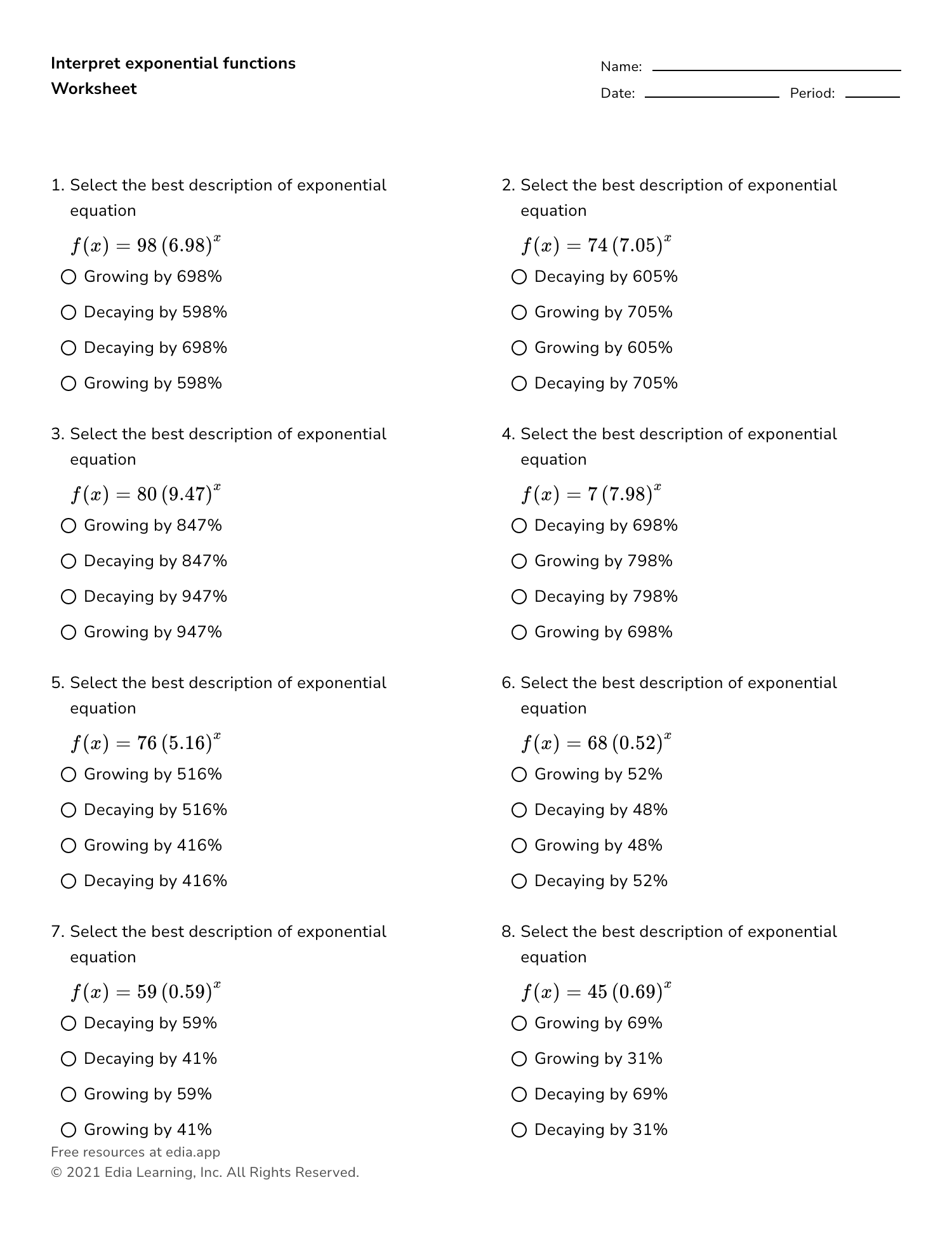


Related posts of "Solving Exponential Functions Worksheet"
