Simplifying Trig Expressions Worksheet is the secret sauce that turns chaotic angles into smooth, snappy algebra. Think of it as a backstage pass that lets you see the real stars of trigonometry: sines, cosines, tangents, and the truest friends—reciprocals, quotients, and double‑angle tricks—without the messy backstage drama. Ready to laugh, learn, and level up your trig game? Let’s dive in!
What’s the Deal with Trig?
Before you sprint into a worksheet, let’s set the stage. Trigonometry is the cousin of algebra that loves right triangles and circles. But most students stare at a sin(x) + cos(x) expression and think it’s a cryptic riddle from a math wizard. Simplifying these expressions is the key to unlocking that wizard’s secret handshake.
Why Simplify?
1️⃣ Cleaner Answers – A neat expression is easier to plug into formulas, graphs, and calculators.
2️⃣ Less Error Prone – Compact forms reduce the chance of typo mishaps during exams.
3️⃣ Deeper Insight – Simplification reveals hidden identities, like seeing the same picture through different lenses.
Common Pitfalls
• Over‑cancelling – Removing a factor that’s actually zero for a particular angle.
• Forgetting domains – Sine and cosine have infinite periodicity; simplify with caution to keep the period intact.
• Skipping the “step back” check – Always verify that the simplified form equals the original across a few test angles.
Step‑by‑Step Playbook
Below is a roadmap that takes you from a tangled expression to a smooth, elegant formula. Keep this as your cheat sheet during worksheet sessions.
1. Identify the Core
Spot the building blocks: sin, cos, tan, cot, sec, csc. Think of them as LEGO pieces. If you see a product of two sines, you’re already at a potential spot for the product-to-sum identity.
2. Convert to One Function (If Possible)
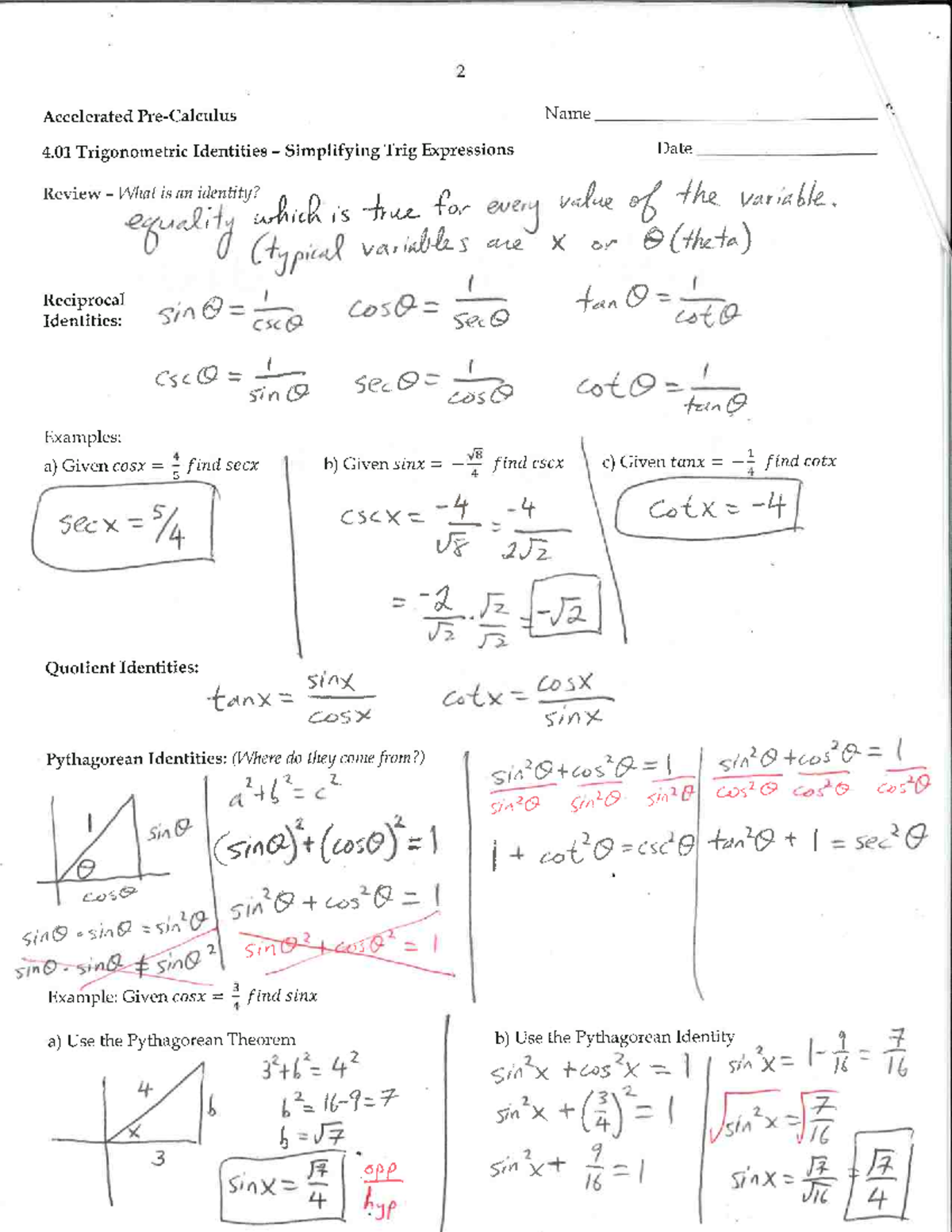
Using the basic reciprocal identities (sec θ = 1/cos θ, csc θ = 1/sin θ, cot θ = cos θ/sin θ) can often collapse the expression into a single trig function, which is easier to handle.
3. Apply Pythagorean Identities
Replace sin²θ + cos²θ with 1. This trick is the “one‑step wonder” for many expressions. For example, if you see √(1 – sin²θ), you can rewrite it as |cosθ|.
4. Use Sum‑to‑Product and Product‑to‑Sum Identities
These identities help turn sums or products into single terms. Remember:
– sin A cos B = ½[sin(A+B) + sin(A–B)]
– cos A cos B = ½[cos(A–B) + cos(A+B)]
– sin A sin B = –½[cos(A+B) – cos(A–B)]
5. Factor, Cancel, and Rethink
Factor common terms, cancel where safe, and then check whether the result can be expressed in a simpler trigonometric function or ratio. If you’re left with a complex fraction, try multiplying by the conjugate to rationalize.
6. Verify with Test Angles
Plug in θ = 0°, 30°, 45°, and 60° to confirm equivalence. This step is like a safety net—if the expression flips the script on one test angle, you’ve made a mistake.
Real‑World Fun: Where Trig Meets Reality
Math is not just about chalk on a board—it’s the backbone of engineering, music, and even your favorite video game graphics. Let’s see how simplifying trig expressions brings the magic to everyday life.
1. Sound Waves in Music Production
When mixing stereo tracks, you often encounter expressions like sin²(θ) + cos²(θ). Simplifying this to 1 means the overall volume stays consistent regardless of phase shifts—no surprise dips or spikes in your beats.
2. GPS and Satellite Calculations
Satellite navigation uses trigonometric equations to compute distances on a spherical Earth. Simplified expressions reduce computational load on micro‑controllers, allowing for faster, more accurate route updates.
3. Animation and Game Development
Animating a character’s swing uses trigonometric functions to create smooth motion. Simplifying the expressions used for rotation matrices means the game runs smoother, especially on mobile devices.
Worksheet Wizardry: Mastering the “Simplifying Trig Expressions Worksheet”
Now that you know the theory, let’s turn the worksheet into a playground. A well‑structured worksheet is your personal dojo for honing simplification skills.
How to Get the Best Worksheets
- Choose worksheets that vary in difficulty—from “warm‑up” identities to “battle‑level” identities involving multiple steps.
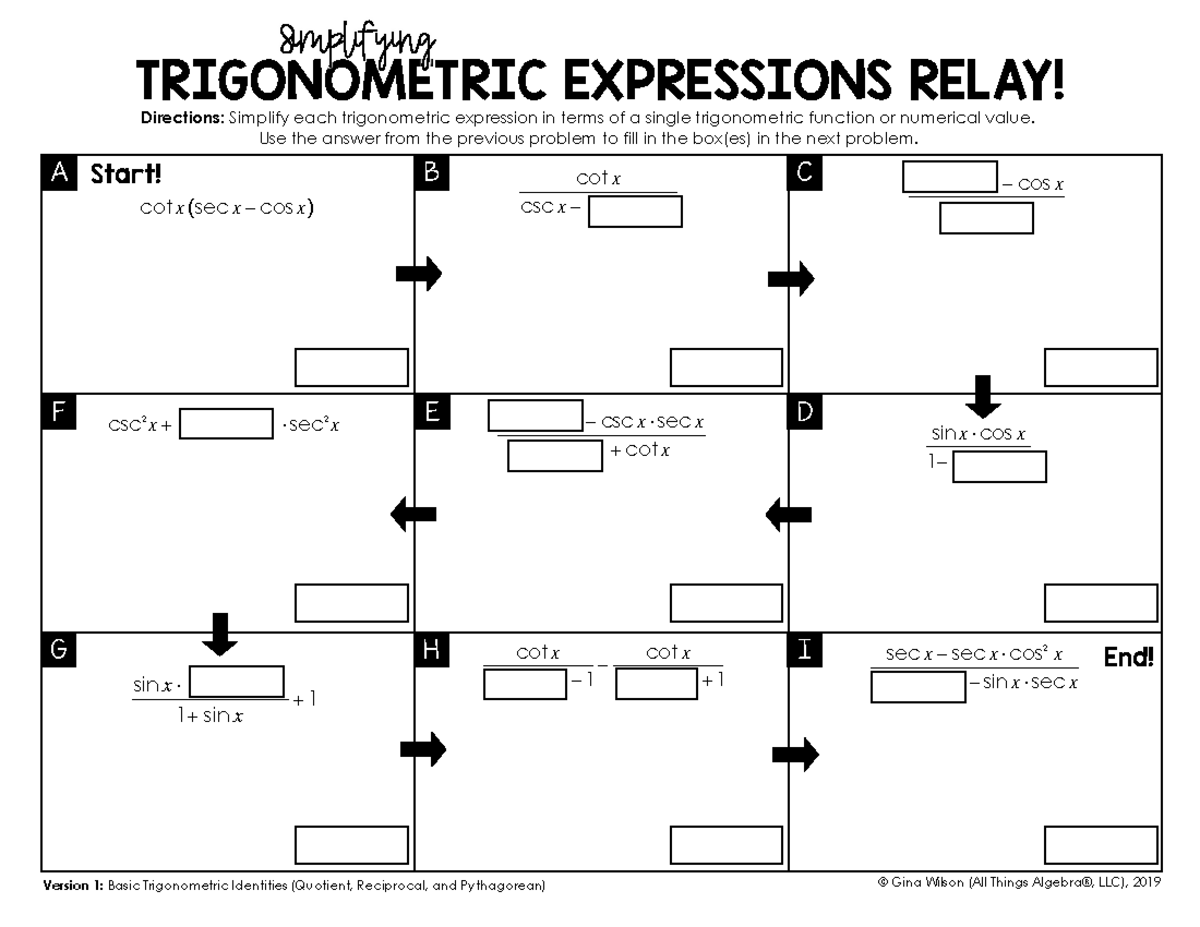
- Look for visual aids: color‑coded functions, diagrams, or “step” boxes that guide you.
- Prefer interactive worksheets that allow you to check answers instantly.
Maximizing Learning on Each Worksheet
1. Read the Problem Carefully – Identify all trig functions before you start manipulating.
2. Work in Pencil (or Digital Notes) – Write intermediate steps; the act of writing reinforces memory.
3. Use the “Double‑Check” Step – After simplifying, evaluate the original and simplified forms at a random angle.
4. Reflect on Patterns – Notice when a particular identity appears repeatedly; this can become a mental shortcut.
Common Worksheet Types
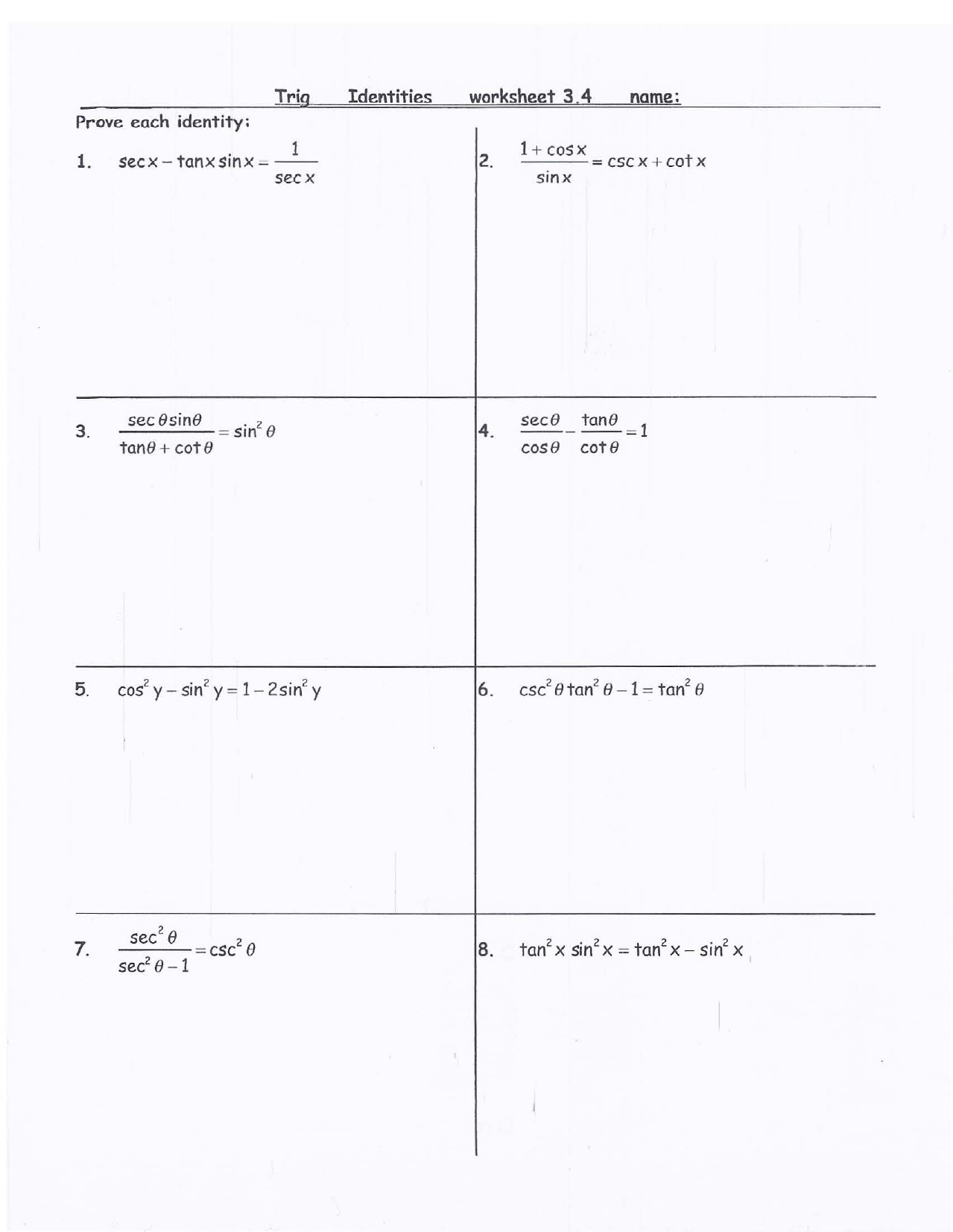
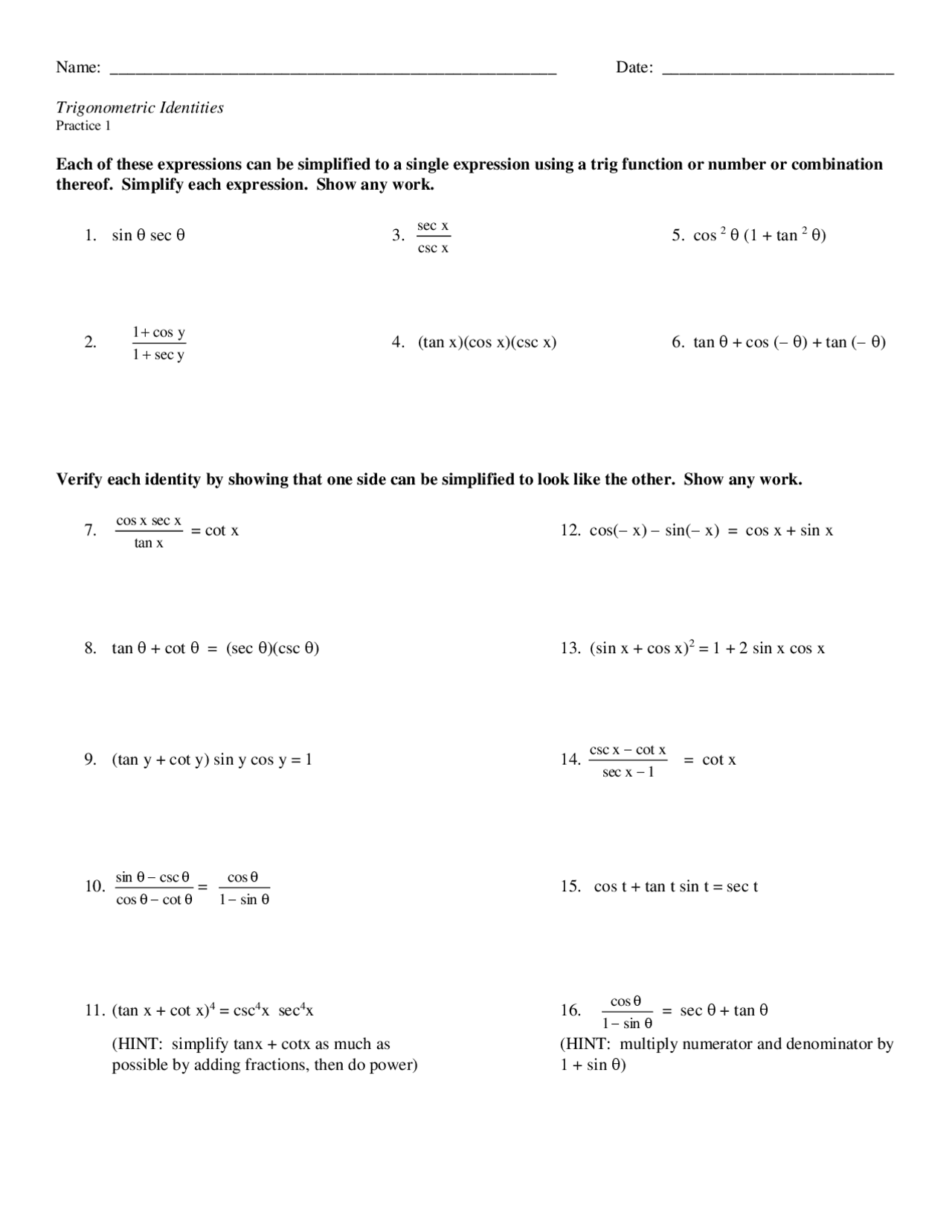
- Identity Proofs – Verify that both sides of an equation are equal.
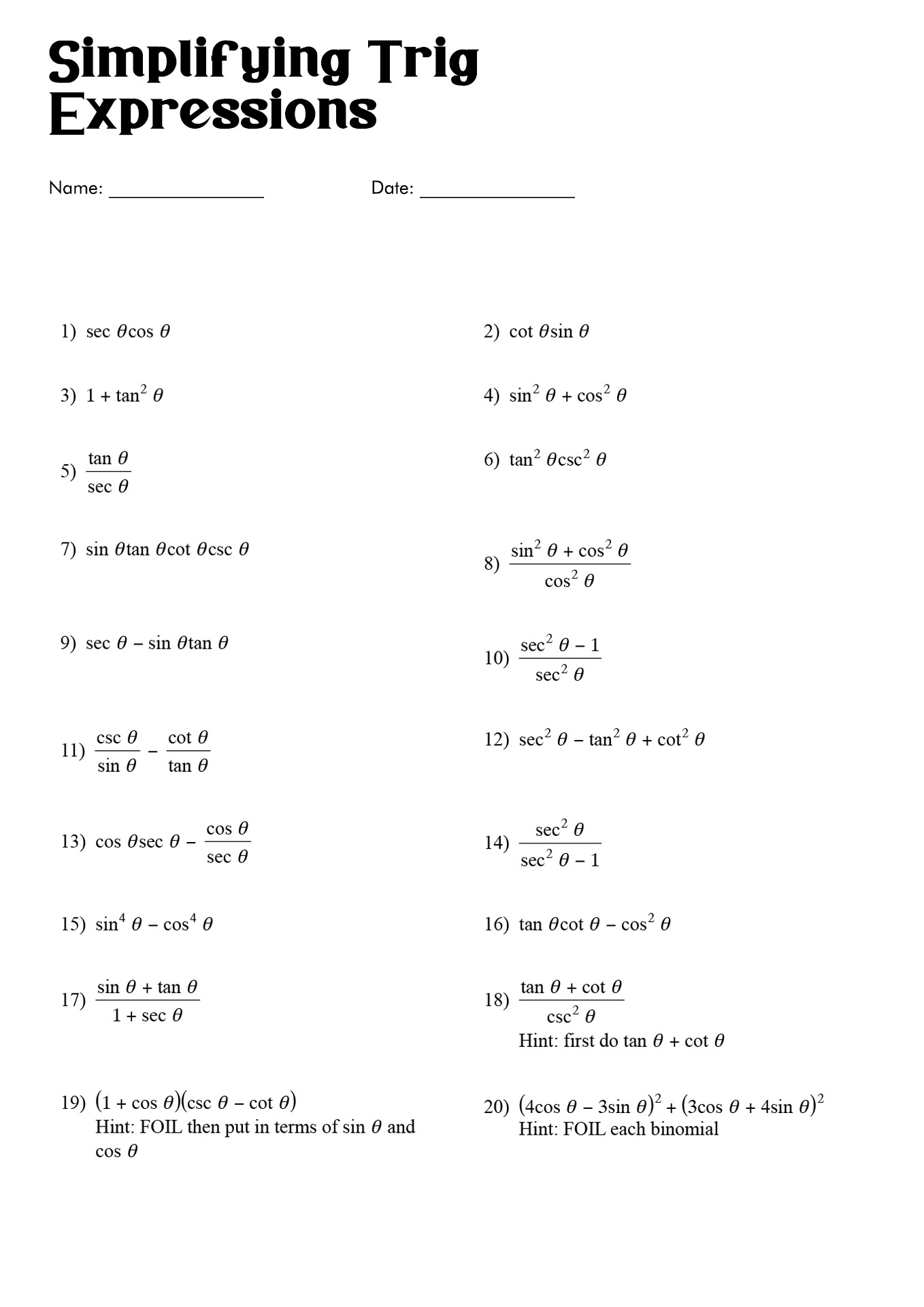
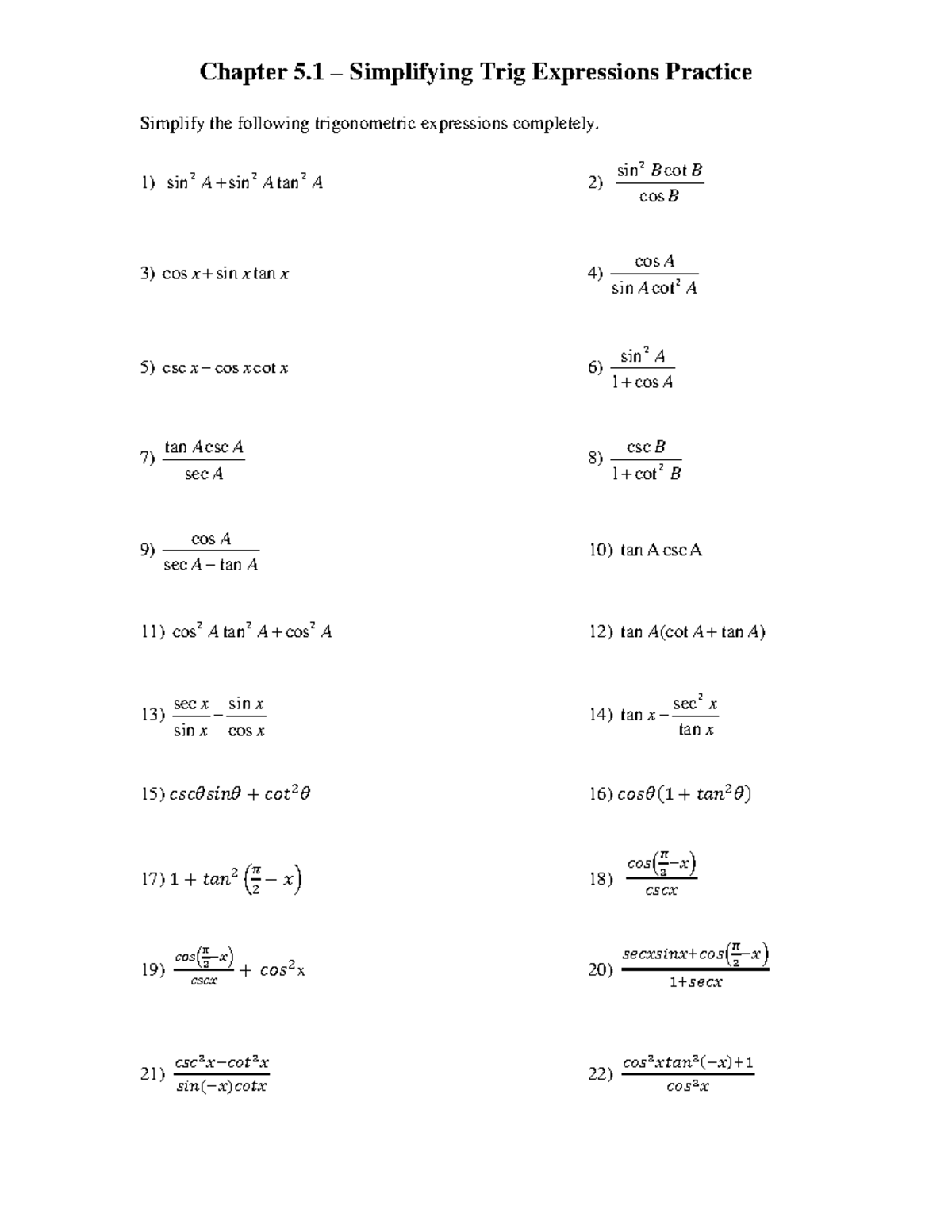
- Expression Simplification – Reduce a complex formula to a clean form.
- Application Problems – Use simplified expressions to solve real‑world scenarios.
- Proof‑by‑Contradiction – Show that a certain expression cannot be simplified further.
FAQs & Bizarre Trig Tales
Why Does Simplifying Matter When I Use a Calculator?
Calculators are great, but they can hide the underlying patterns that help you spot mistakes in exams or when coding algorithms. A simplified form is also more interpretable by humans.
Can I Always Convert Everything to Sine?
Not always. While converting to a single function can simplify, sometimes keeping a product (like sin θ cos θ) preserves useful information for integration or differentiation.
What Happens if I Cancel a Zero?
That’s a classic trap! If an expression contains a factor that could be zero at a given angle, canceling it removes that case. Always check the domain before canceling.
Did Trig Ever Get This Hard?
Historically, trigonometry was the secret weapon of navigators and astronomers. Without modern calculators, they had to simplify expressions on paper to chart courses across oceans. Their knack for identities lives on in your worksheet.
Funny Side Note: The “Pythagorean Cat”
Picture a cat chasing a laser pointer at 30° and 60° angles. The cat’s path can be described by sin and cos. When you simplify the expressions for its velocity, the cat actually runs in a straight line—further proof that simplification brings harmony to the chaos.
Conclusion: Your Simplification Superpowers
Mastering the Simplifying Trig Expressions Worksheet is like training a superhero—every identity you learn adds a new power to your toolbox. With practice, you’ll turn complex, mind‑bending expressions into clean, elegant formulas that make sense in both the classroom and the real world. Keep the worksheet handy, stay curious, and let the trigonometric adventures begin!








Related posts of "Simplifying Trig Expressions Worksheet"
