Pythagorean Theorem And Converse Worksheet serves as an essential bridge between conceptual geometry and practical application, offering students a structured environment to test their understanding and hone problem-solving skills. By engaging with interactive problems, students move beyond memorization to a deeper comprehension of how right‑angled triangles relate to real world phenomena—from engineering designs to architectural layouts and even everyday navigation tasks. Below, we explore the value of these worksheets, how to use them effectively, and ways to maximize learning outcomes.
Understanding the Core Concepts
Before diving into worksheets, it is helpful to revisit the fundamental principles that underlie them. The Pythagorean Theorem states that in a right‑angled triangle, the square of the hypotenuse (the side opposite the right angle) equals the sum of the squares of the other two sides. Symbolically, for a triangle with legs of lengths a and b and hypotenuse c, the relationship is a² + b² = c².
The Converse of the Pythagorean Theorem takes this relationship in the opposite direction. If a triangle’s side lengths satisfy a² + b² = c², then the triangle must be right‑angled with the side c as the longest side. This subtle twist transforms a simple algebraic check into a powerful tool for identifying right angles in a variety of contexts.
Designing Effective Worksheets
Structure and Progression
- Beginner Section: Simple numerical problems that reinforce basic squaring and addition skills.
- Intermediate Section: Mix of integer and fractional side lengths, encouraging the use of the square root function.
- Advanced Section: Includes algebraic variables, parametric forms, and real-world scenario problems such as calculating distances between geographic points.
- Challenge Problems: Puzzles requiring multiple steps or creative reasoning, ideal for gifted learners or classroom competitions.
Visual Aids and Diagrams
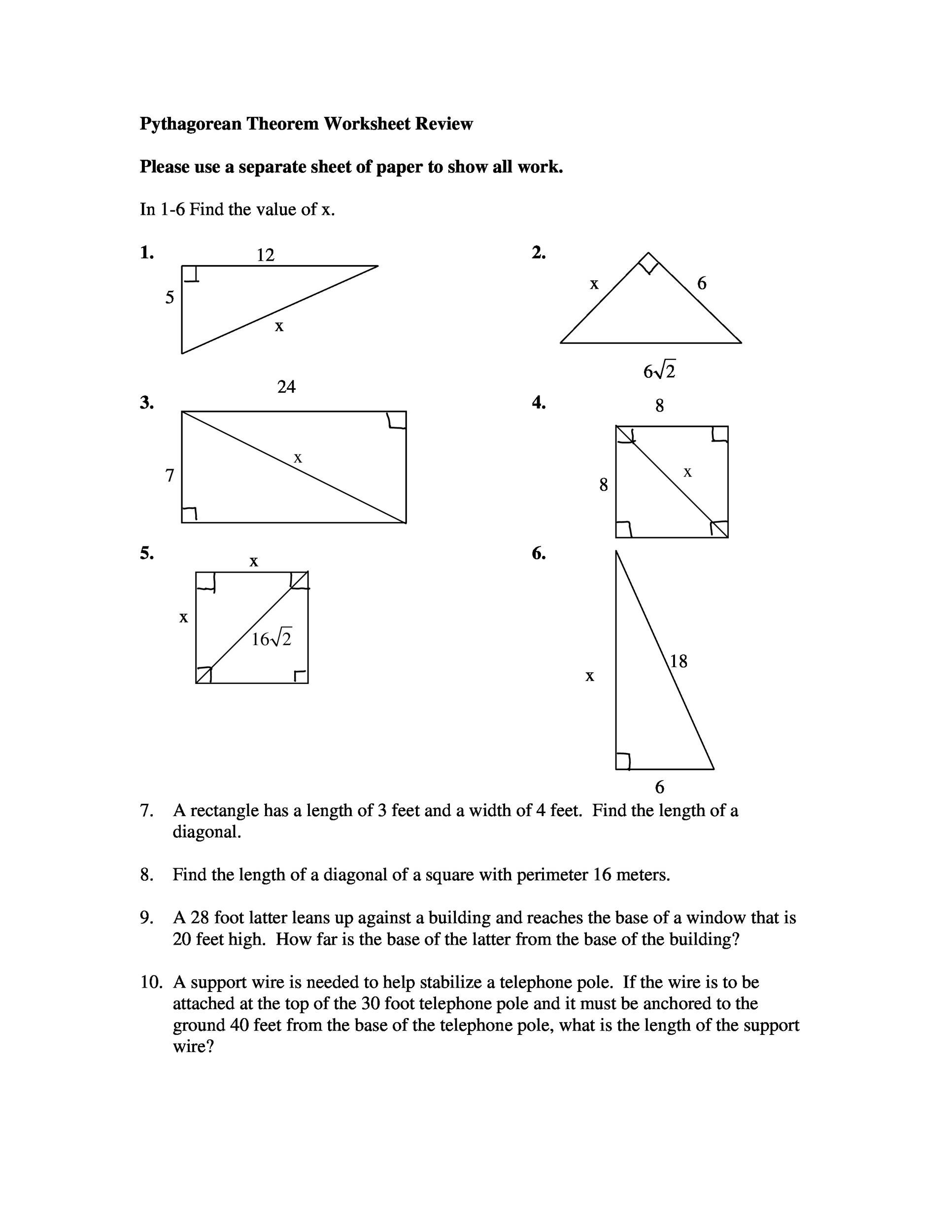
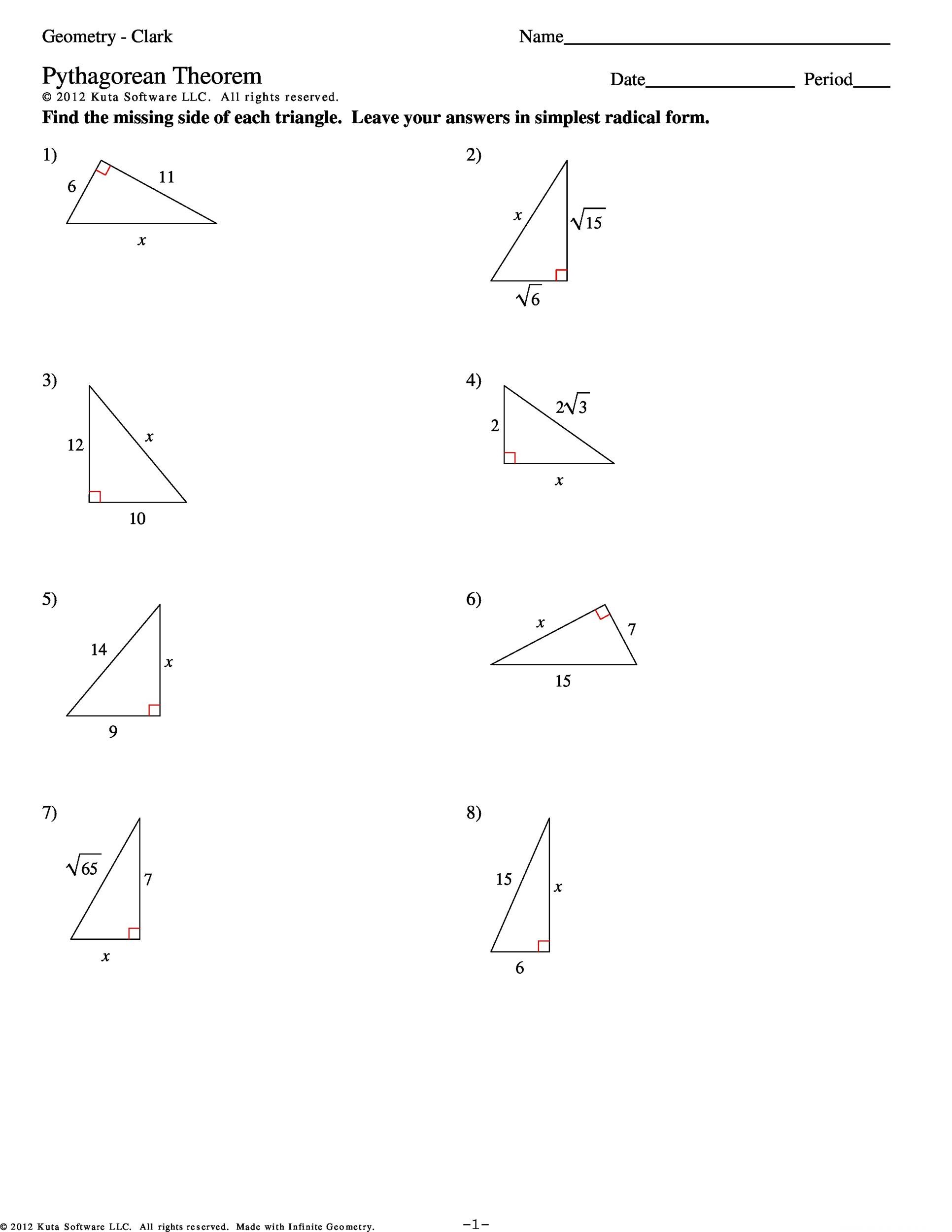
High‑resolution diagrams enhance comprehension. A clear labeling of sides with variables, and a distinct representation of the hypotenuse in bold lines, helps students visualize the theorem’s application. Worksheets that allow students to color or shade the squares on each side can reinforce the geometric interpretation of algebraic expressions.
Answer Key and Explanations
Providing an answer key with step‑by‑step reasoning supports self‑assessment. Each answer should explain why a particular calculation was performed, how the theorem was applied, and what the result indicates about the triangle’s properties.
Using Worksheets in Classroom Settings
Active Learning Strategies
1. Peer‑Teaching Sessions: Students pair up to solve problems, then swap answers and justify each step. This dialogue reinforces critical thinking and exposes learners to alternative solving methods.
2. Flipped Classroom Assignments: Students complete worksheets before class, freeing time for in‑class problem‑solving and discussion. Reviewing common mistakes together fosters a collaborative learning environment.
3. Gamification: Convert worksheet challenges into timed contests or scoreboards. Recognition of the highest accuracy or fastest solutions motivates continued engagement.
Integrating Technology
Digital worksheets allow dynamic manipulation of side lengths, immediate feedback, and interactive graphing. Tools such as GeoGebra or simple spreadsheet formulas let students experiment with variable changes and instantly see the geometric effects.
Assessment and Progress Tracking
Use the worksheets as diagnostic tests at the beginning of a unit, followed by periodic reviews. By comparing scores across sections, teachers can identify specific conceptual gaps—such as misreading the hypotenuse or misapplying the square root.
Real‑World Applications Highlighted in Worksheets
Architecture and Construction
In building design, the Pythagorean relationship helps calculate load distributions and verify structural integrity. Worksheets that model simple roof pitches or window placements illustrate how the theorem ensures that angles remain consistent across multiple frames.
Navigation and Surveying
Determining the straight‑line distance between two GPS points often requires the theorem. Worksheet scenarios can include calculating the diagonal span of a rectangular plot or the shortest path between two landmarks.
Physics and Engineering
In projectile motion, the components of velocity are treated as perpendicular vectors. Worksheets that ask students to combine or decompose vectors using the theorem provide tangible insights into real‑world motion.
Art and Design
Artists use right triangles to create perspective and proportion. By applying the theorem, they can maintain accurate proportions across scaling transformations. Worksheet examples might involve aligning a vanishing point or ensuring that a set of parallel lines converge correctly in a composition.
Tips for Maximizing Learner Engagement
Incorporate Storytelling
Frame problems around a narrative: a pirate charting a treasure map, a hiker calculating a trail’s slope, or an engineer designing a bridge. Stories give context and motivate students to solve the problems as part of a larger goal.
Encourage Reflection
After each worksheet, ask students to write a brief reflection: what strategy worked, where they struggled, and how the theorem connects to a real‑life scenario they encountered outside the classroom. Reflection strengthens metacognitive skills and consolidates learning.
Utilize Differentiated Paths
Provide optional extensions for advanced learners—such as proving the theorem using algebraic identities—or simplified versions for students needing additional support, like using pre‑filled values for one side and asking to compute the missing side.
Common Misconceptions and How to Address Them
Misidentifying the Hypotenuse
Students often mislabel the longest side, leading to incorrect application of the theorem. Worksheets should include a quick visual check, reminding learners that the hypotenuse is always opposite the right angle and longest in the triangle.
Forgetting the Converse Condition
While many grasp the forward theorem, they sometimes overlook the converse, which verifies right angles. Incorporate problems where students must determine if a set of side lengths represents a right triangle, reinforcing the bidirectional nature of the relationship.
Confusing Addition and Subtraction in Squares
Squaring each side is crucial; students may mistakenly subtract or combine terms incorrectly. Clear examples that isolate each step—first squaring, then summing—help prevent this error.
Extending the Learning Experience
Project‑Based Learning
Assign a mini‑project where students design a simple machine or structure requiring right triangles. They must use worksheets to calculate dimensions, then build a model using craft materials, illustrating the practical impact of geometric relationships.
Cross‑Curricular Connections
Integrate the worksheets with algebra lessons on quadratic equations, or with trigonometry by exploring sine, cosine, and tangent relationships in right triangles. This cross‑curriculum approach shows students the interconnectivity of mathematical concepts.
Online Community Sharing
Encourage students to share solved worksheets or new problem ideas in a class forum or learning management system. Peer contributions foster a sense of ownership and collective improvement.
Conclusion
When thoughtfully designed and strategically deployed, a Pythagorean Theorem And Converse Worksheet becomes more than a set of equations; it transforms into a versatile educational resource that bridges abstract theory and concrete application. By offering a gradual learning curve, visual reinforcement, and real‑world context, these worksheets cultivate robust problem‑solving skills. Teachers and learners alike can harness this tool to build confidence, clarify misconceptions, and ultimately see the enduring relevance of the Pythagorean relationship in everyday life. Whether in a traditional classroom, a blended learning environment, or an individual study session, these worksheets empower students to navigate the geometry of the world with precision and creativity.









Related posts of "Pythagorean Theorem And Converse Worksheet"
