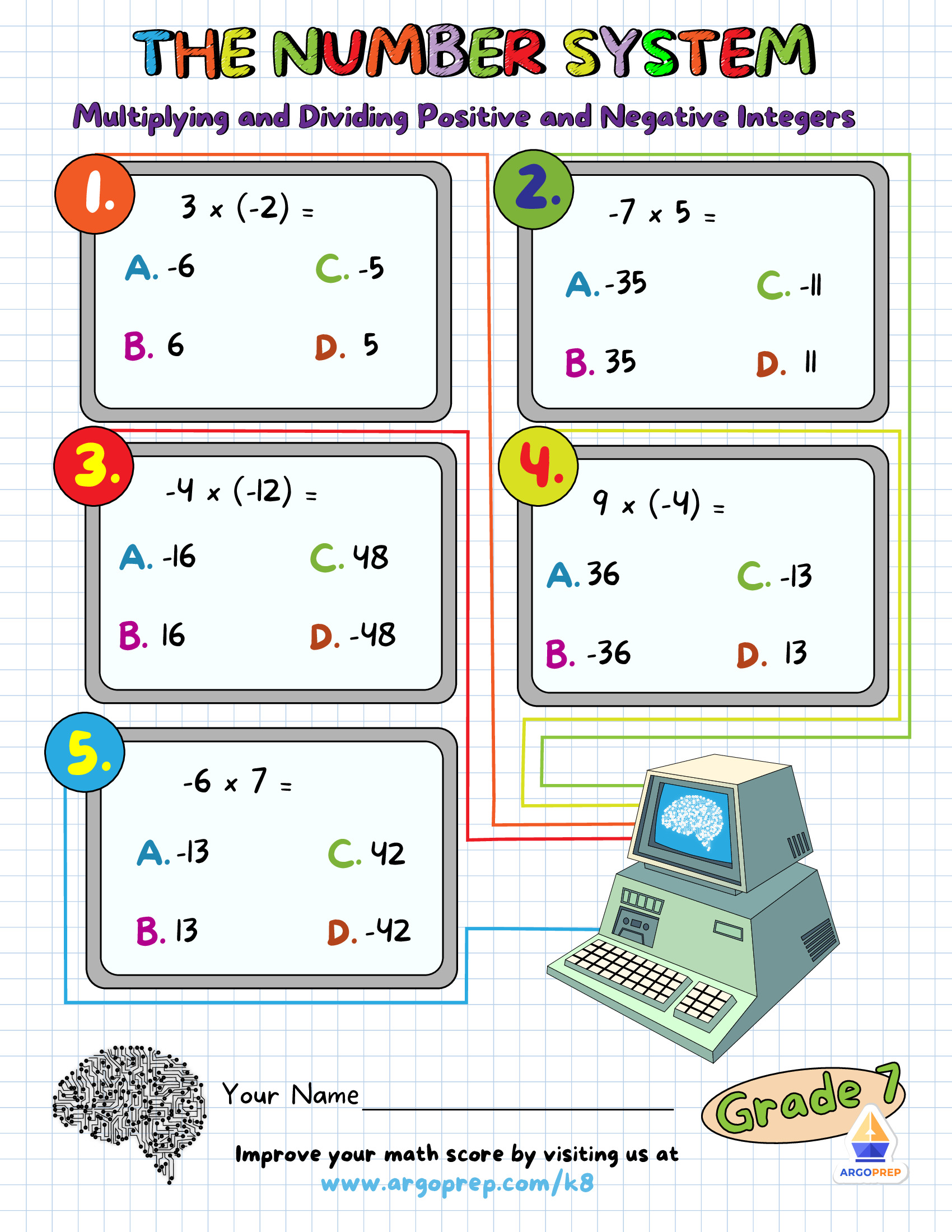
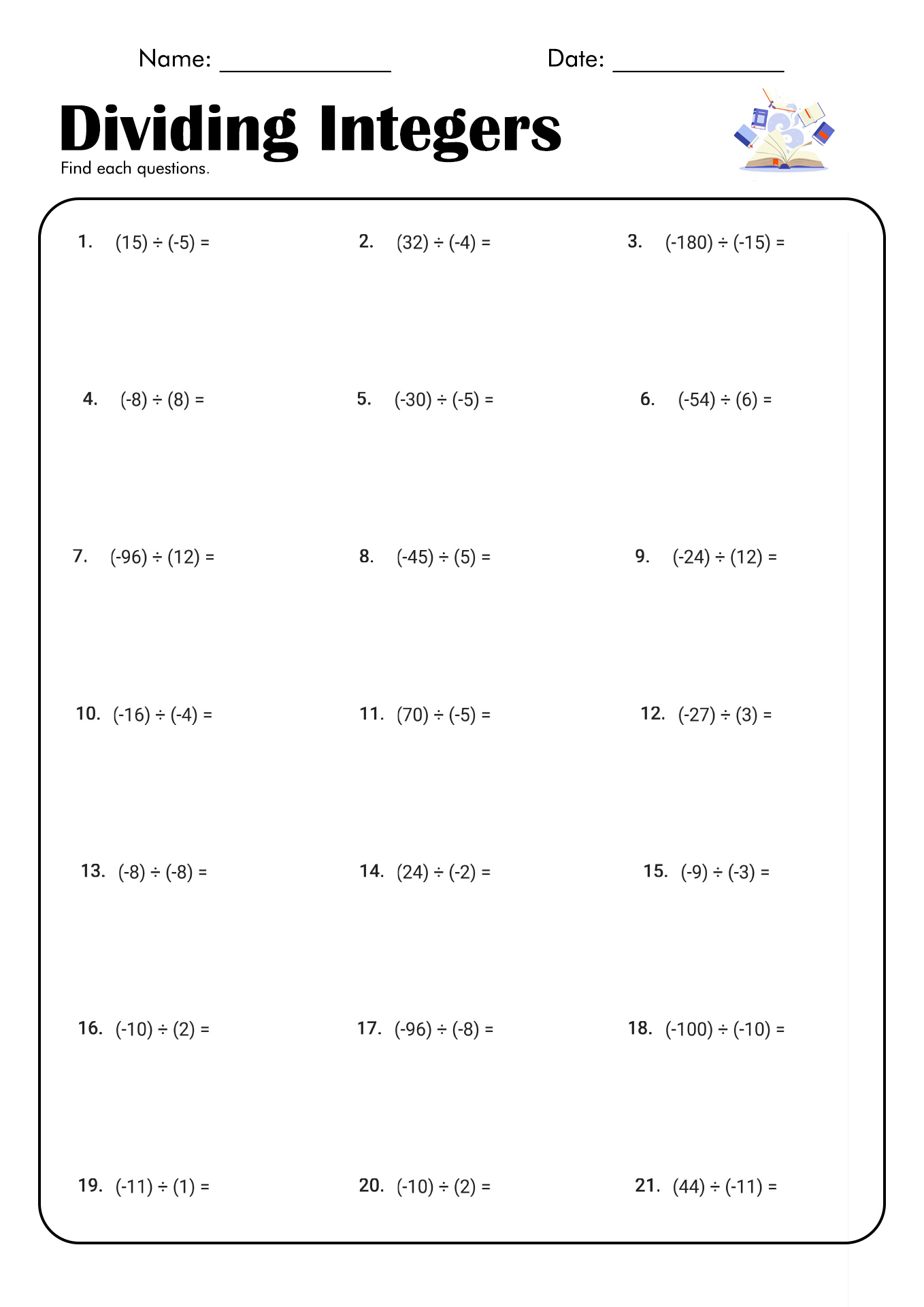
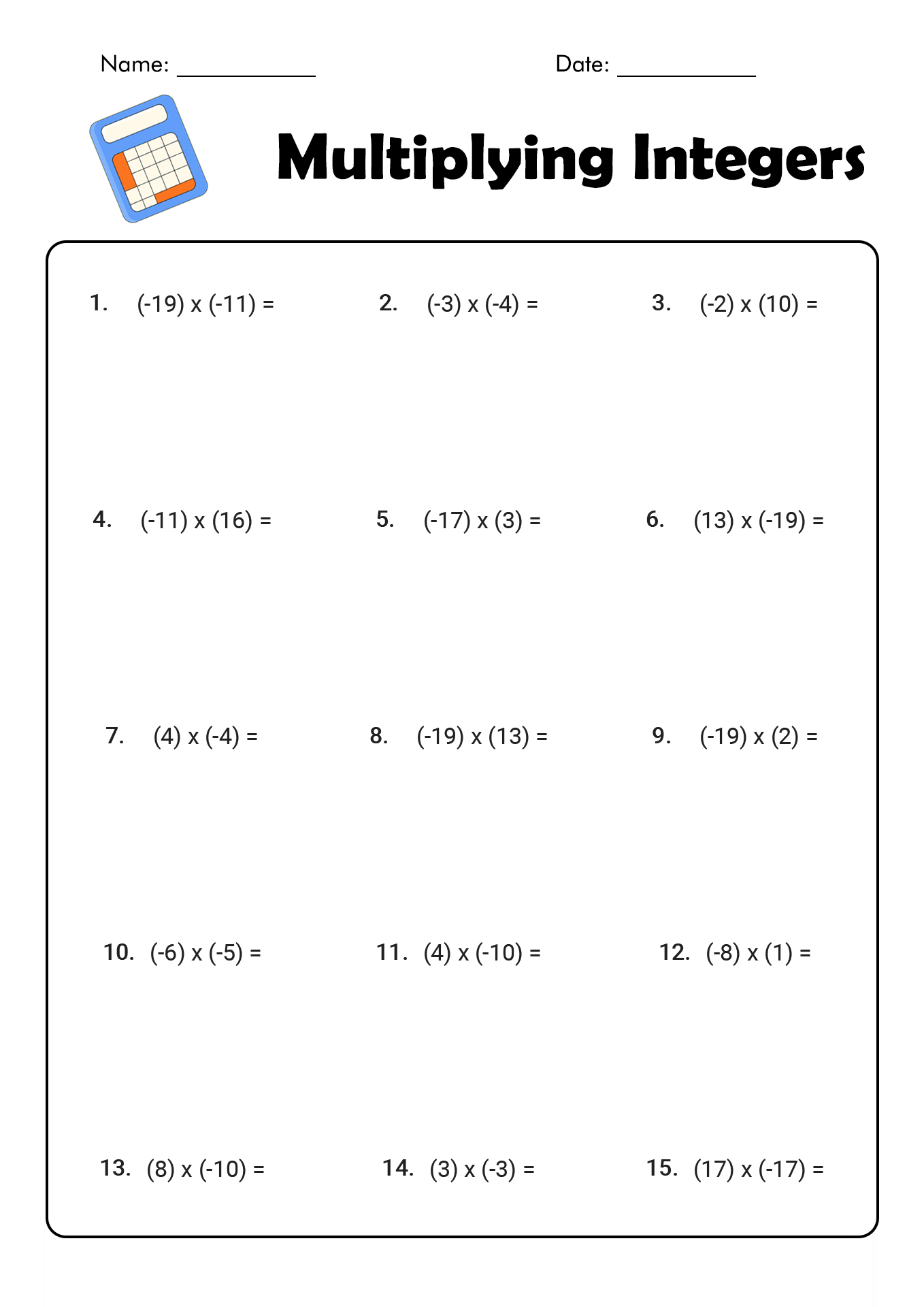
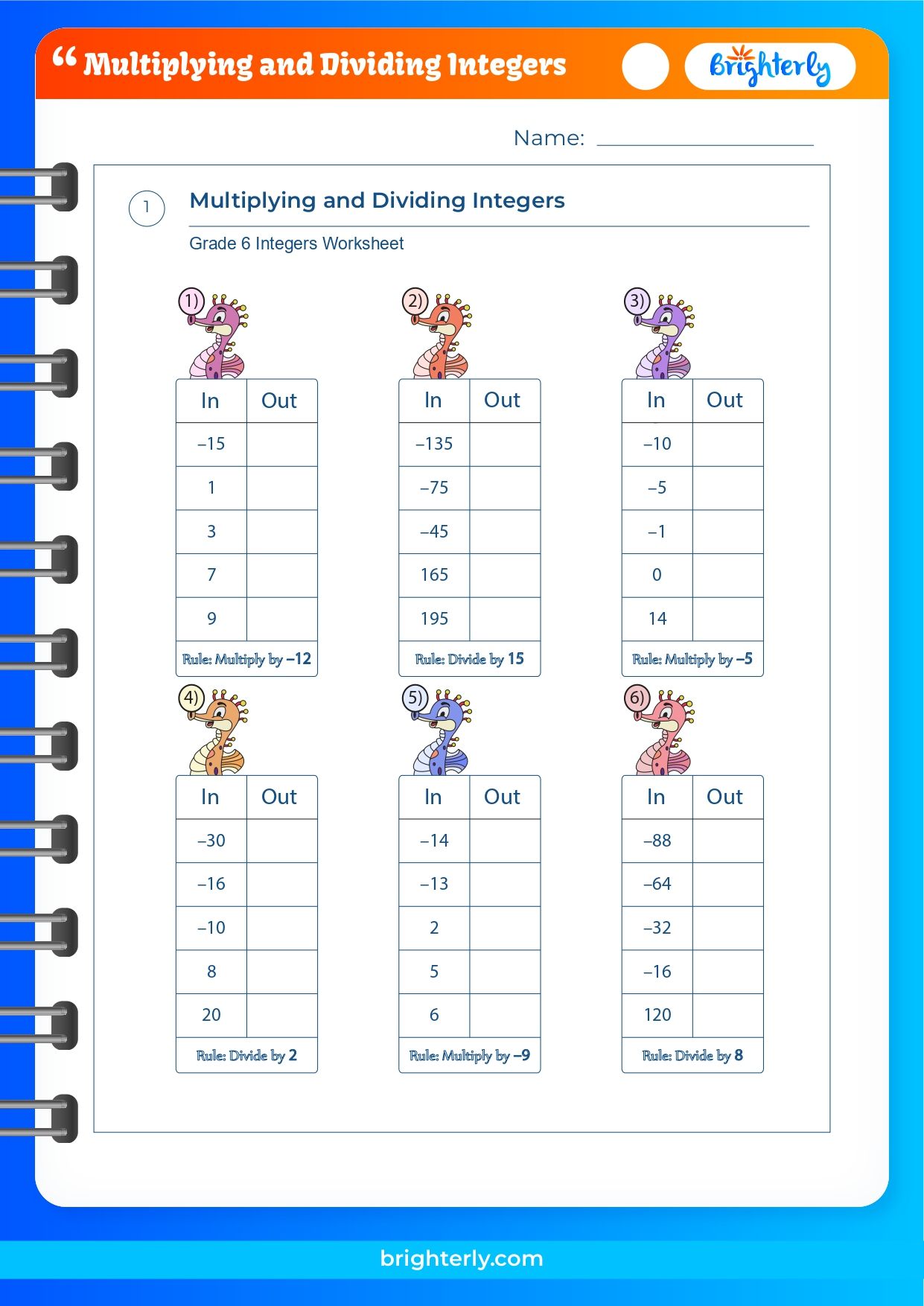
Looking for a reliable resource to sharpen your skills in Integers Worksheet Multiplying And Dividing can be a game changer for both students and educators. This guide dives deep into strategies, common pitfalls, and real‑world examples to help you master integer multiplication and division with confidence.
Understanding the Fundamentals
Before tackling worksheets, it’s essential to grasp the core principles that govern integer operations. Integer multiplication and division follow specific rules that differ subtly from operations with only positive numbers.
Sign Rules in Multiplication
- Positive × Positive = Positive
- Negative × Negative = Positive
- Positive × Negative = Negative
- Negative × Positive = Negative
These rules help you determine the sign of the product before you even perform the calculation.
Sign Rules in Division
- Division follows the same sign logic as multiplication.
- When dividing a negative by a positive or a positive by a negative, the result is negative.
- Dividing two negatives yields a positive.
Remembering these simple patterns eliminates guesswork and reduces errors.
Zero’s Unique Role
Zero is the only integer that turns any product or quotient to zero when it is a factor or divisor. Understanding this helps avoid the classic “zero trap” where a student might mistakenly think a non‑zero dividend divided by zero is a finite number.
Common Mistakes and How to Avoid Them
Even seasoned learners can trip over common pitfalls. Spotting these early leads to better performance on worksheets.
Misapplying Sign Rules
Students often forget that multiplying two negatives yields a positive. Repeating the sign chart in practice problems can reinforce correct application.
Forgetting to Simplify Fractions
After dividing, many overlook the step of reducing the fraction to its simplest form. For example, 12 ÷ 4 simplifies to 3/1, not 3.
Ignoring the Order of Operations
In mixed operations, the precedence of multiplication and division over addition and subtraction can confuse students. Clear step‑by‑step notation, such as using parentheses, clarifies the intended order.
Misreading Negative Signs
In printed worksheets, a minus sign can be mistaken for a dash or a hyphen. Encourage students to underline or circle the negative sign before solving.
Step‑by‑Step Guide to Mastering Multiplication
Here is a systematic approach that turns tedious calculations into a repeatable routine.
1. Identify the Signs
Look at each integer. Note if it’s positive or negative. Write a quick sign summary: + × +, – × -, etc.
2. Compute the Absolute Values
Ignore signs temporarily and multiply the magnitudes. Use a multiplication table or calculator for efficiency.
3. Reapply the Sign Rules
After you have the absolute product, determine its sign based on the rule chart. If the number of negative factors is odd, the product is negative; if even, it’s positive.
4. Check for Mistakes
Verify by adding the product back to a zero value or by using a quick mental check (e.g., 3 × (-5) = -15; is the magnitude 15? Yes.)
Step‑by‑Step Guide to Mastering Division
Division with integers shares many steps with multiplication, but additional care is needed for the quotient’s sign and the remainder.
1. Set Up the Problem
Rewrite the division as a fraction or use long division format. For example, 24 ÷ (-6) becomes 24/(-6).
2. Determine the Sign of the Quotient
Apply the sign rule: positive divided by negative is negative. So 24 ÷ (-6) = -4.
3. Perform the Division of Absolute Values
Divide 24 by 6 to get 4. Then apply the negative sign from step 2.
4. Handle Remainders
When the dividend isn’t a multiple of the divisor, express the remainder in fraction form. For instance, 25 ÷ (-4) = -6 with a remainder of 1, which can be written as -6 1/4.
5. Verify Accuracy
Multiply the quotient by the divisor and add the remainder to confirm it equals the original dividend.
Real‑World Applications
Seeing how integer operations apply in everyday contexts can motivate learners to practice more.
Financial Calculations
Budget deficits and profits often involve negative numbers. For example, a company might have a debt of -$500,000 and an asset of +$750,000. Multiplying these values can help calculate compound effects on net worth.
Temperature Changes
Tracking temperature shifts over a week may involve adding or subtracting negative degrees. Multiplying the number of days by the daily change gives total variation.
Engineering and Physics
When calculating forces, velocities, or currents, directions are represented by signs. Multiplying two opposing forces yields a negative resultant, indicating direction.
Game Strategy
Many board games use integer multiplication for scoring. Understanding how to quickly compute these scores gives players a competitive edge.
Tips for Teachers and Parents
Guiding students through integer worksheets requires more than just handing out problems. Here are actionable strategies.
1. Use Visual Aids
Place a number line on the board and illustrate how multiplying or dividing moves a point left or right. This spatial representation demystifies the abstract nature of negative numbers.
2. Create a Sign Chart
Develop a chart that students can refer to when they’re unsure. Encourage them to draw it during practice to reinforce memory.
3. Encourage Mental Math
Practice quick sign checks mentally. For instance, before solving 7 × (-8), students can mentally confirm the product should be negative, then focus on the magnitude.
4. Use Error Logs
Have students maintain a log of common mistakes. Reviewing this log weekly helps them track improvement.
5. Offer Immediate Feedback
When correcting worksheets, point out not just the error but the underlying rule that was missed. This turns each correction into a learning moment.
Effective Practice Strategies
Consistency beats cramming. Here’s how to structure a practice routine.
Daily Drill Sets
Allocate 10–15 minutes each day to solve a mix of multiplication and division problems. Rotate between problems that emphasize sign rules and those that focus on magnitude.
Peer Teaching
Pair students so they can explain sign rules to each other. Teaching a concept often solidifies the teacher’s own understanding.
Gamification
Create flashcards or online quizzes that award points for speed and accuracy. Turn worksheets into friendly competitions.
Progress Tracking
Use a simple spreadsheet to record scores over time. Visual progress charts can motivate continued effort.
Assessment and Feedback
Effective assessment goes beyond grading. It informs instruction and boosts confidence.
Formative Checkpoints
Insert mini‑quizzes after each worksheet section. Immediate feedback helps students correct misconceptions early.
Rubric Development
Design rubrics that value correct sign application, accurate calculation, and clean notation. This encourages students to focus on all aspects of the problem.
Self‑Assessment Tools
Provide students with checklists: Did I identify the signs correctly? Did I simplify the product? Did I handle remainders? Self‑reflection improves metacognition.
Resources for Further Learning
Beyond worksheets, a variety of tools can deepen understanding.
Interactive Apps
Apps that let students drag numbers onto a number line or visualize multiplication as area help reinforce concepts.
Online Video Series
Short video lessons that focus on sign rules and step‑by‑step problem solving are ideal for visual learners.
Community Forums
Joining math discussion boards allows students to ask questions and see different problem‑solving approaches.
Conclusion
Mastering integer multiplication and division is more than memorizing formulas—it’s about building a mental framework that recognizes signs, simplifies magnitudes, and applies the rules consistently. By integrating structured practice, visual aids, and real‑world scenarios, learners can transform challenging worksheets into engaging, confidence‑boosting tasks. Embrace these strategies, stay persistent, and watch both skill and enthusiasm grow, turning every worksheet into a stepping stone toward mathematical mastery.






Related posts of "Integers Worksheet Multiplying And Dividing"
