Inequalities Worksheet Word Problems are the hidden gems that turn abstract math symbols into everyday decision‑making scenarios, and they’re the perfect way to help students see the relevance of algebra in real life. Whether you’re a teacher looking for fresh classroom material, a parent trying to keep your child’s math skills sharp, or a lifelong learner who enjoys a good challenge, this guide will walk you through everything you need to know to create, solve, and master inequality word problems with confidence and enthusiasm.
Why Inequalities Matter in Real Life
At first glance, inequalities may seem like a purely academic construct, but they actually model countless situations we encounter daily. From budgeting and nutrition to sports statistics and environmental thresholds, understanding how to interpret “greater than,” “less than,” or “between” statements equips students with a powerful decision‑making toolkit.
Consider these everyday examples:
- A family plans a road trip and wants to keep fuel consumption under 10 gallons per 100 miles.
- A nutritionist advises a client to keep daily sugar intake below 30 grams.
- A coach determines that a sprinter must finish a race in less than 12 seconds to qualify for the next round.
Each scenario can be translated into an inequality, making the abstract concept tangible and instantly useful. When students recognize this connection, their motivation skyrockets, and their problem‑solving skills become more adaptable.
Key Concepts to Master
Understanding Inequality Symbols
There are four primary symbols:
- < (less than)
- > (greater than)
- ≤ (less than or equal to)
- ≥ (greater than or equal to)
Each symbol defines a relationship between two expressions. Emphasize the direction of the arrow—think of it as an open mouth that “eats” the larger value.
Solution Sets and Number Lines
Visual learners benefit from drawing number lines. Plot the critical point where the inequality changes from false to true, then shade the appropriate region. Open circles indicate strict inequalities (<, >), while closed circles represent inclusive inequalities (≤, ≥). This visual cue reinforces the concept of infinite solutions.
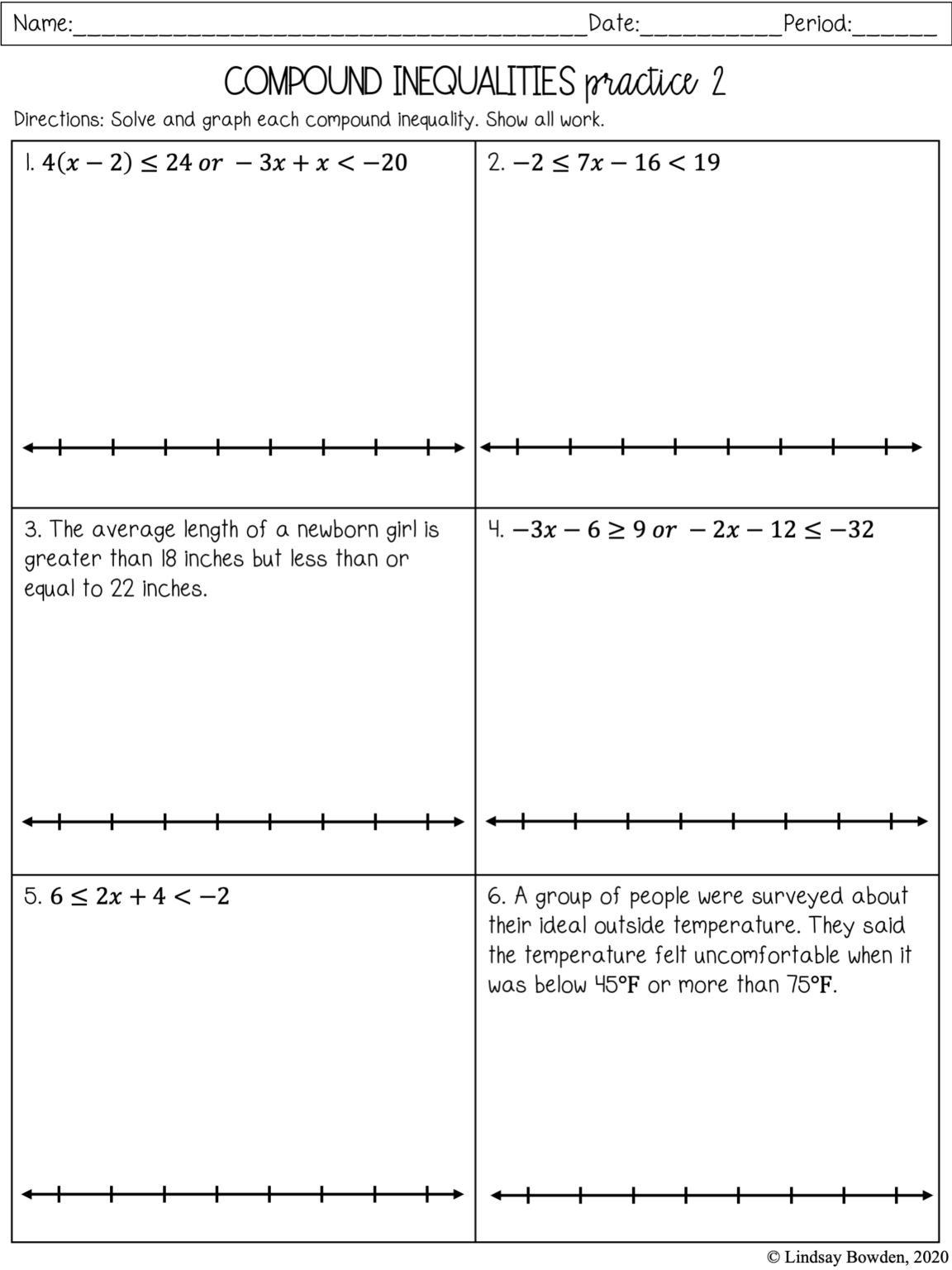
Compound Inequalities
Real‑world problems often involve ranges, such as “between 5 and 12.” These are expressed as compound inequalities:
5 < x ≤ 12
Teach students to treat each part separately, solve them individually, and then find the intersection (for “and”) or union (for “or”) of the solution sets.
Translating Words into Math
The biggest hurdle is converting a story into a symbolic inequality. Highlight key phrases:
- “At most” → ≤
- “At least” → ≥
- “More than” → >
- “Less than” → <
- “Between … and …” → compound inequality
Encourage students to underline these trigger words in the problem statement before writing any equations.
Step‑by‑Step Strategies for Solving Word Problems
1. Read Carefully and Highlight Keywords
First, read the problem twice. On the second pass, underline or bold the inequality cues and any quantities that will become variables.
2. Define the Variable(s)
Assign a clear, descriptive variable. For example, let c represent the cost of a concert ticket, or let t be the time in minutes a runner spends training each day.
3. Write the Inequality
Translate the highlighted language into a mathematical statement. Keep the inequality oriented so the variable of interest is on the left side whenever possible; this makes solving more straightforward.
4. Solve the Inequality
Apply the same rules you use for equations—add, subtract, multiply, or divide—while remembering the critical rule: multiplying or dividing by a negative number flips the inequality sign.
5. Interpret the Solution in Context
After obtaining the solution set, answer the original question in plain language. If the solution is “x ≥ 7,” you might say, “You need to save at least $7 each week to reach your goal.”
6. Verify with a Test Value
Pick a number from the solution set and plug it back into the original word problem to ensure the statement holds true. This final check builds confidence and catches sign errors.
Common Pitfalls and How to Avoid Them
Flipping the Inequality Sign Accidentally
When you multiply or divide by a negative, the sign must reverse. A common mnemonic is “Negative flips, positive stays.” Write a quick reminder on the board or on a sticky note for students to glance at before they perform that step.
Misinterpreting “Between” Statements
Students sometimes write “5 ≤ x < 12” when the problem says “between 5 and 12, exclusive.” Clarify the difference between inclusive and exclusive boundaries, and practice with visual number‑line examples.
Forgetting Units
Word problems are rich with units—dollars, minutes, miles, grams. Forgetting to carry units through the calculation can lead to nonsensical answers. Encourage students to write units next to each number and keep them visible throughout the solving process.
Overlooking Multiple Variables
Some scenarios involve two or more unknowns, leading to systems of inequalities. Teach students to set up a second inequality based on a second condition, then solve the system using substitution or graphing.
Sample Worksheet Problems with Detailed Solutions
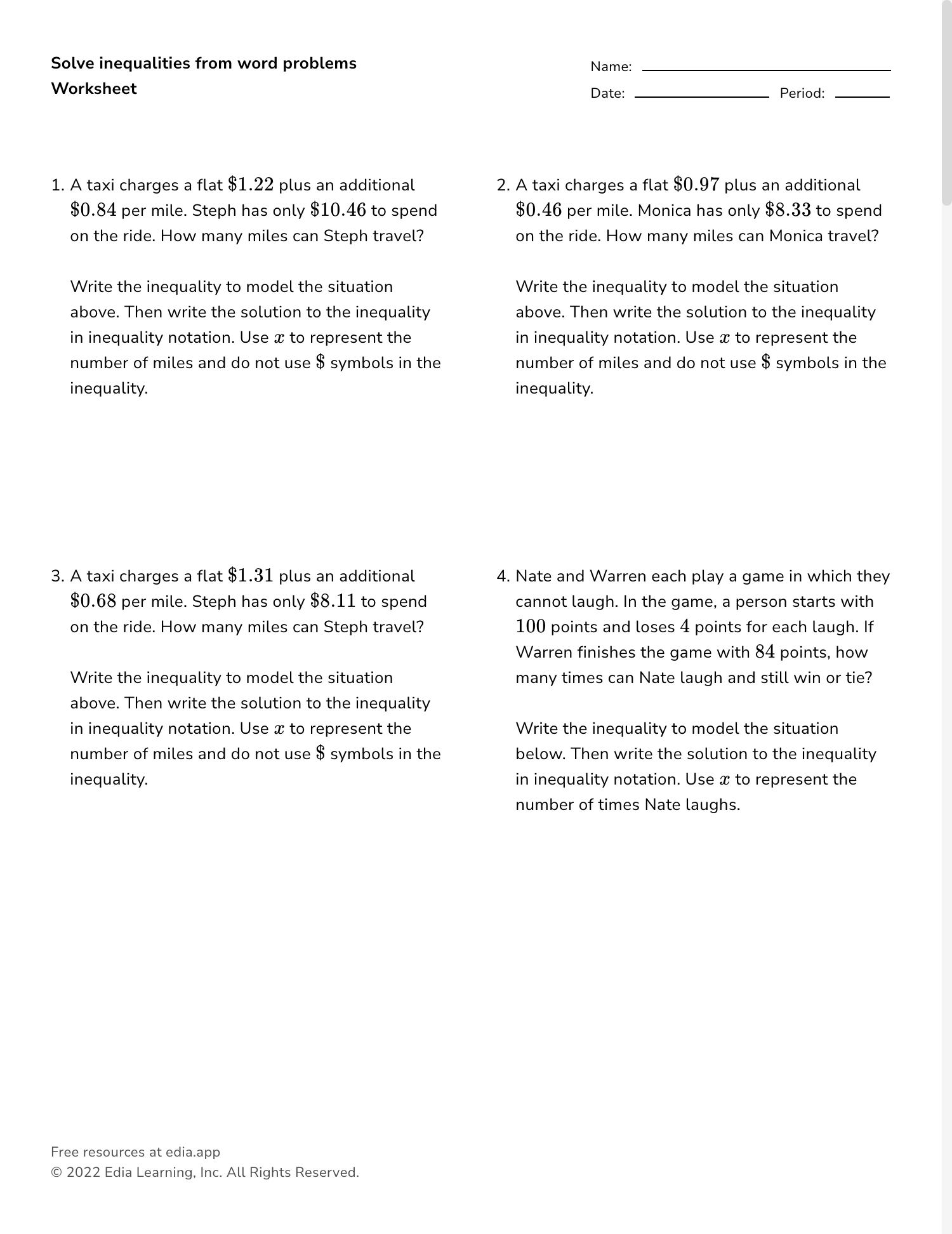
Problem 1: Budgeting for a School Trip
Students need to raise at least $150 to fund a class field trip. Each student can contribute an amount p dollars, and the class has 30 students. Write an inequality to represent the situation and determine the minimum contribution per student.
Solution:
- Define the variable: Let p be the contribution per student.
- Set up the inequality: 30p ≥ 150.
- Solve for p: Divide both sides by 30 → p ≥ 5.
- Interpretation: Each student must contribute at least $5 to meet the goal.
- Verification: 30 × 5 = 150, which meets the requirement.
Problem 2: Healthy Snack Portion
A nutritionist advises that a child’s daily fruit intake should be less than 2 cups, but more than ½ cup. Represent this as a compound inequality and describe the acceptable range.
Solution:
- Let f be the number of cups of fruit.
- Write the compound inequality: ½ < f < 2.
- Interpretation: The child can eat any amount greater than 0.5 cups and less than 2 cups each day.
Problem 3: Speed Limit Challenge
A driver wants to keep their average speed under 65 miles per hour on a 200‑mile trip that must be completed in no less than 3 hours. Formulate the inequality and find the maximum average speed the driver can maintain.
Solution:
- Let s represent average speed in miles per hour.
- Time equals distance divided by speed, so the time taken is 200 ÷ s.
- Since the driver wants to finish in at least 3 hours: 200 ÷ s ≥ 3.
- Multiply both sides by s (positive, so sign stays): 200 ≥ 3s.
- Divide by 3: s ≤ 66.67.
- Because the driver also wants to stay under the legal limit of 65 mph, combine the two: s ≤ 65.
- Interpretation: The driver must keep the average speed at 65 mph or slower to satisfy both constraints.
Problem 4: Plant Growth Experiment
A biology class measures the height of a plant each day. The plant must grow at least 0.3 cm per day to meet the experiment’s goal of reaching 12 cm in 30 days. Write an inequality for the daily growth g and determine the minimum daily growth required.
Solution:
- Let g be daily growth in centimeters.
- Total growth after 30 days: 30g.
- Set up inequality: 30g ≥ 12.
- Solve: g ≥ 12 ÷ 30 = 0.4 cm.
- Interpretation: The plant must grow at least 0.4 cm each day, a slightly higher rate than the initial estimate.
Tips for Teachers and Parents
Incorporate Real‑World Data
Use current events, sports statistics, or personal finance scenarios that resonate with your students. When the numbers reflect something familiar, engagement naturally rises.
Use Visual Aids
Number lines, bar models, and inequality “balance” scales help visual learners see the abstract relationships. Even a quick sketch on a whiteboard can clarify a confusing problem.
Encourage Collaborative Problem Solving
Pair students and have them explain each step to one another. Teaching a concept reinforces understanding, and peers often catch mistakes that a single student might miss.
Gradual Release of Responsibility
Start with guided practice where you solve a problem together, then move to independent worksheets. Provide a checklist that students can reference: read, underline, define, translate, solve, interpret, verify.
Differentiate the Difficulty
Offer a mix of simple single‑variable inequalities and more complex multi‑variable or compound problems. This allows advanced learners to stay challenged while giving struggling students a chance to build confidence.
Conclusion
Mastering Inequalities Worksheet Word Problems is more than an academic exercise; it equips learners with a versatile framework for making informed decisions in everyday life. By emphasizing real‑world connections, breaking down the translation process, and providing clear, step‑by‑step strategies, educators and parents can transform inequalities from a source of anxiety into a source of empowerment. The sample problems and teaching tips in this guide offer a ready‑to‑use toolbox that can be adapted to any classroom or home‑learning environment. With consistent practice, reflective verification, and a dash of creativity, students will not only solve inequalities with ease—they’ll start spotting them in the world around them, turning mathematics into a living, breathing part of their daily narrative.




Related posts of "Inequalities Worksheet Word Problems"
