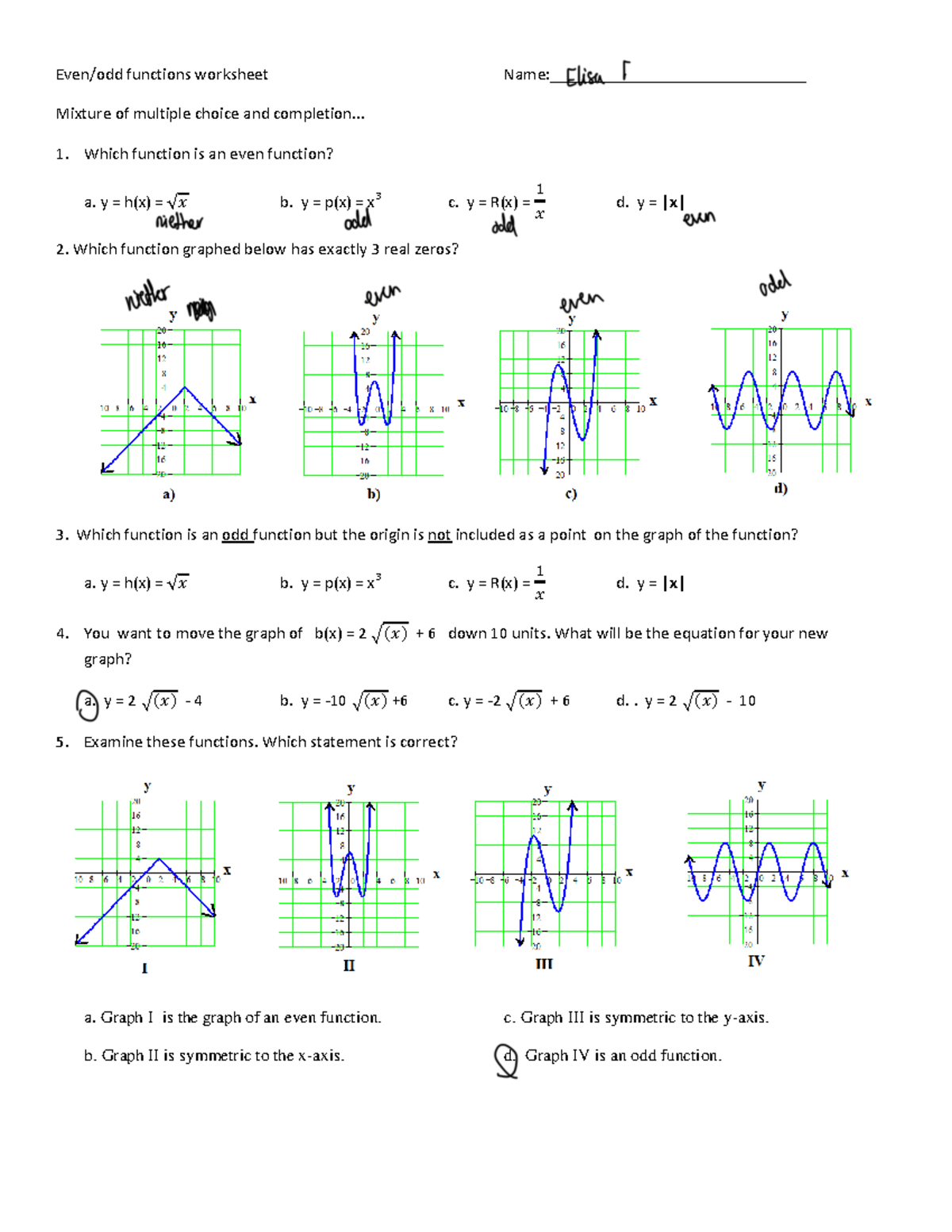
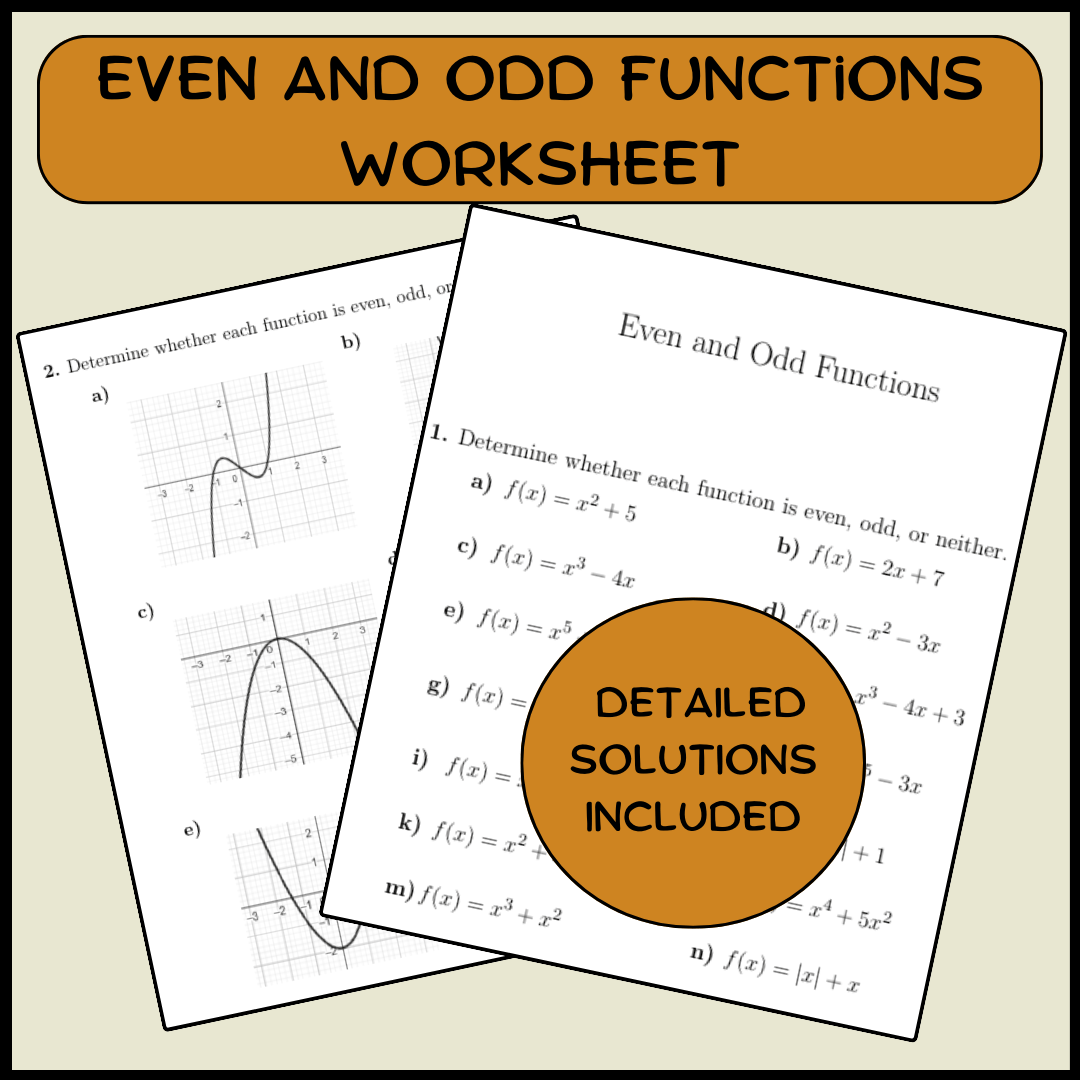
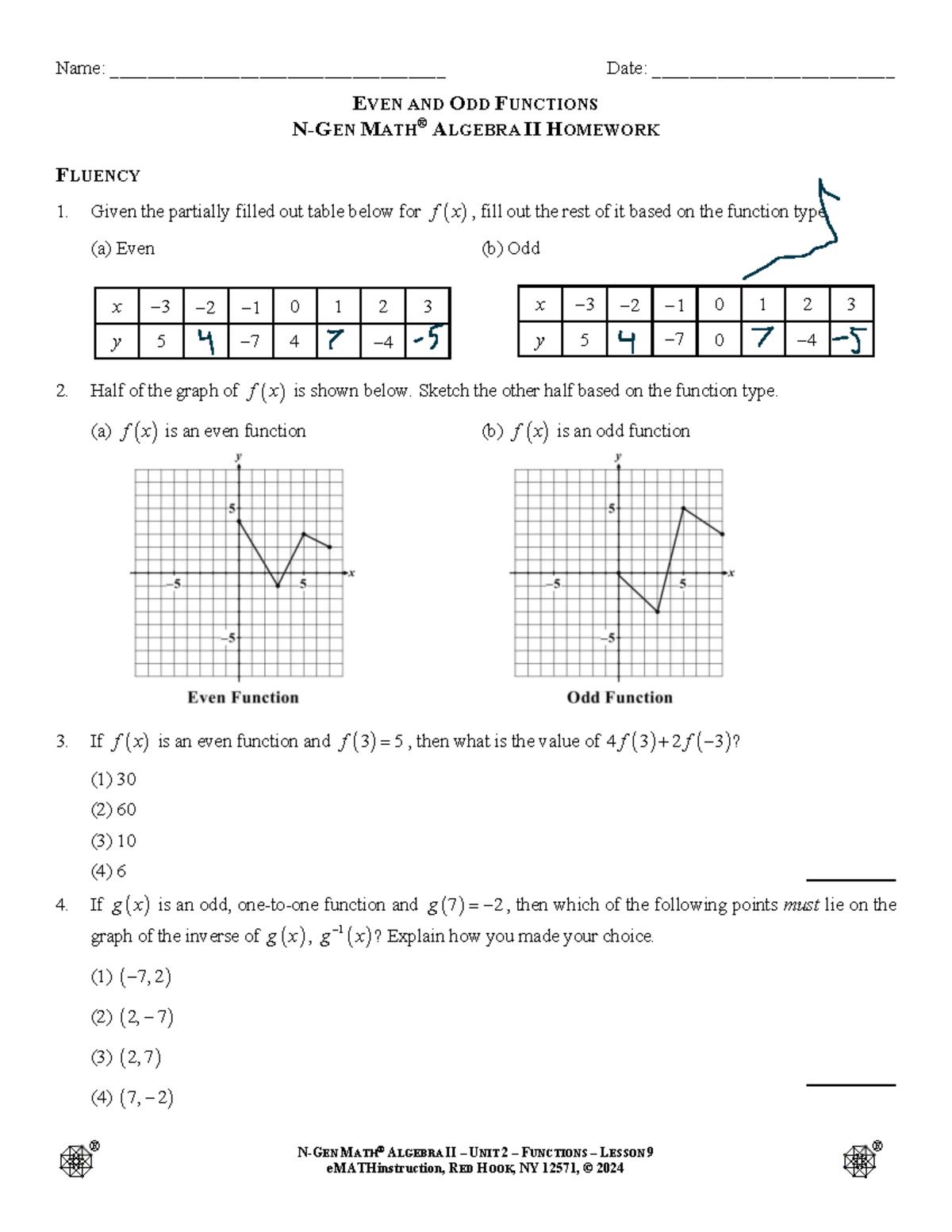
Even Odd Functions Worksheet serves as a powerful instructional tool that bridges the gap between abstract mathematical concepts and tangible problem‑solving skills, allowing students to recognize, categorize, and manipulate functions based on their symmetry properties with confidence and clarity.
Understanding Even and Odd Functions
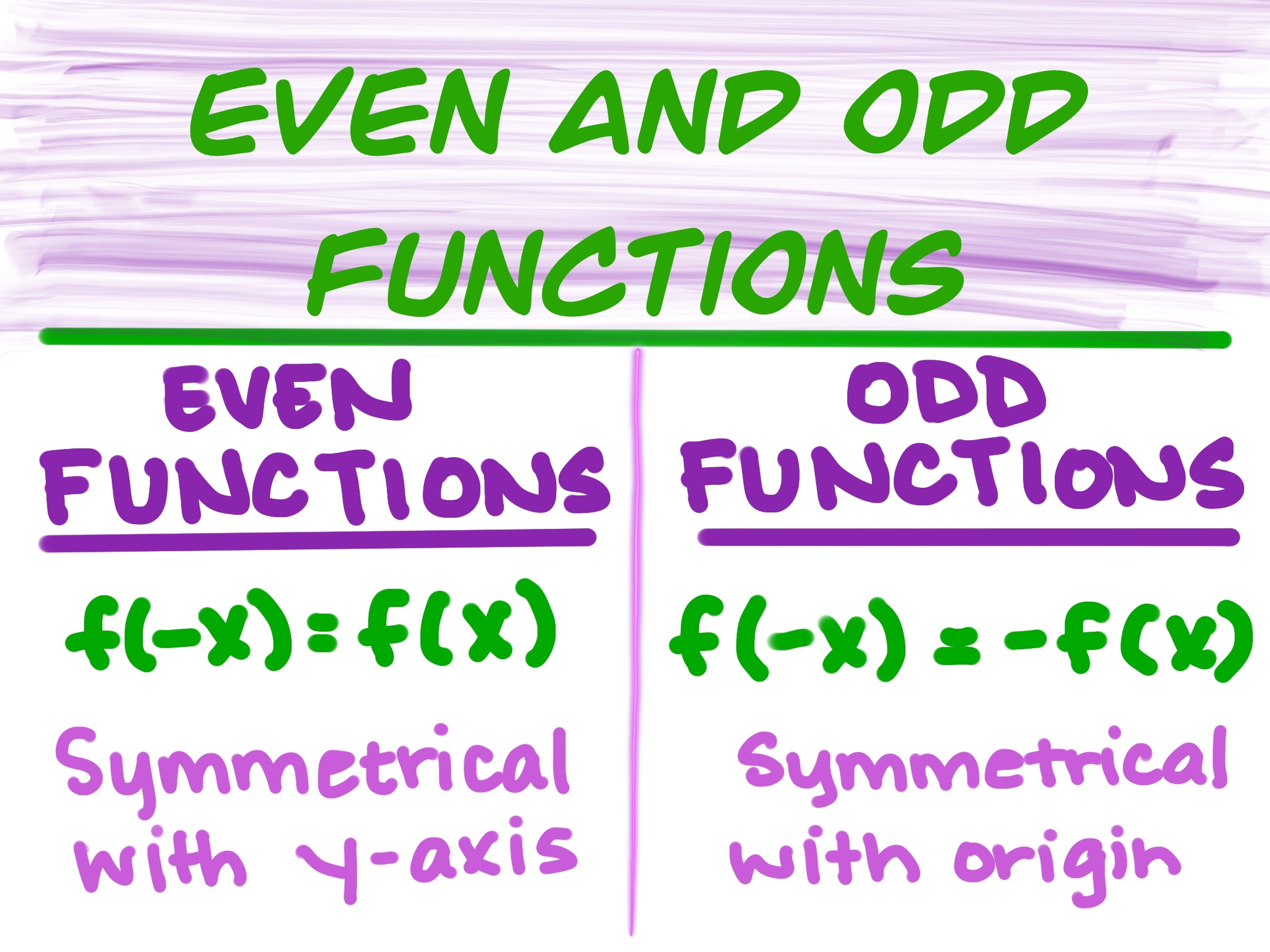
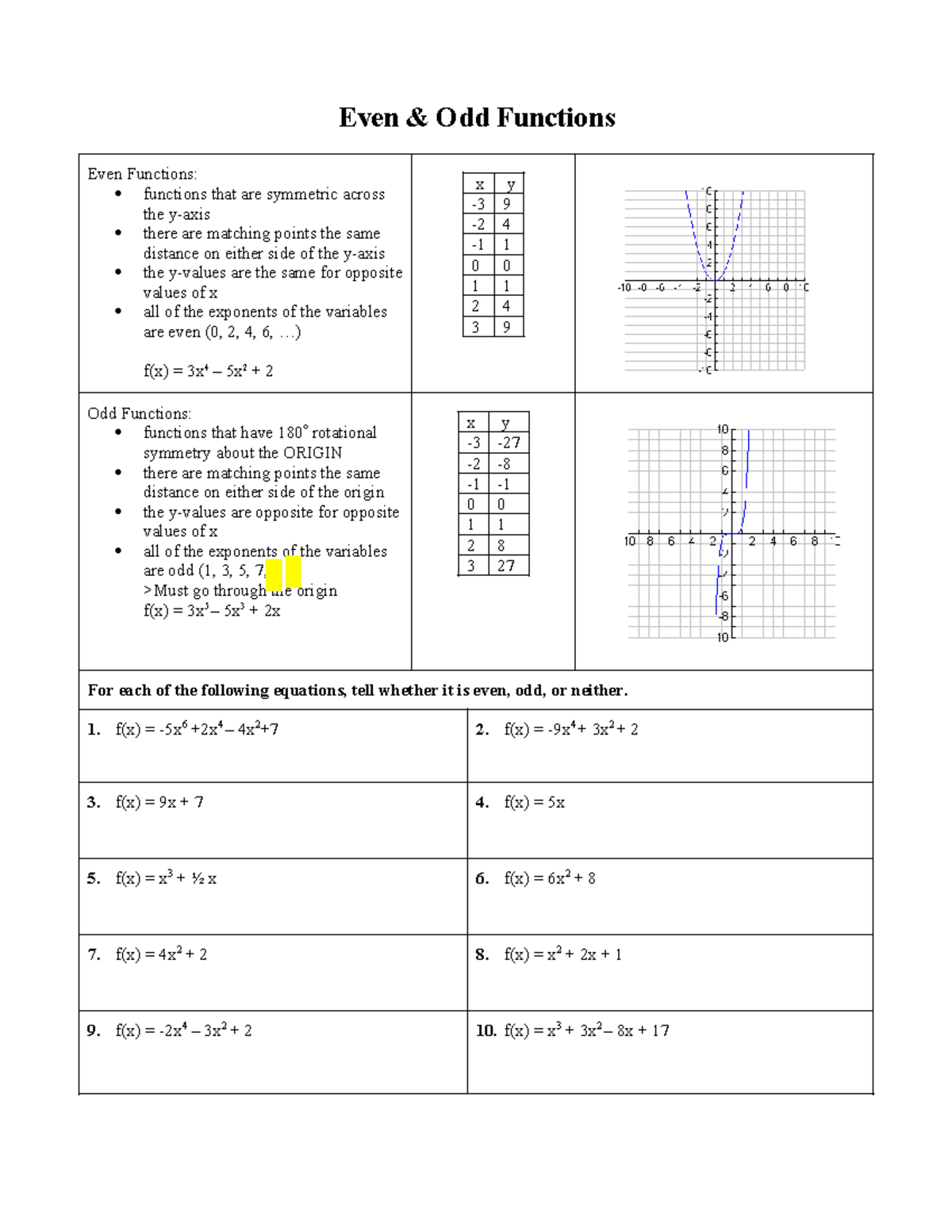
In mathematics, a function \(f(x)\) is classified as even when it satisfies the condition \(f(-x)=f(x)\) for every \(x\) in its domain. Graphically, even functions are symmetric with respect to the \(y\)-axis, meaning the left‑hand side of the graph mirrors the right‑hand side. Classic examples include \(f(x)=x^2\), \(f(x)=\cos x\), and constant functions.
Conversely, a function is odd if it fulfills \(f(-x)=-f(x)\) for all \(x\). This definition yields symmetry about the origin; rotating the graph 180 degrees around the origin leaves it unchanged. Typical odd functions are \(f(x)=x^3\), \(f(x)=\sin x\), and linear functions passing through the origin such as \(f(x)=5x\).
Grasping these definitions is essential because even and odd properties simplify integration, differentiation, and series expansions. Moreover, many physical phenomena—such as even‑symmetry potentials in physics or odd‑symmetry waveforms in engineering—directly rely on these concepts.
Why an Even Odd Functions Worksheet Matters
Worksheets provide structured practice that reinforces theoretical understanding through repeated application. An Even Odd Functions Worksheet offers several pedagogical advantages:
- Active Engagement: Students actively classify functions rather than passively reading definitions.
- Immediate Feedback: Well‑designed worksheets include answer keys or self‑checking sections, allowing learners to correct misconceptions instantly.
- Skill Transfer: Repeated exposure enables students to apply symmetry concepts in calculus, differential equations, and physics.
- Assessment Ready: Teachers can use worksheet results to gauge class comprehension and tailor subsequent instruction.
Designing an Effective Even Odd Functions Worksheet
Creating a worksheet that maximizes learning requires careful selection of function types, progressive difficulty, and clear instructions. Below are key design principles.
Selecting a Balanced Function Set
Include a mixture of polynomial, trigonometric, exponential, and piecewise functions. This variety ensures students encounter symmetry in multiple contexts. For each category, provide at least two even, two odd, and one function that is neither, prompting students to justify their classification.
Progressive Difficulty
Start with straightforward identification tasks, then move to proving even/odd nature algebraically, followed by application problems such as evaluating integrals or determining Fourier series coefficients. This scaffolding builds confidence before tackling complex scenarios.
Clear Instructions and Formatting
Use concise prompts like “Determine whether the function is even, odd, or neither. Show all steps.” Provide ample space for working out calculations, and include a separate answer section to prevent premature checking.
Incorporating Real‑World Contexts
Embedding word problems that involve symmetry—such as analyzing the shape of a bridge arch (even) or the motion of a pendulum about its equilibrium (odd)—helps students see relevance beyond the classroom.
Step‑by‑Step Guide to Solving Worksheet Problems
Students often benefit from a systematic approach. The following checklist can be printed on the worksheet itself, reinforcing disciplined problem‑solving habits.
Step 1: Write the Function Explicitly
Copy the given function onto a clean part of the paper. This reduces transcription errors and clarifies the expression you will manipulate.
Step 2: Substitute \(-x\) for \(x\)
Replace every occurrence of \(x\) with \(-x\). Pay close attention to even powers, odd powers, and sign‑changing operations. Simplify the resulting expression as much as possible.
Step 3: Compare the Result to the Original Function
If \(f(-x)=f(x)\) exactly, the function is even. If \(f(-x)=-f(x)\) holds, the function is odd. If neither condition is satisfied, the function is neither even nor odd.
Step 4: Justify Your Classification
Provide a brief written explanation. For example: “Because all terms have even exponents, the function is symmetric about the \(y\)-axis, making it even.” This reinforces conceptual understanding.
Step 5: Apply the Classification
Many worksheet problems ask you to leverage the classification—for instance, simplifying an integral over a symmetric interval. Use known properties: the integral of an odd function over \([-a,a]\) equals zero, while the integral of an even function can be doubled over \([0,a]\).
Common Mistakes and How to Avoid Them
Even experienced learners can fall into predictable traps. Identifying these pitfalls early prevents frustration and solidifies mastery.
Ignoring Domain Restrictions
Some functions are only defined for certain \(x\) values (e.g., square roots of \(x\)). Substituting \(-x\) without checking the domain may produce undefined expressions, leading to incorrect classifications. Always verify that both \(x\) and \(-x\) lie within the function’s domain before proceeding.
Mistaking Coefficients for Symmetry
A common error is assuming that a constant multiplier changes parity. In reality, multiplying an even (or odd) function by any non‑zero constant preserves its parity. For example, \(5\cos x\) remains even because the cosine factor dictates symmetry.
Overlooking Piecewise Definitions
When a function is defined differently on separate intervals, each piece must be examined individually. The overall function may be even, odd, or neither depending on how the pieces mirror each other across the origin or \(y\)-axis.
Confusing Even/Odd with Positive/Negative
Evenness and oddness describe symmetry, not sign. An even function can take negative values (e.g., \(f(x)=-x^2\)). Clarify this distinction in explanations to avoid conceptual confusion.
Real‑World Applications of Even and Odd Functions
Understanding symmetry transcends pure mathematics and appears in engineering, physics, economics, and computer science.
Signal Processing
In Fourier analysis, even components correspond to cosine terms while odd components correspond to sine terms. Decomposing a signal into even and odd parts simplifies filtering and reconstruction tasks.
Structural Engineering
Designs such as arches or bridges often exploit even symmetry to distribute loads uniformly. Recognizing an even shape allows engineers to model only half the structure, reducing computational effort.
Quantum Mechanics
Wave functions that are even or odd under spatial inversion possess distinct energy eigenvalues. Identifying parity helps predict particle behavior in symmetric potentials.
Economics
Supply and demand curves that exhibit odd symmetry about the origin can model markets where positive and negative price changes have mirrored effects, aiding in equilibrium analysis.
Practical Tips for Teachers Using the Worksheet
Educators can maximize the worksheet’s impact by integrating it strategically into lesson plans.
Pre‑Lesson Warm‑Up
Begin class with a quick “think‑pair‑share” where students classify a few simple functions orally. This activates prior knowledge and prepares them for the written worksheet.
Guided Practice
Work through the first two problems together on the board, modeling the step‑by‑step approach. Highlight common errors and ask students to predict the outcome before revealing the solution.
Independent Work with Timed Sessions
Allocate a focused time block—typically 15–20 minutes—for students to complete the worksheet independently. This encourages concentration and mimics test conditions.
Reflective Review
After collection, review the most frequent mistakes as a class. Encourage students to rewrite problematic solutions correctly, reinforcing learning through correction.
Leveraging Technology to Enhance Worksheet Learning
Digital tools can augment traditional paper worksheets, offering interactive and adaptive experiences.
Online Form Builders
Platforms like Google Forms allow teachers to create auto‑graded versions of the worksheet. Immediate feedback helps students self‑correct and accelerates mastery.
Graphing Calculators and Software
Encourage students to plot functions using graphing calculators or free software (e.g., Desmos). Visual confirmation of symmetry deepens conceptual insight.
Collaborative Whiteboards
Virtual whiteboards enable real‑time problem solving in remote or hybrid classrooms. Teachers can annotate student work live, demonstrating the substitution step and symmetry checks.
Conclusion
Mastering the identification and application of even and odd functions is a cornerstone of higher‑level mathematics, and a well‑crafted Even Odd Functions Worksheet provides the structured practice necessary to achieve fluency. By understanding the theoretical definitions, designing purposeful worksheets, following systematic solving strategies, and avoiding common misconceptions, both students and teachers can unlock the practical power of symmetry across disciplines. Integrating real‑world examples and modern technology further enriches the learning experience, ensuring that the concepts endure beyond the classroom and become valuable tools in scientific, engineering, and analytical pursuits.








Related posts of "Even Odd Functions Worksheet"
