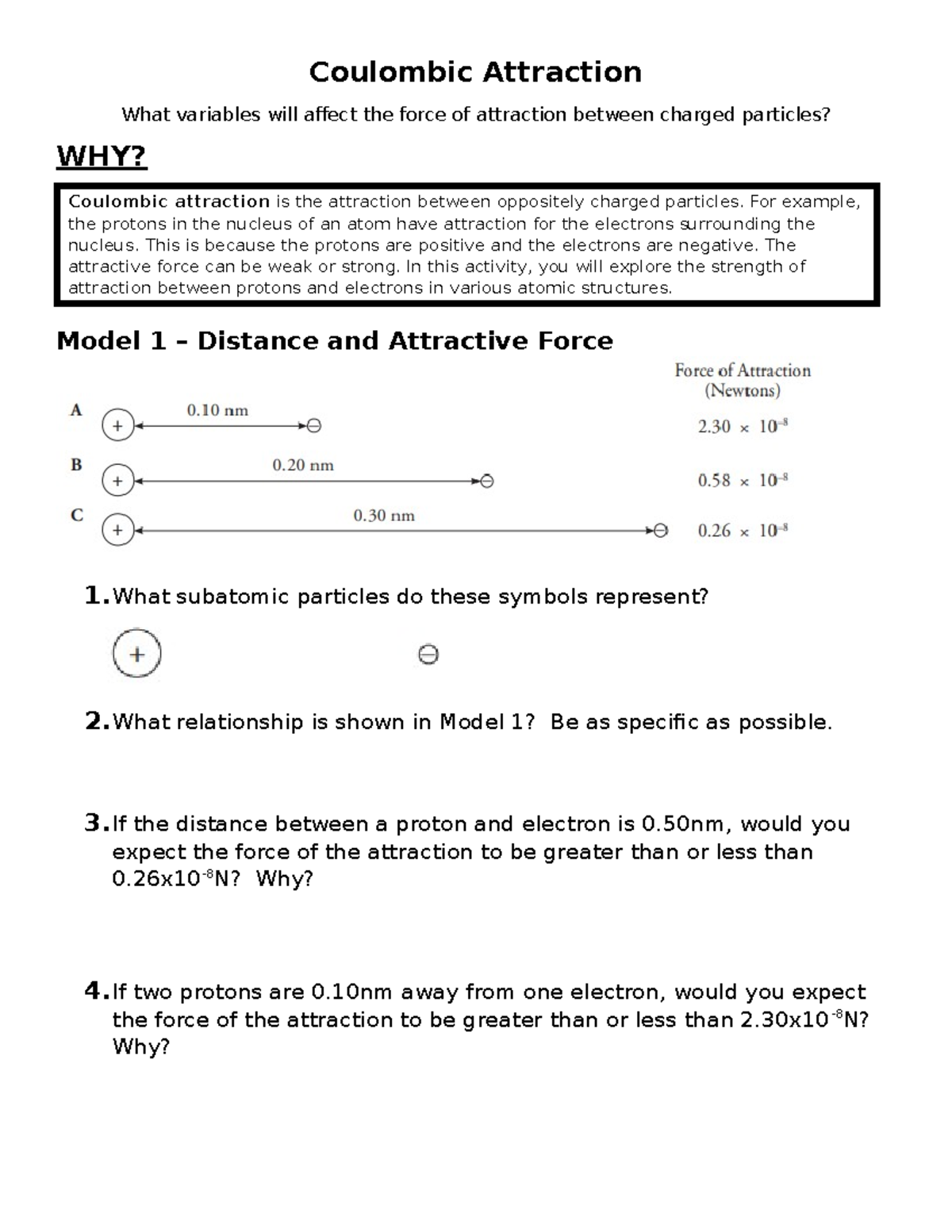
Coulombic Attraction Worksheet Answers are essential for mastering electrostatics and demonstrating a firm grasp of the forces that shape the microscopic world. By exploring the underlying concepts, working through detailed examples, and applying practical strategies, students can confidently tackle any worksheet problem that involves calculating electric forces.
Understanding Coulombic Attraction Basics
The Coulomb’s Law Formula
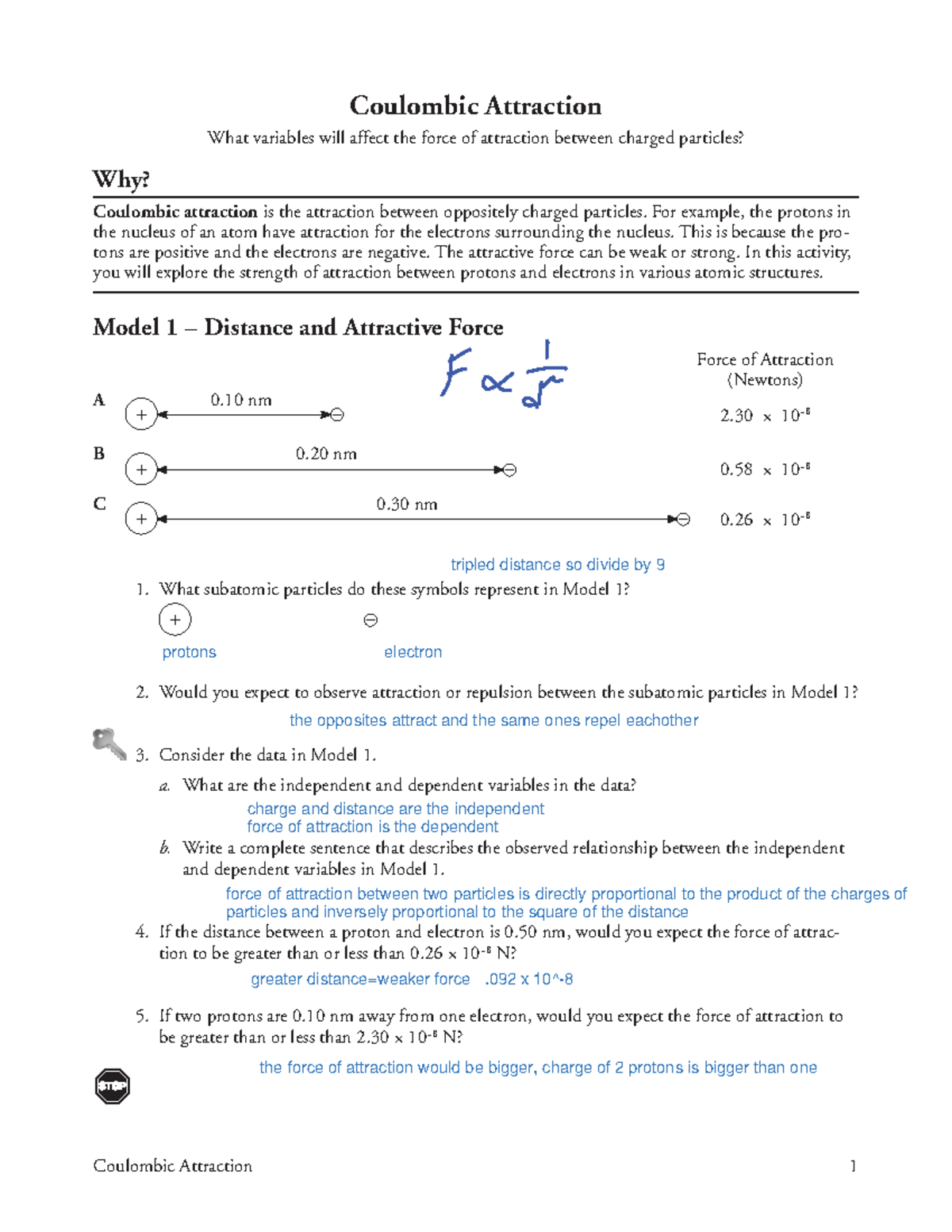
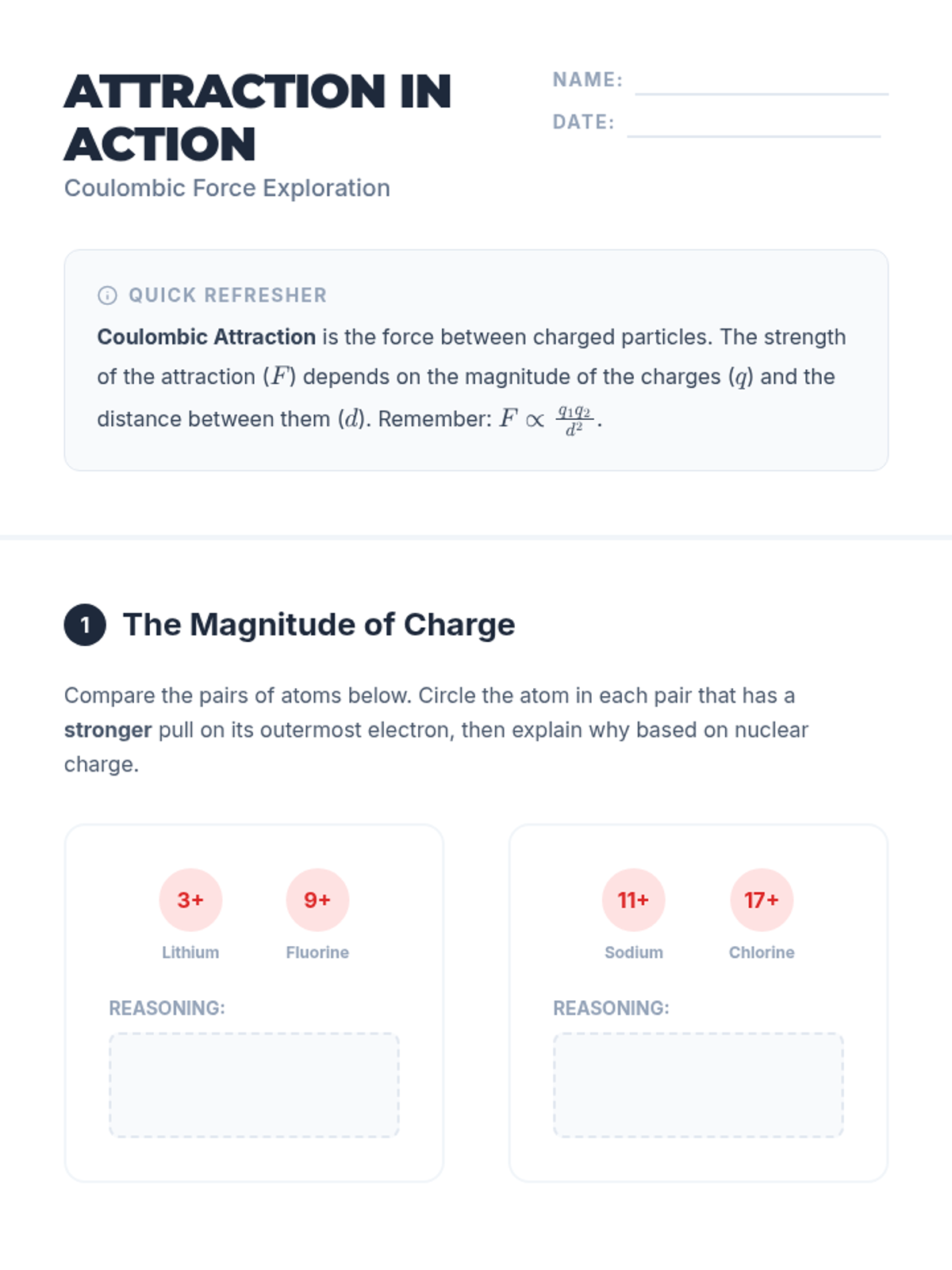
The backbone of every worksheet question is Coulomb’s Law, expressed as F = k·|q₁·q₂| / r². In this equation, F represents the magnitude of the force between two point charges, k is Coulomb’s constant (8.987 × 10⁹ N·m²/C²), q₁ and q₂ are the charges in coulombs, and r is the separation distance in meters. Remember that the law applies to point charges, but for most worksheet problems the point-charge approximation is sufficiently accurate.
Key Variables and Units
Students often struggle with unit consistency. Charges are measured in coulombs (C), distance in meters (m), and the resulting force in newtons (N). When converting from millivolts or microcoulombs, be sure to use the proper conversion factors before plugging numbers into the formula. A quick check: if you compute a force and the unit appears as N·m, you have likely missed a squared distance.
Common Mistakes in Worksheet Problems
- Sign confusion: The magnitude of the force is always positive, but the direction depends on the signs of the charges.
- Distance squared error: Forgetting to square the distance leads to forces that are too large by a factor of the distance.
- Unit misalignment: Mixing centimeters and meters or forgetting to convert microcoulombs to coulombs.
Step-by-Step Guide to Solving Worksheet Questions
Identifying the Given Information
Read the problem carefully and underline each known quantity: charge values, distance, and any additional constants provided. Note whether the problem specifies the force as attractive or repulsive; this will guide you in determining the direction of the force vector, though the magnitude remains the same.
Setting Up the Equation Correctly
Insert the known values into F = k·|q₁·q₂| / r². If the worksheet presents the force in kilonewtons (kN) or another unit, plan to convert your final answer accordingly. Remember: if the question asks for the force magnitude, drop the absolute value sign after solving.
Performing Calculations with Precision
When handling large or small numbers, use scientific notation to avoid rounding errors. For instance, if q₁ = 3 × 10⁻⁶ C and q₂ = –5 × 10⁻⁶ C, their product is –15 × 10⁻¹² C² (or –1.5 × 10⁻¹¹ C²). After dividing by r² and multiplying by k, keep track of significant figures based on the least precise measurement in the problem.
Checking Your Answer for Reasonableness
A quick sanity check: if the charges are tiny (microcoulombs) and the distance is short (centimeters), expect forces in the micro‑newton to milli‑newton range. If your answer is orders of magnitude off, revisit the unit conversions or the exponent calculations.
Example Problems with Full Answers
Example 1: Force Between Two Charges
Charges: q₁ = 4.0 × 10⁻⁶ C, q₂ = –2.0 × 10⁻⁶ C; distance: r = 0.05 m.
Solution:
- Calculate product: q₁·q₂ = –8.0 × 10⁻¹² C².
- Square distance: r² = (0.05 m)² = 2.5 × 10⁻³ m².
- Insert into Coulomb’s Law: F = (8.987 × 10⁹ N·m²/C²)·|–8.0 × 10⁻¹² C²| / 2.5 × 10⁻³ m².
- Compute numerator: 8.987 × 10⁹ · 8.0 × 10⁻¹² = 71.896 × 10⁻³ ≈ 7.19 × 10⁻² N·m².
- Divide by 2.5 × 10⁻³: 7.19 × 10⁻² / 2.5 × 10⁻³ ≈ 28.8 N.
- Result: F = 28.8 N attractive.
Example 2: Calculating Force in a Real-World Scenario
Two small balloons each carry q = 1.5 × 10⁻⁷ C and are separated by r = 0.2 m.
Solution:
- Product: q₁·q₂ = (1.5 × 10⁻⁷)² = 2.25 × 10⁻¹⁴ C².
- r² = (0.2)² = 0.04 m².
- F = (8.987 × 10⁹)·(2.25 × 10⁻¹⁴) / 0.04 ≈ (202.2075 × 10⁻⁵) / 0.04 ≈ 5.06 × 10⁻³ N.
- Result: F ≈ 5.1 × 10⁻³ N (repulsive).
Example 3: Troubleshooting Incorrect Results
Problem statement: Charges q₁ = 2 × 10⁻⁶ C, q₂ = 3 × 10⁻⁶ C, distance r = 0.10 m.
Student’s calculation: F = 1.08 N (incorrect).
Root Cause: The student omitted the absolute value, leading to a negative sign that was dropped incorrectly.
Corrected Steps:
- Product: 6 × 10⁻¹².
- r² = 0.01.
- F = (8.987 × 10⁹)·(6 × 10⁻¹²) / 0.01 = (53.922 × 10⁻³) / 0.01 = 5.392 N.
- Result: F = 5.39 N.
Tips for Mastering Coulombic Attraction Worksheets
Visualizing Charge Interactions
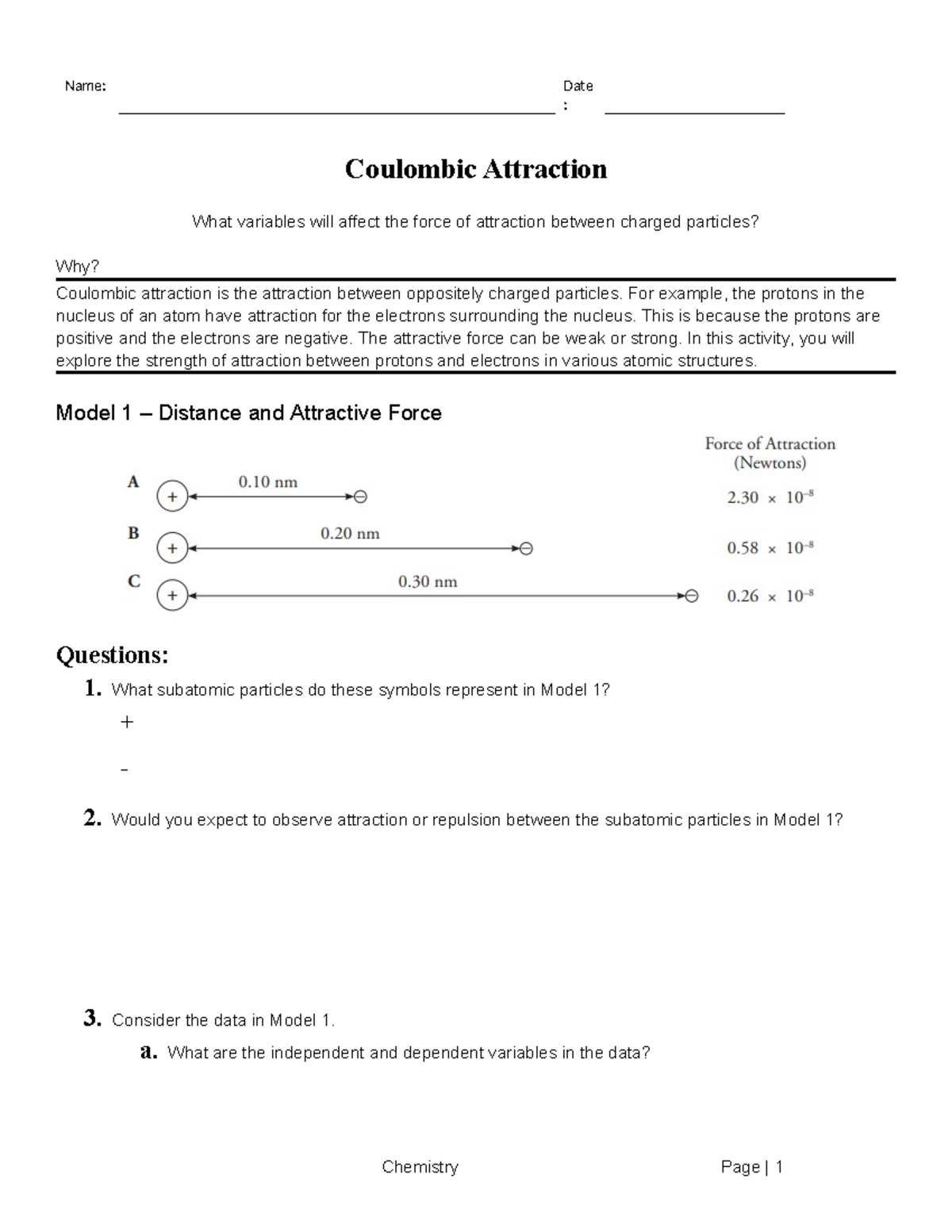
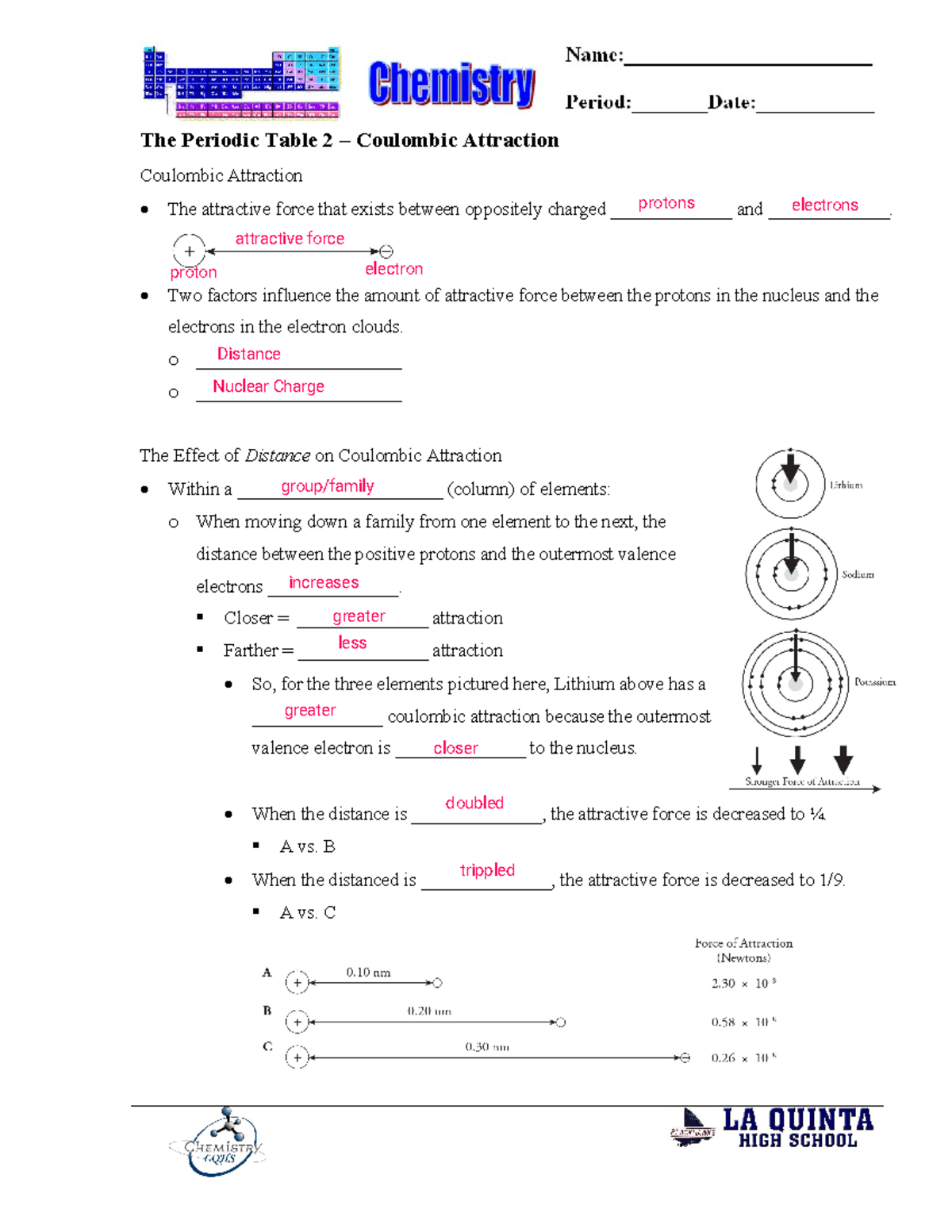
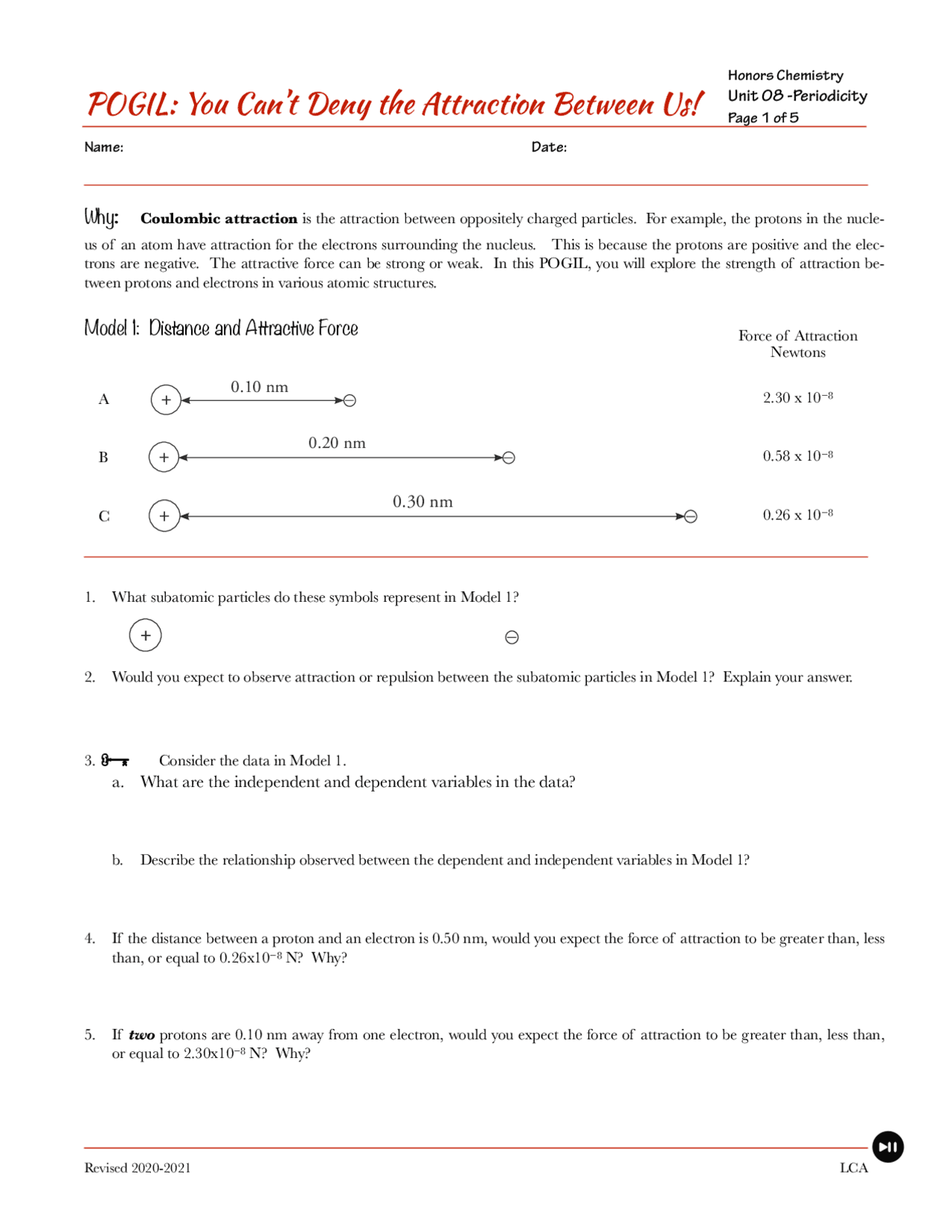
Use diagrams to map charge signs and distances before plugging numbers into the formula. Drawing a simple line with arrows indicating direction helps solidify the concept of attraction versus repulsion.
Practice with Manipulatives or Simulations
Virtual tools like interactive Coulomb simulations let you adjust charge values and see real-time force vectors. Manipulating these variables reinforces how changes affect force magnitude.
Review Common Answer Formats
Many worksheets require answers in scientific notation or with specific significant figures. Familiarize yourself with the formatting guidelines provided by the instructor to avoid partial credit deductions.
Using Unit Conversion Effectively
When distances are given in centimeters, convert to meters first: 1 cm = 0.01 m. Similarly, microcoulombs to coulombs: 1 µC = 1 × 10⁻⁶ C. These simple conversions prevent calculation errors.
Frequently Asked Questions
What if the charges are of opposite signs?
The force is attractive. In the formula, the product q₁·q₂ will be negative, but the absolute value ensures the magnitude remains positive. Remember to indicate direction if the worksheet asks for a vector result.
How do I handle distances in centimeters vs meters?
Always convert centimeters to meters before squaring the distance. For example, a 15 cm gap becomes 0.15 m; squaring yields 0.0225 m² instead of 225 cm².
Why do some worksheets use different constants?
Some worksheets may adopt a simplified constant like k = 9 × 10⁹ N·m²/C² for easier mental math. When using such values, note that the result will differ slightly from the more precise constant, but the difference is usually acceptable for classroom exercises.
Final Thoughts and Takeaways
Mastering Coulombic Attraction Worksheet Answers hinges on a solid grasp of Coulomb’s Law, meticulous unit management, and thoughtful problem‑solving strategies. By systematically identifying given data, correctly setting up equations, and validating results, you transform seemingly daunting worksheet questions into clear, manageable steps. Regular practice, visual aids, and attention to formatting conventions will sharpen your skills and build confidence. Armed with these tools, you’ll navigate any electrostatic worksheet with precision and ease, turning abstract concepts into tangible, quantifiable results.










Related posts of "Coulombic Attraction Worksheet Answers"
