Comparing 3 Digit Numbers Worksheets are a cornerstone of early numeracy instruction, helping students develop a deep understanding of place value, order of magnitude, and number sense. By practicing the art of comparing numbers from 100 to 999, learners gain confidence that will carry them through more complex mathematical challenges.
Why Comparing 3 Digit Numbers Matters
At first glance, comparing two three-digit numbers may appear simple, but it actually touches on several critical skills. When students learn to read the hundreds, tens, and units places, they build a visual map of numerical value. This skill is essential for later topics like addition, subtraction, and even algebraic thinking. Moreover, mastering comparison equips students to make quick mental judgments—an everyday ability useful in budgeting, estimating distances, and analyzing data.
Developing Place Value Awareness
Each digit in a 3‑digit number represents a different power of ten. A comparison worksheet that highlights the hundreds place forces students to ask, “Which has more hundreds?” before considering tens or units. This stepwise approach reinforces the hierarchical nature of numbers.
Encouraging Logical Reasoning
Comparison tasks require students to evaluate multiple conditions: first the highest place value, then the next, and so on. By walking through these logical steps, learners practice systematic thinking, a skill that extends far beyond mathematics.
Structure of an Effective Worksheet
Good comparison worksheets are clear, varied, and scaffolded. Below is a practical checklist that teachers and parents can use to design or select worksheets that meet these criteria.
Clear Instructions and Examples
- Begin with a concise explanation of how to compare numbers.
- Include a worked example that demonstrates the step‑by‑step process.
- Use consistent symbols (e.g., “>” for greater than, “<” for less than).
Progressive Difficulty
- Start with simple comparisons where one number is clearly larger.
- Introduce mixed‑place comparisons such as 456 vs. 467 or 321 vs. 214.
- End with problems that require careful evaluation of all three place values.
Diverse Question Types
- Multiple choice to reinforce quick decisions.
- Fill‑in blanks for practicing written responses.
- Graphical representations that show numbers on a number line.
Real‑World Contexts
Contextualize problems to keep engagement high: “A school bus holds 345 passengers, while the next bus can carry 368. Which bus can hold more?” Such scenarios help students see the relevance of number comparison outside the classroom.
Step‑by‑Step Approach to Solving Comparison Problems
Below is a systematic method that can be taught and repeated until mastery. By teaching students this routine, you create a reliable framework that reduces errors.
1. Identify the Hundreds Place
Compare the leftmost digit of each number. If one is greater, that number is larger; if equal, proceed to the next step.
2. Evaluate the Tens Place
When hundreds are identical, compare the middle digit. Again, a higher digit wins, but equality leads to the final step.
3. Examine the Units Place
The rightmost digit determines the winner if the first two places are equal.
4. Write the Correct Symbol
Use “>” or “<” to indicate which number is bigger, ensuring students also check for “=” when numbers are identical.
Common Pitfalls and How to Avoid Them
Even adept students can fall into traps if the worksheet design or instruction is weak. Identifying these common errors can improve overall accuracy.
Misreading Place Values
Students often overlook that the first digit is the hundreds place. Using colored markers or bold fonts can help emphasize the order.
Overreliance on Size Perception
Some learners try to guess the larger number based on visual weight. Encourage them to follow the stepwise method instead of intuition.
Skipping the Units Place
When hundreds and tens match, some skip the final comparison. Reinforce the necessity of checking every place value.
Strategies for Teachers: Making Worksheets Interactive
Passive filling of answers is not the best way to build deep number sense. Here are several classroom strategies to transform static worksheets into engaging learning experiences.
Peer Review Sessions
After completing a worksheet, have students exchange papers and double‑check each other’s work using the same method. This encourages collaborative learning and immediate feedback.
Digital Drag‑and‑Drop Tools
Incorporate online platforms where students can drag numbers onto a comparison bar or a number line, reinforcing spatial reasoning.
Timed Challenges
Introduce a short timed quiz to help students build speed. Provide instant scoring to celebrate quick, accurate comparisons.
Real‑Time Feedback with Flashcards
Use flashcards with three‑digit numbers on one side and a comparison symbol on the other. Students can match quickly and receive instant feedback.
Tips for Parents: Supporting Learning at Home
Parents can play a vital role in reinforcing number comparison skills outside of school hours.
Daily Comparison Games
Use kitchen measuring cups or toy cars to compare lengths. Ask “Which set has more?” to practice place value thinking.
Integrate with Everyday Activities
When shopping, compare prices of different items. Use the comparison symbols to write a short note: “Item A costs $128, Item B costs $149. Which is more?”
Use Printable Worksheets Wisely
Print a few worksheets and set a regular practice time, such as a 10‑minute session before dinner. Keep the environment low‑pressure and reward correct answers with stickers or a fun badge.
Sample Worksheet Design: A Practical Blueprint
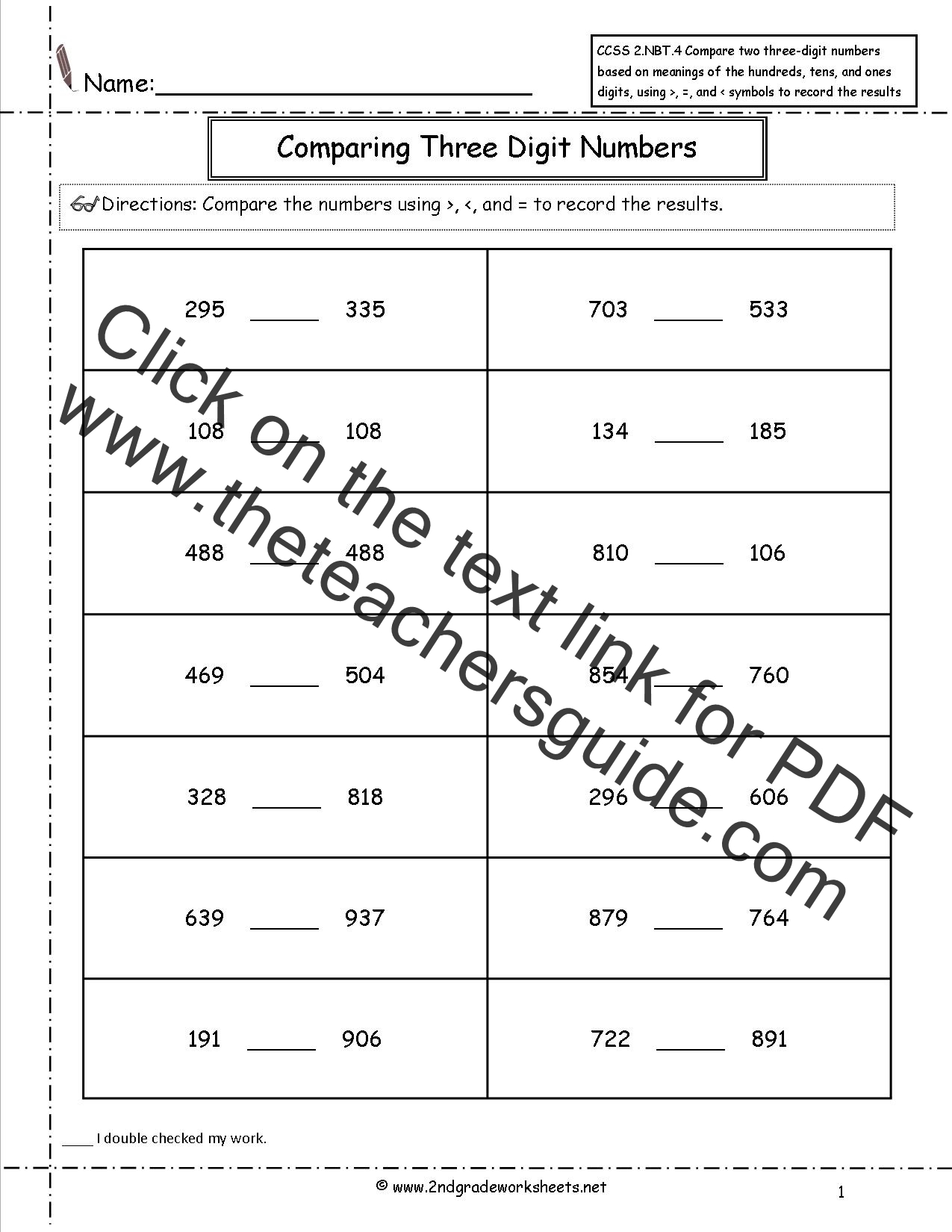
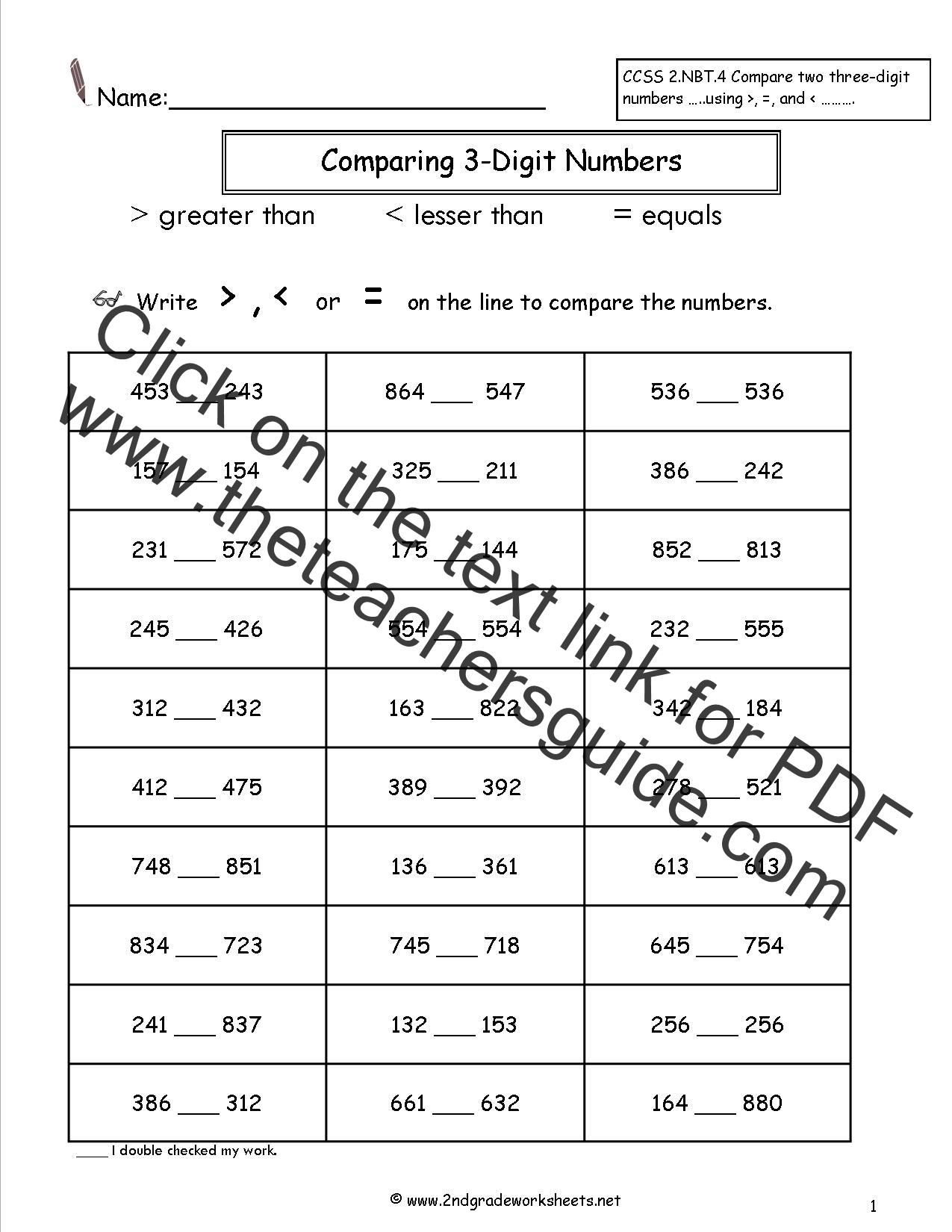
Below is a detailed outline for a 20‑question worksheet that balances variety and rigor. You can adapt this template for print or digital use.
Section 1: Simple Comparisons (1–5)
- 346 ? 359
- 210 ? 201
- 555 ? 559
- 999 ? 100
- 400 ? 400
Section 2: Mixed Place Values (6–12)
- 482 ? 470
- 319 ? 321
- 876 ? 878
- 207 ? 237
- 654 ? 645
- 123 ? 132
- 578 ? 567
Section 3: Contextual Questions (13–20)
- A fruit basket holds 312 apples; another holds 321. Which basket has more apples?
- There are 245 students in a classroom and 248 in the next. Which class is larger?
- The distance from town A to B is 478 km, from B to C is 470 km. Which route is longer?
- A library has 879 books; the school office has 892. Which has more books?
- A 3‑year‑old can lift 134 grams; a 5‑year‑old can lift 138 grams. Who can lift more?
- One box weighs 435 g, another weighs 453 g. Which is heavier?
- The price of a toy is $567, while a game costs $576. Which is cheaper?
SEO Tips for Blog Post Visibility
While this article is aimed at educators and parents, optimizing it for search engines ensures it reaches those in need.
Use Targeted Keywords Naturally
Incorporate phrases like “3‑digit number comparison practice,” “early math worksheets,” and “place value games” throughout, but avoid keyword stuffing.
Add Meta Tags (in the head section of the full HTML page)
Include a descriptive title, meta description, and alt text for images to improve search ranking.
Build Internal Links
Link to related posts such as “Teaching Place Value with Visual Aids” or “Math Games for Grade 2” to keep readers on the site.
Encourage Social Sharing
Provide share buttons for Facebook, Twitter, and Pinterest, so educators can spread the worksheets among their peers.
Conclusion
Mastering Comparing 3 Digit Numbers Worksheets is more than an academic exercise; it equips young learners with logical thinking, confidence in number sense, and a solid foundation for future math challenges. By selecting or designing worksheets that follow a clear, scaffolded structure, teachers and parents can create engaging, effective practice sessions. Remember to emphasize place value, encourage stepwise reasoning, and use real‑world contexts to keep the learning relevant. With consistent practice, students will not only solve comparison problems accurately but also develop a lifelong appreciation for mathematics.







Related posts of "Comparing 3 Digit Numbers Worksheets"
