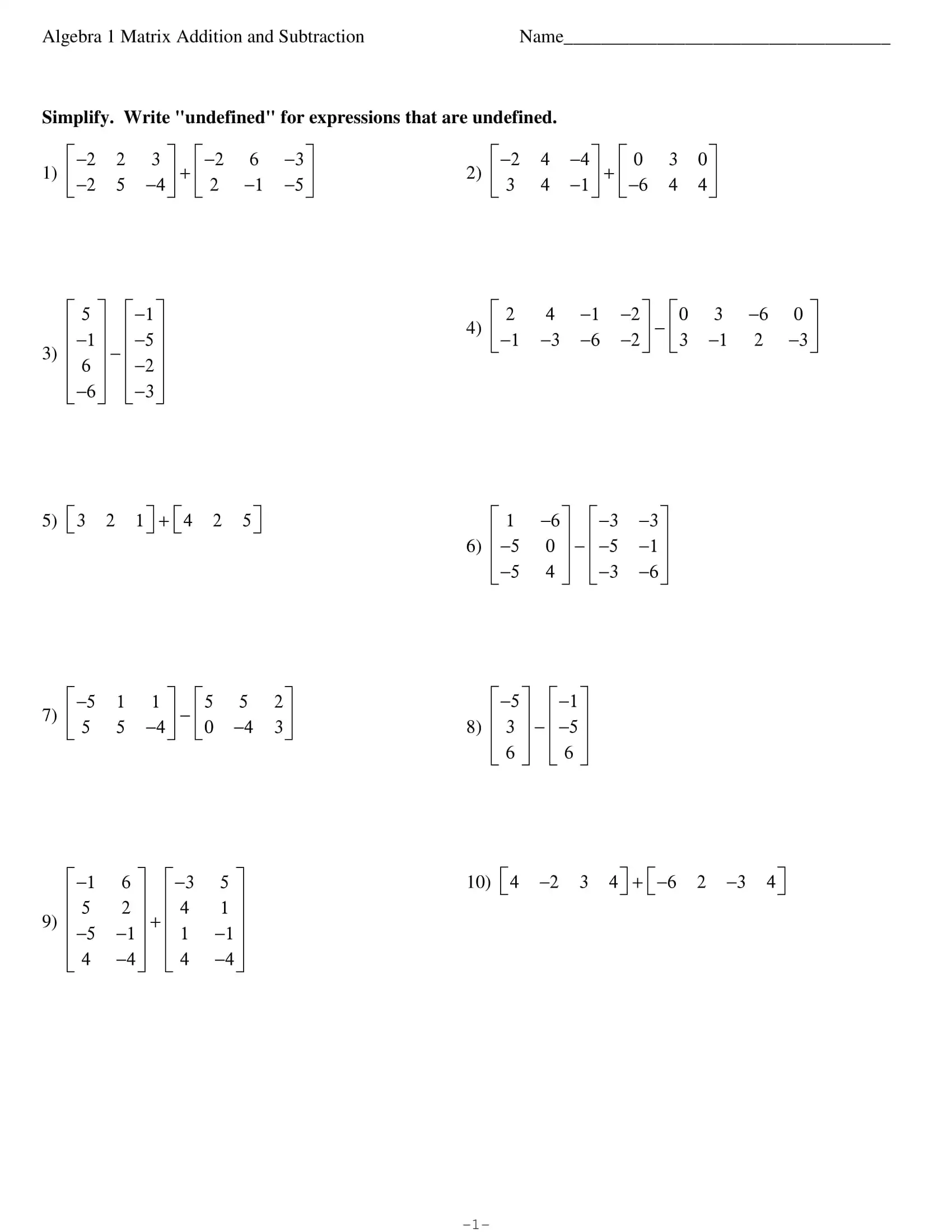
Adding And Subtracting Matrices Worksheet offers students a hands‑on way to cement the fundamental operations that power everything from computer graphics to economics, and the best part is that a well‑designed worksheet turns abstract symbols into an interactive puzzle they can solve step by step. Whether you’re a middle‑school teacher looking to boost confidence, a high‑school instructor preparing for linear‑algebra prerequisites, or a parent searching for extra practice, this guide walks you through the why, the what, and the how of creating, using, and mastering matrix addition and subtraction worksheets.
Why Mastering Matrix Addition and Subtraction Matters
Matrix operations are the building blocks of linear transformations, system‑of‑equations solving, and data‑science algorithms. By practicing addition and subtraction early, students develop a mental toolkit that makes more advanced topics—like determinants, eigenvalues, and vector spaces—feel less intimidating. Moreover, the act of aligning rows and columns reinforces spatial reasoning and attention to detail, two skills that cross‑discipline boundaries from geometry to coding.
Core Concepts Behind Adding and Subtracting Matrices
Same Dimensions, Same Rules
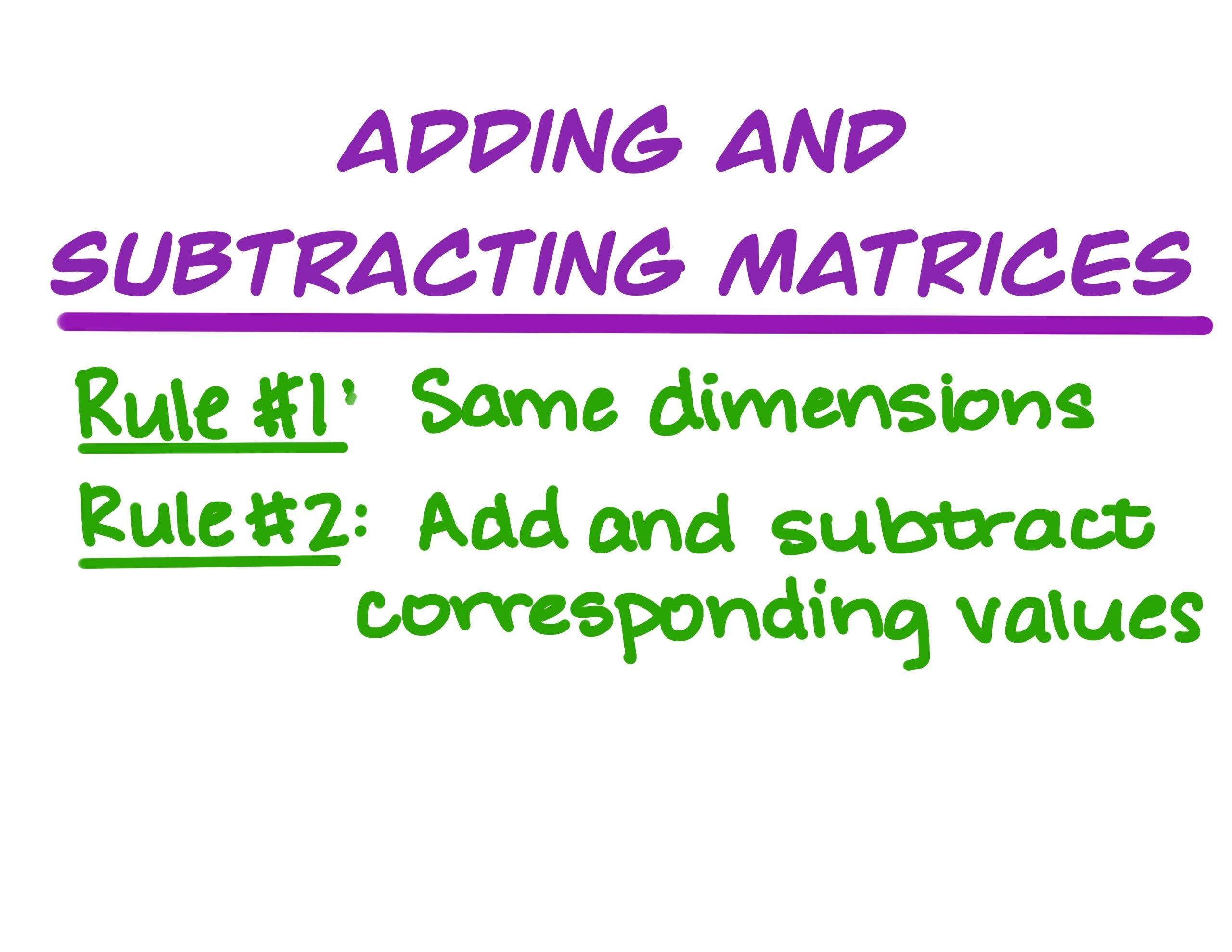
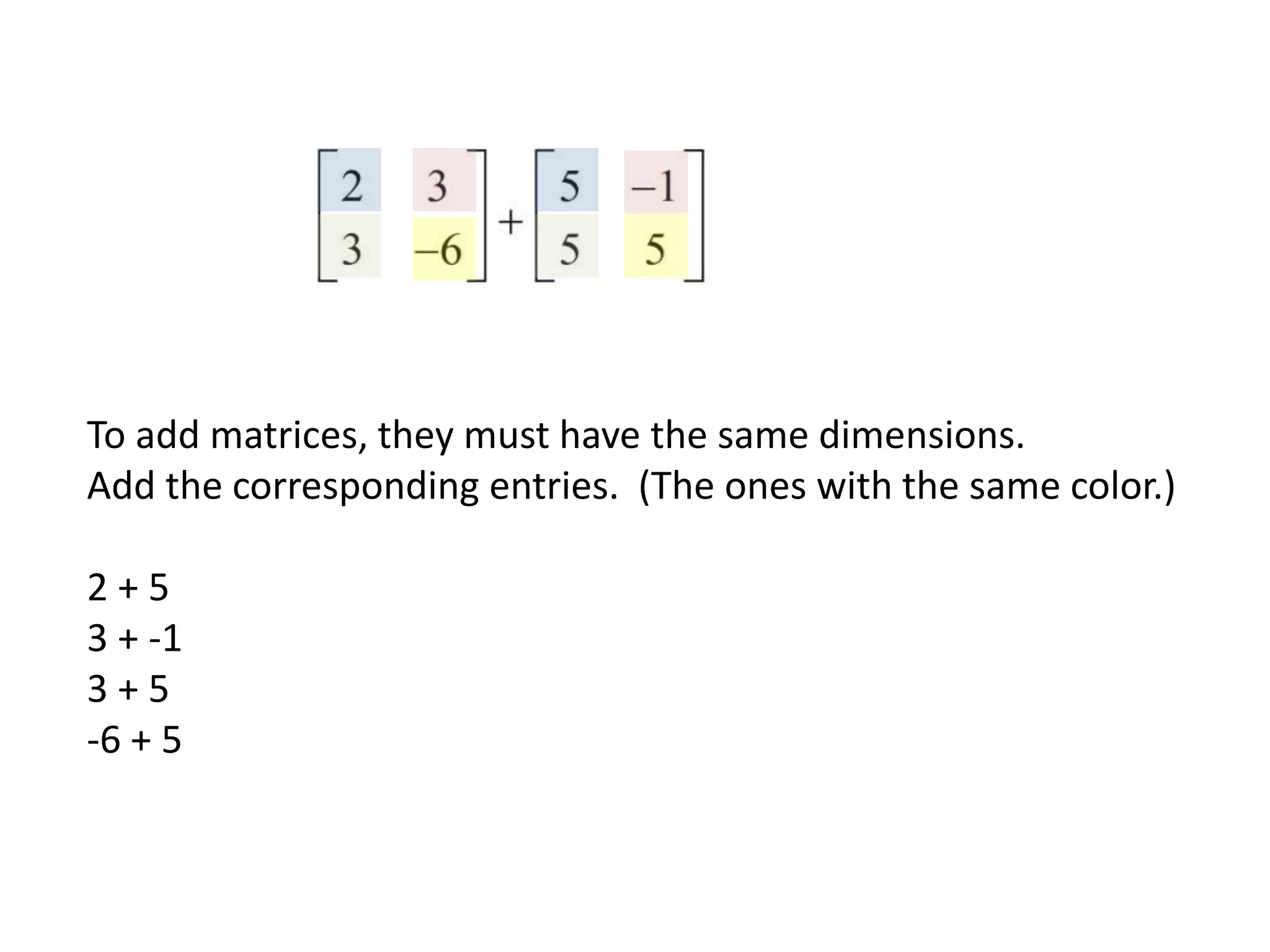
The most crucial rule is that only matrices of identical dimensions can be added or subtracted. A 3×2 matrix can combine only with another 3×2 matrix; attempting to add a 3×2 to a 2×3 results in an undefined operation. This restriction mirrors real‑world constraints, such as matching data tables before performing element‑wise calculations.
Element‑wise Computation
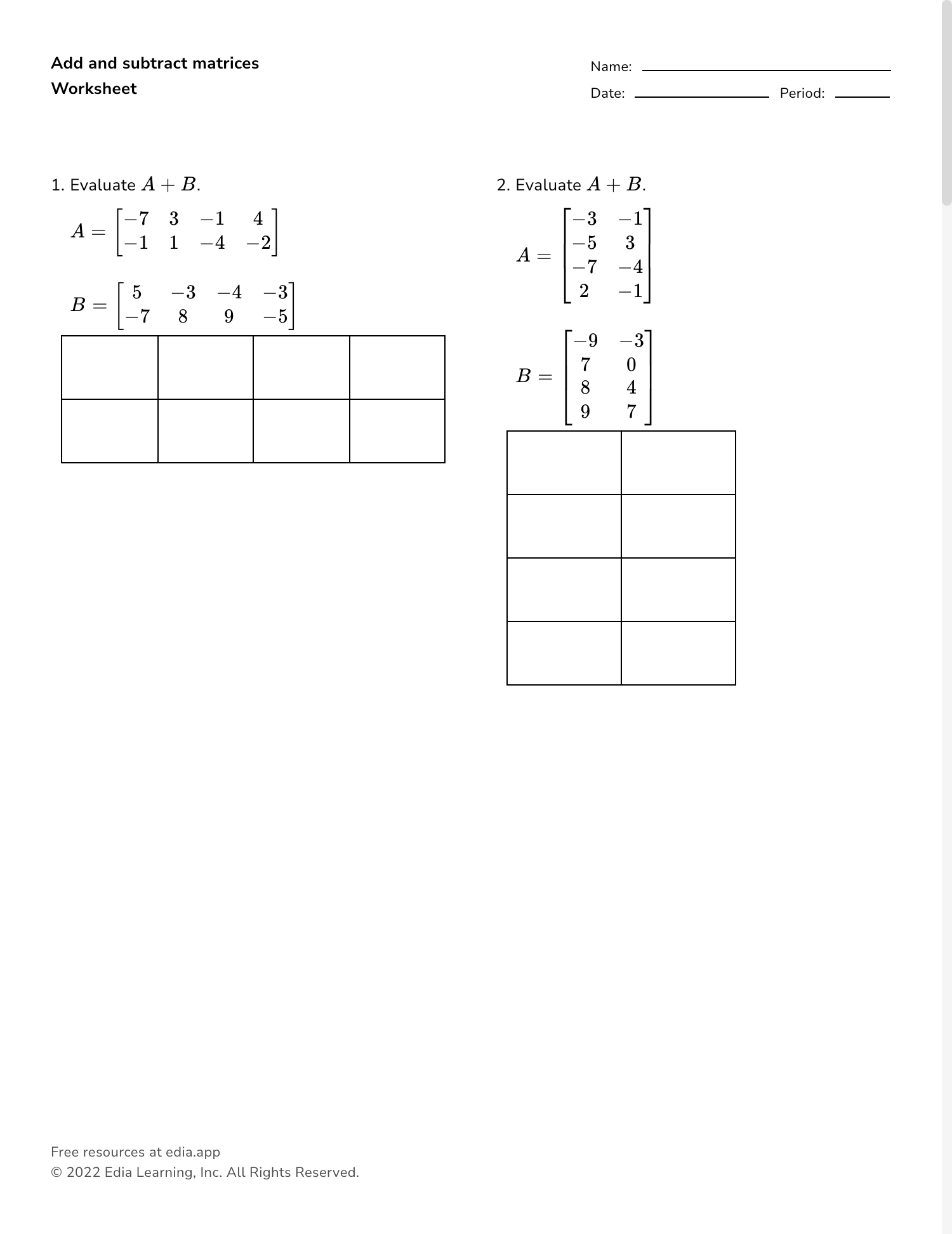
Once dimensions match, addition and subtraction become straightforward: add or subtract each corresponding entry. For matrices A = [aij] and B = [bij], the sum C = A + B has entries cij = aij + bij. The same pattern holds for subtraction, with cij = aij – bij. This element‑wise view is perfect for worksheet problems that ask students to fill in the missing entries.
Zero Matrix and Additive Inverses
Introducing the zero matrix (all entries are 0) helps learners understand the identity element for addition. Similarly, the additive inverse of a matrix A is –A, a matrix whose entries are the negatives of A. Worksheets that pair a matrix with its inverse reinforce the concept that A + (–A) = 0.
Designing an Effective Adding And Subtracting Matrices Worksheet
Choosing the Right Difficulty Level
Start with 2×2 matrices for beginners, then gradually introduce larger sizes (3×3, 4×4) as confidence builds. Include a mix of:
- Pure computation problems (e.g., add two given matrices).
- Fill‑in‑the‑blank challenges (e.g., determine the missing entry).
- Word‑problem contexts (e.g., combining inventory tables).
Balancing straightforward calculations with contextual questions keeps the worksheet engaging and demonstrates real‑world relevance.
Visual Layout Tips
Clear grid lines, consistent spacing, and bold headings reduce cognitive load. Use shading or color blocks to separate the original matrices from the answer area. When printing, leave ample space for students to write intermediate steps, encouraging a process‑oriented mindset rather than a “guess‑and‑check” approach.
Integrating Answer Keys and Self‑Check Sections
Provide a separate answer key that mirrors the worksheet format, allowing students to self‑grade without revealing the steps. Additionally, embed short “check‑your‑work” prompts after every few problems, such as “Verify that each row sum matches the expected total.” This reinforces error‑spotting skills.
Step‑by‑Step Strategies for Solving Worksheet Problems
Read, Highlight, and Align
Begin by reading the entire problem. Highlight the dimensions of each matrix and write them underneath the matrices if they aren’t already labeled. Align the matrices side by side, ensuring each row and column matches its counterpart.
Perform the Operation Row by Row
Work systematically:
- Take the first row of the first matrix and add/subtract the first row of the second matrix.
- Write the resulting row in the answer grid.
- Repeat for each subsequent row.
Using a ruler or a straight edge can help keep rows straight, especially on larger worksheets.
Check with the Zero Matrix
After completing the addition or subtraction, add the zero matrix of the same size to the result. If the entries remain unchanged, the work is likely correct—a quick mental verification technique that students can adopt.
Spot Common Mistakes
Typical errors include:
- Mixing up row and column indices (e.g., adding a12 to b21).
- Forgetting to change the sign when subtracting a negative number.
- Leaving a blank entry blank or copying a digit incorrectly.
Encourage students to review each row and column after finishing, looking specifically for these pitfalls.
Real‑World Applications That Bring Worksheets to Life
Budget Tracking
Imagine two monthly expense tables for a small business: one for fixed costs and another for variable costs. Adding the matrices yields the total monthly outlay, while subtracting the variable-cost matrix from the total reveals the fixed costs. A worksheet that mirrors this scenario shows how matrix math directly supports financial literacy.
Image Processing
In digital photography, each pixel can be represented as a matrix of color intensities. Adding a “brightness adjustment” matrix to an image matrix brightens the picture, whereas subtracting a “noise” matrix can help clean up an image. Including a simplified version of this in a worksheet helps students visualize the power of element‑wise operations.
Game Development
Video‑game designers use matrices to handle transformations like moving a character on a grid. Adding a “translation” matrix to the character’s position matrix updates its location instantly. A worksheet that asks students to calculate the new position after a series of moves ties math to the excitement of gaming.
Tips for Teachers to Maximize Worksheet Impact
Start With a Mini‑Lesson
Before handing out the worksheet, spend five minutes reviewing the core rule (same dimensions) and demonstrating one example on the board. Use a projector or interactive whiteboard to show the alignment process in real time.
Incorporate Collaborative Checks
Pair students and let them compare answers after completing a section. Peer discussion often uncovers misconceptions faster than teacher grading alone. Encourage them to explain why a particular entry is correct, reinforcing verbal reasoning.
Use Exit Tickets
At the end of the class, give a quick “exit ticket” with one addition or subtraction problem. Collecting these provides immediate feedback on whether the worksheet concepts have been mastered.
Differentiate with Extension Tasks
For advanced learners, add a column that asks them to compute the determinant of the resulting matrix, or challenge them to convert the matrix addition problem into a system of linear equations and solve it.
Student Strategies for Independent Practice
Create a Personal Cheat Sheet
Write down the step‑by‑step process on a small index card: “1️⃣ Check dimensions, 2️⃣ Align rows, 3️⃣ Add/subtract each entry, 4️⃣ Verify with zero matrix.” Having a visual reminder speeds up future practice.
Use Color Coding
When working on paper, color each corresponding row pair with the same highlighter. This reduces the chance of mixing rows and helps keep the work organized.
Practice Mental Arithmetic
Since matrix addition and subtraction are essentially many small addition/subtraction problems, sharpening mental math improves speed and accuracy. Quick drills with two‑digit numbers before tackling a worksheet can boost confidence.
Self‑Quiz with Flashcards
Write a matrix on one side of a flashcard and ask, “What is the result when you add the matrix B?” Flip the card to see the answer. Repeating this with varied sizes reinforces pattern recognition.
Common Pitfalls and How to Overcome Them
Dimension Mismatch Anxiety
Students sometimes stare at a problem, unsure if the matrices match. Teach them to write the size in parentheses right after each matrix (e.g., A(2×3)). This habit instantly clarifies whether the operation is valid.
Sign Errors in Subtraction
When subtracting a negative entry, the sign flips to positive. A handy mnemonic: “Minus a minus becomes a plus.” Encourage students to rewrite the subtraction as addition of the additive inverse before calculating.
Copy‑Paste Mistakes
Transcribing numbers incorrectly is a frequent source of errors. Suggest that students double‑check each entry by reading it aloud while writing the answer.
Skipping Verification
Rushing to the next problem without a quick sanity check often leads to cascading mistakes. A 30‑second pause to recompute one row or column can catch errors early.
Digital Resources and Printable Options
While the focus here is on printable worksheets, many educators complement paper practice with interactive platforms that allow instant feedback. Look for tools that let students drag and drop matrix entries, automatically enforce dimension rules, and generate custom problem sets based on class performance.
When printing, choose high‑quality paper and a printer setting that preserves grid lines. For younger learners, a slightly larger cell size (about 1 inch square) makes writing numbers more comfortable.
Assessing Mastery After Worksheet Completion
Rubric‑Based Scoring
Develop a simple rubric that awards points for:
- Correct dimension identification (10 %).
- Accurate entry‑by‑entry computation (70 %).
- Proper verification steps (10 %).
- Neatness and organization (10 %).
This balanced approach rewards both accuracy and process.
Follow‑Up Problems
After grading, give a short set of mixed problems that include both addition and subtraction, as well as a few “trick” questions where one matrix has a different size. Analyzing how students handle these reveals whether they truly understand the underlying rule.
Reflective Journals
Ask students to write a brief reflection: “What part of adding matrices was easy? What confused me?” This metacognitive step reinforces learning and provides teachers with insight for future instruction.
Conclusion
Mastering the Adding And Subtracting Matrices Worksheet is more than an academic checkpoint; it builds a foundation for higher‑level mathematics, problem‑solving in science and engineering, and practical everyday tasks like budgeting and image editing. By designing worksheets that blend clear structure, real‑world context, and opportunities for self‑verification, educators can transform a routine algebraic skill into an engaging, confidence‑boosting experience. Students who internalize the step‑by‑step process, practice regularly, and reflect on their work will find matrix operations intuitive and ready to apply in any discipline that values logical, organized thinking. With the strategies, examples, and tips outlined above, you now have a comprehensive toolkit to create, teach, and master adding and subtracting matrices—ensuring every learner can navigate the matrix world with ease and enthusiasm.







Related posts of "Adding And Subtracting Matrices Worksheet"
