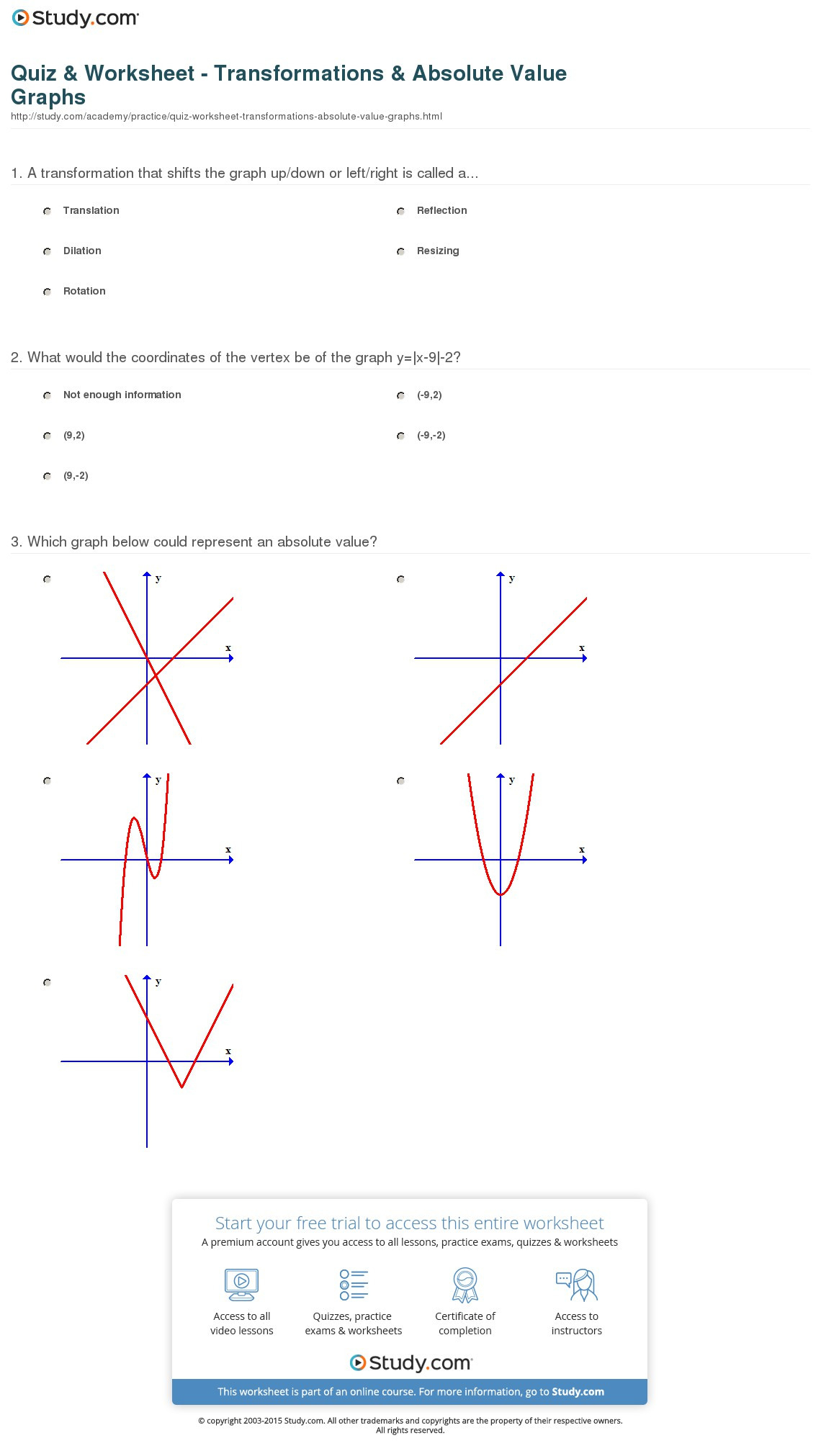
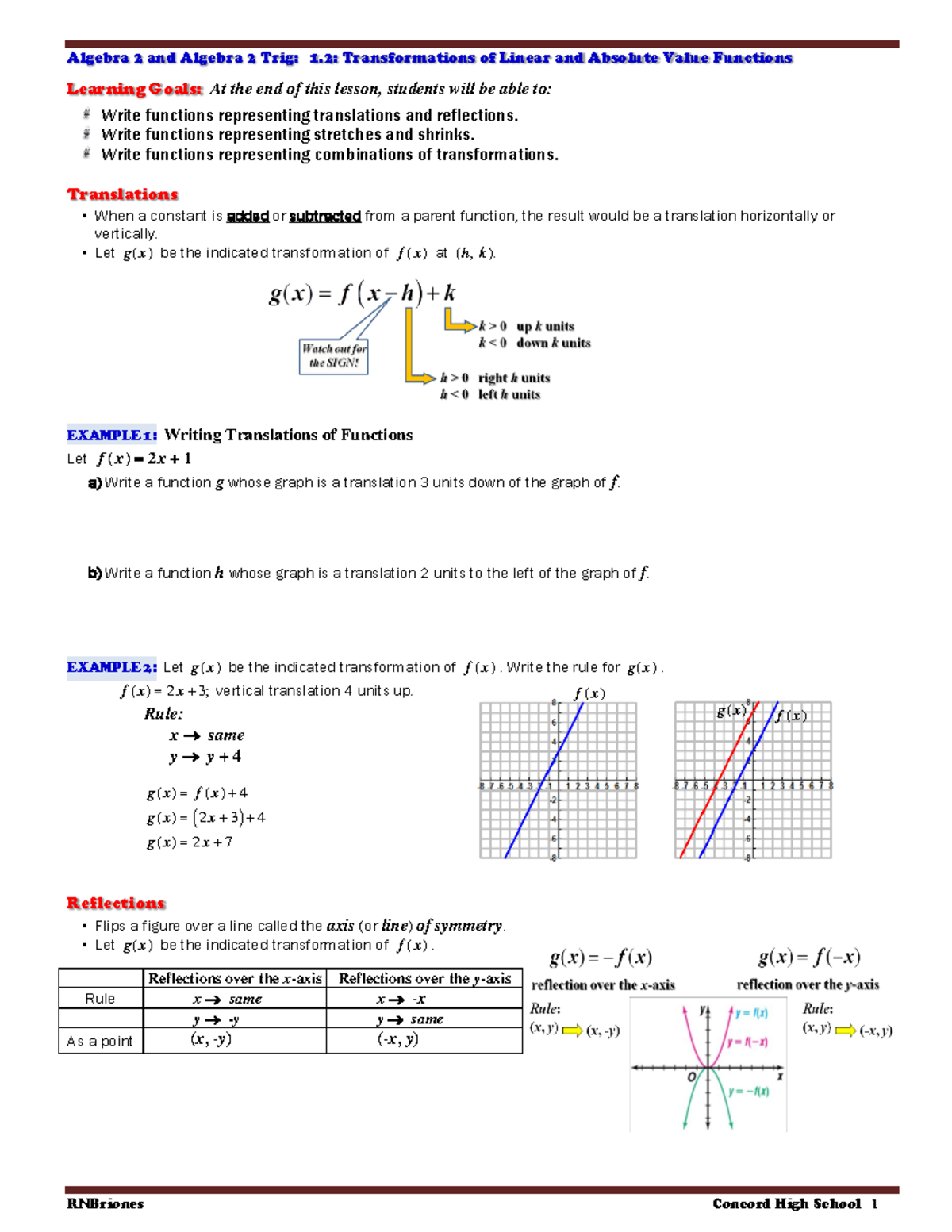
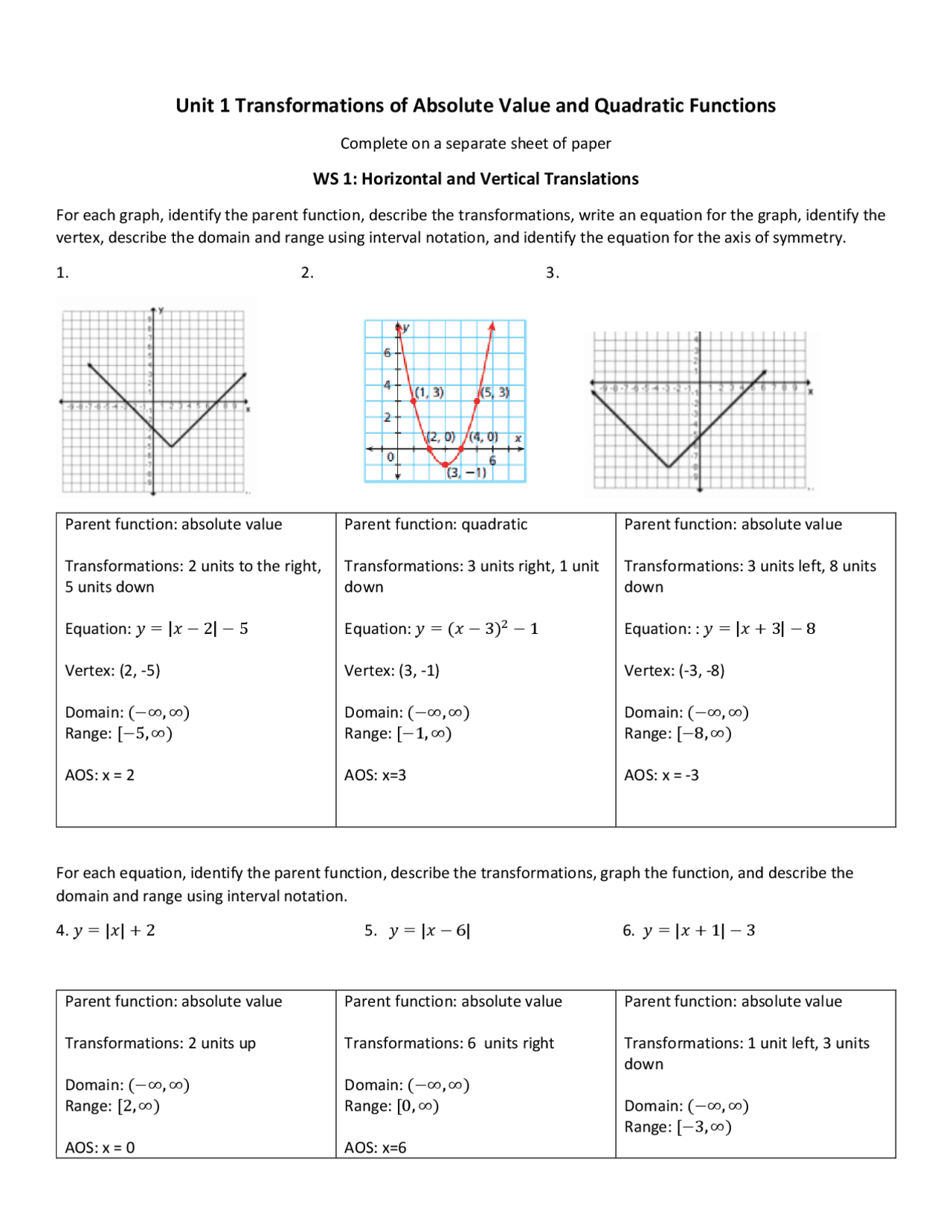
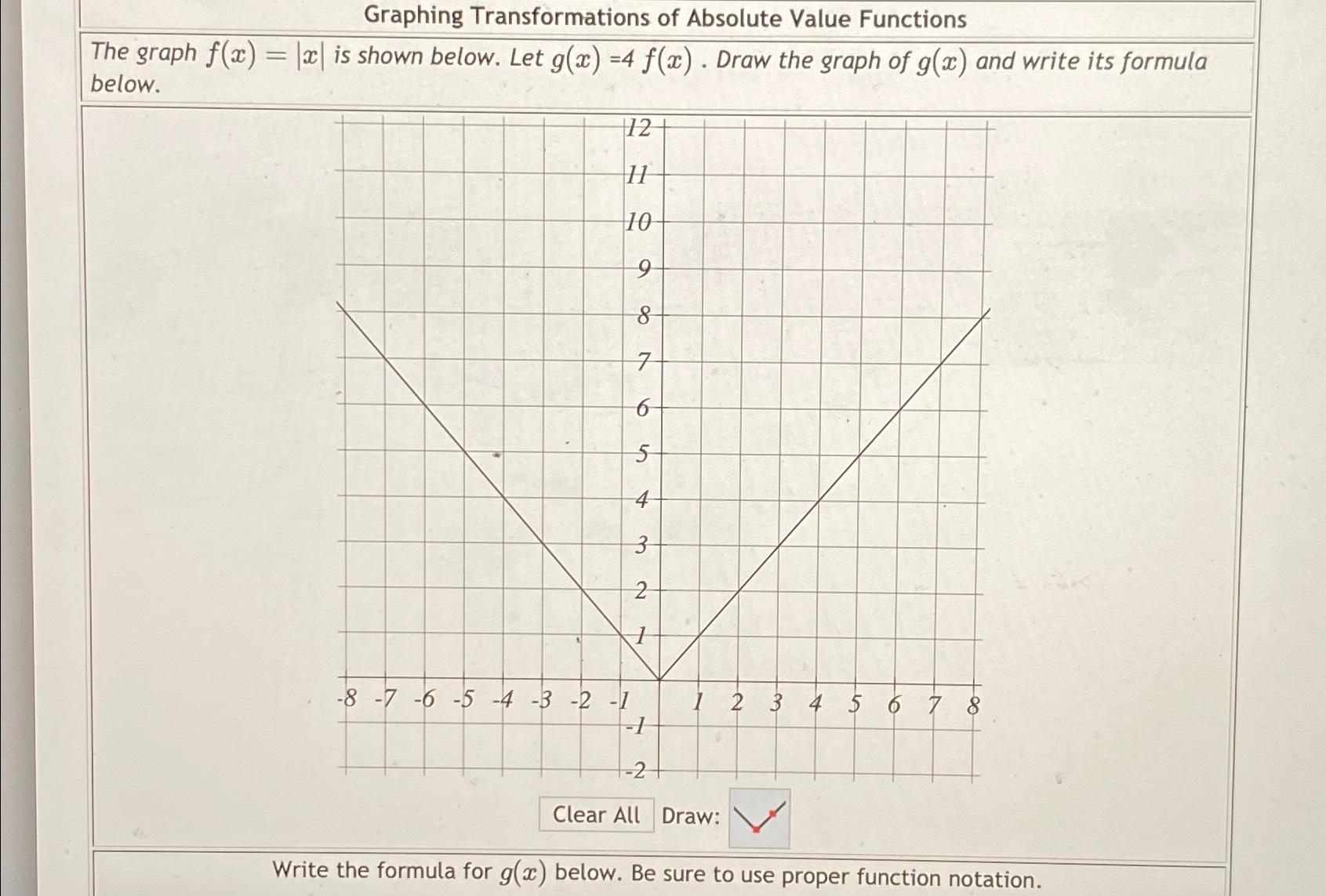
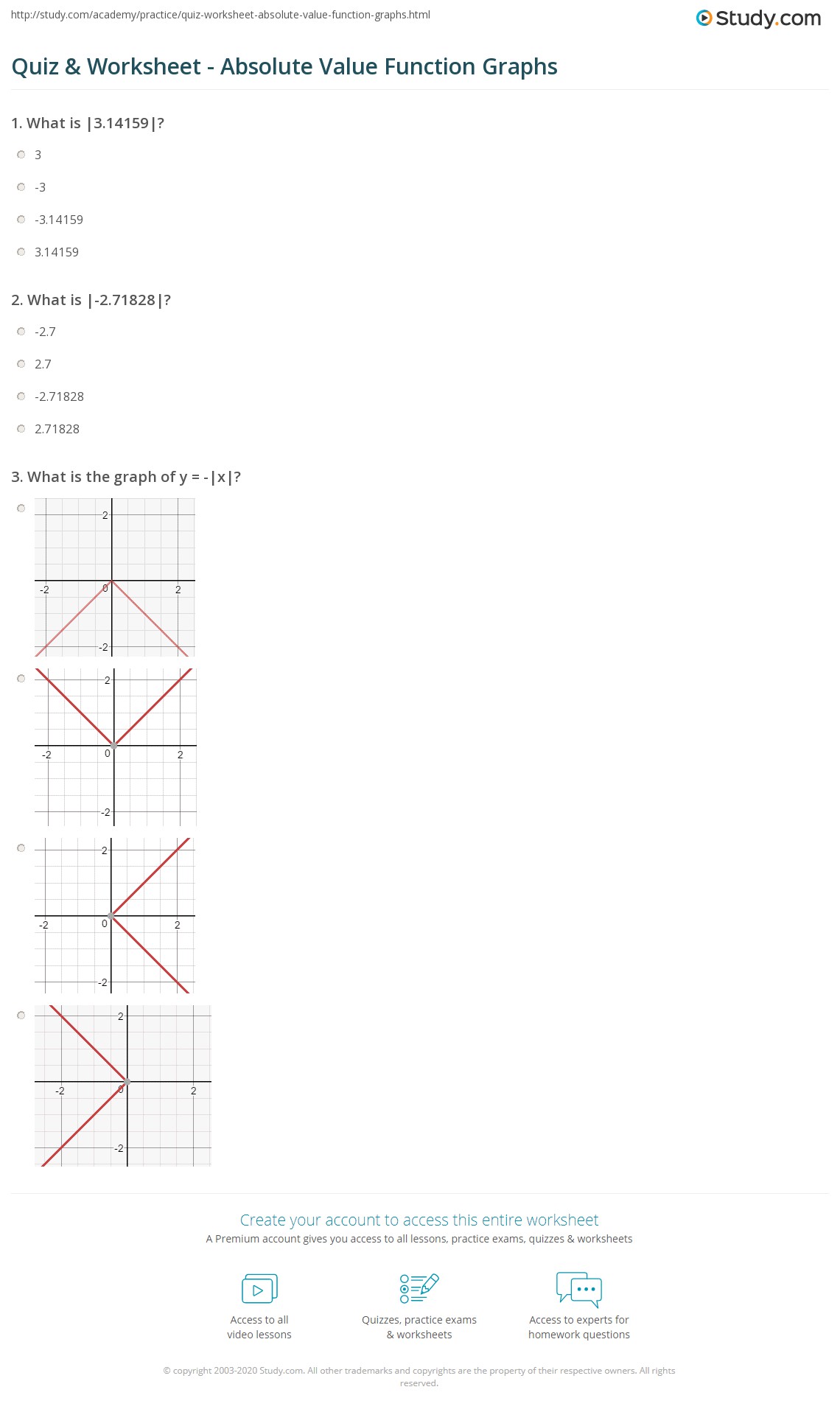
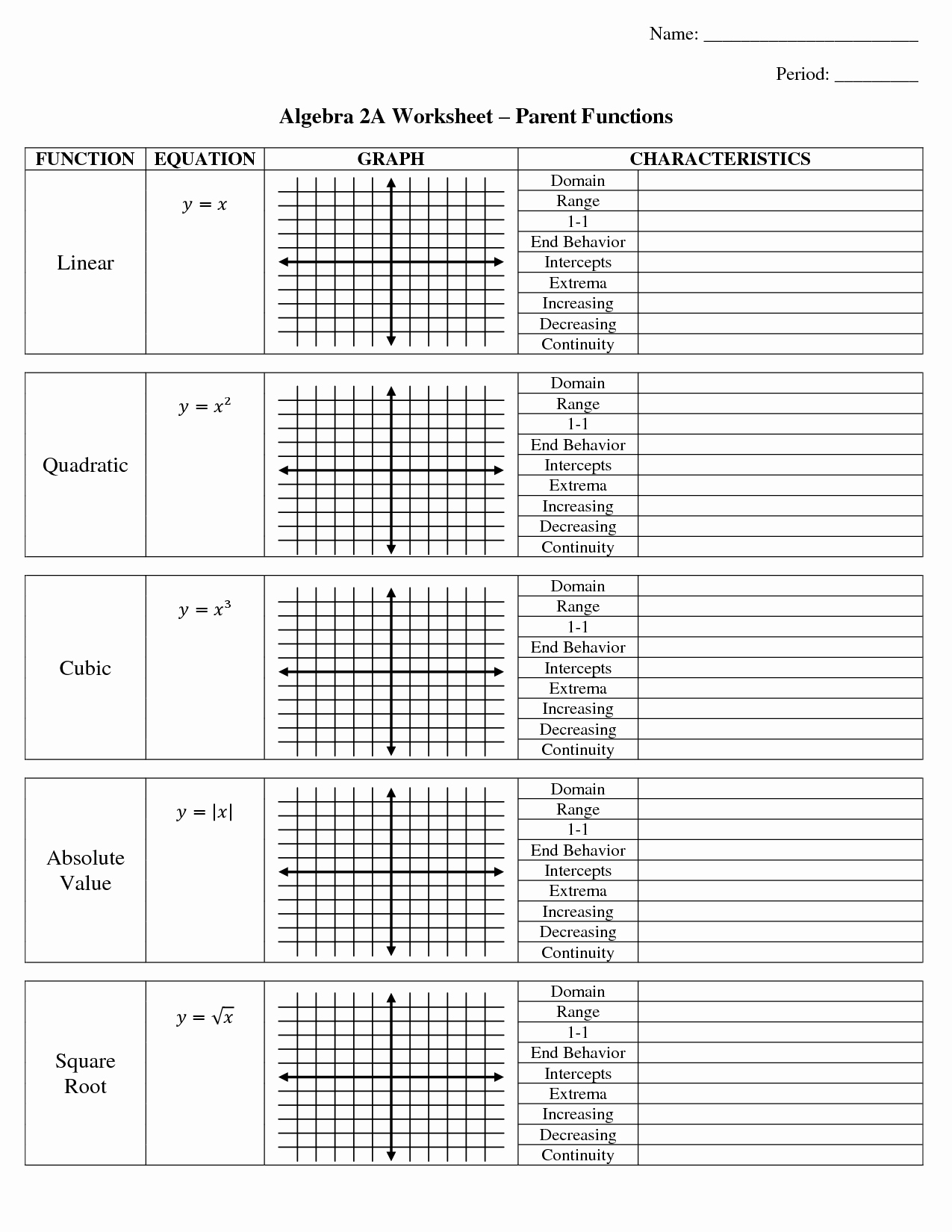
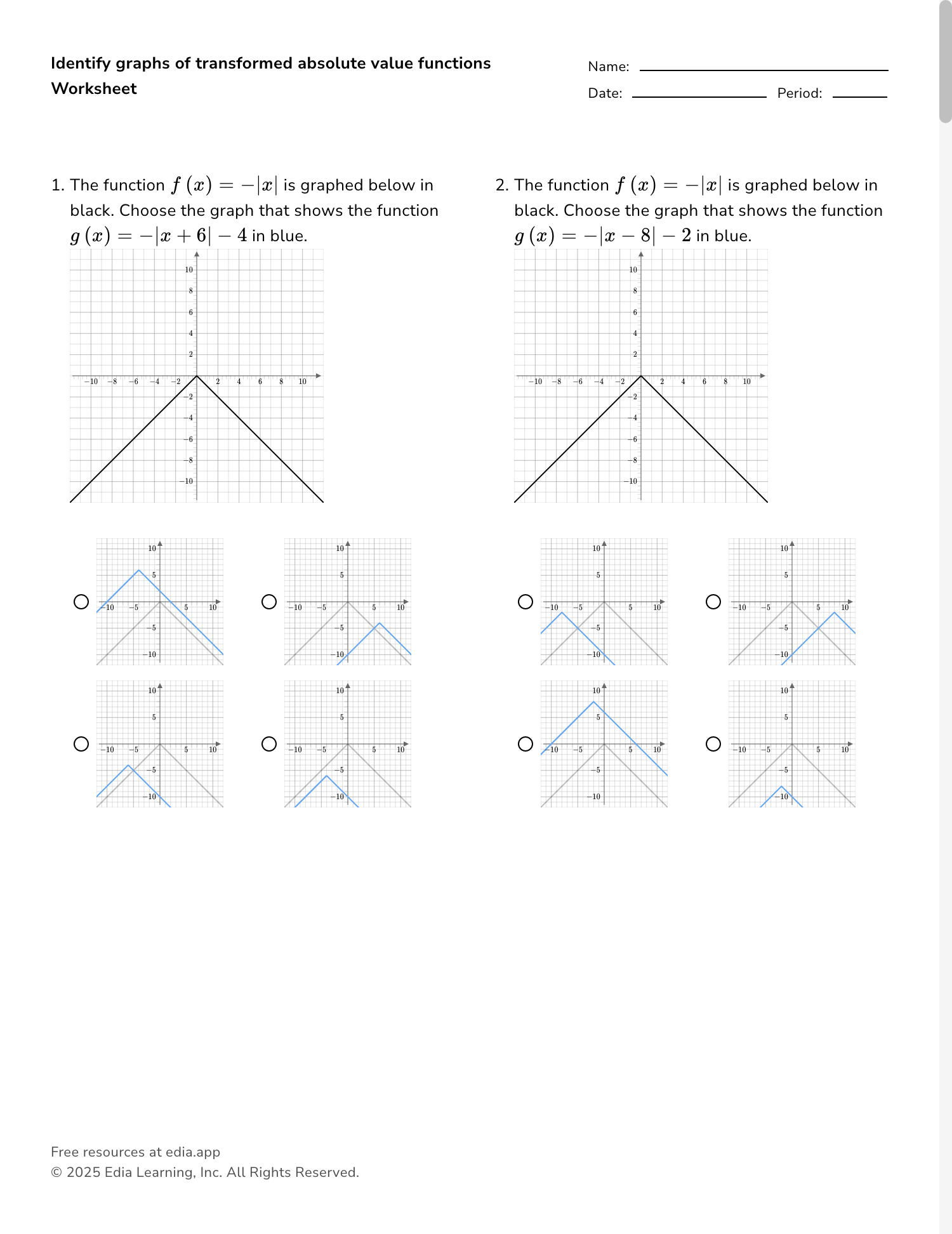
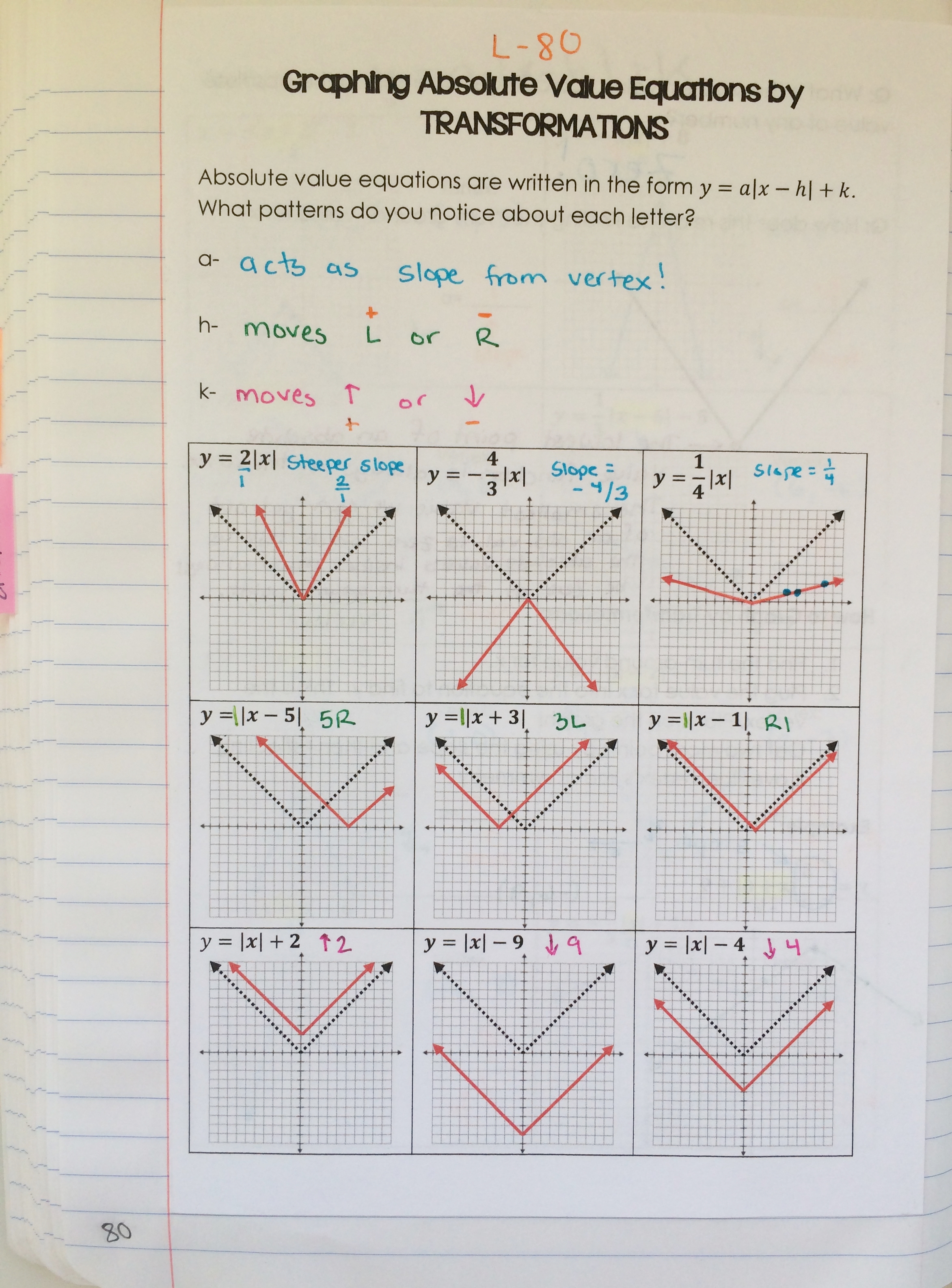
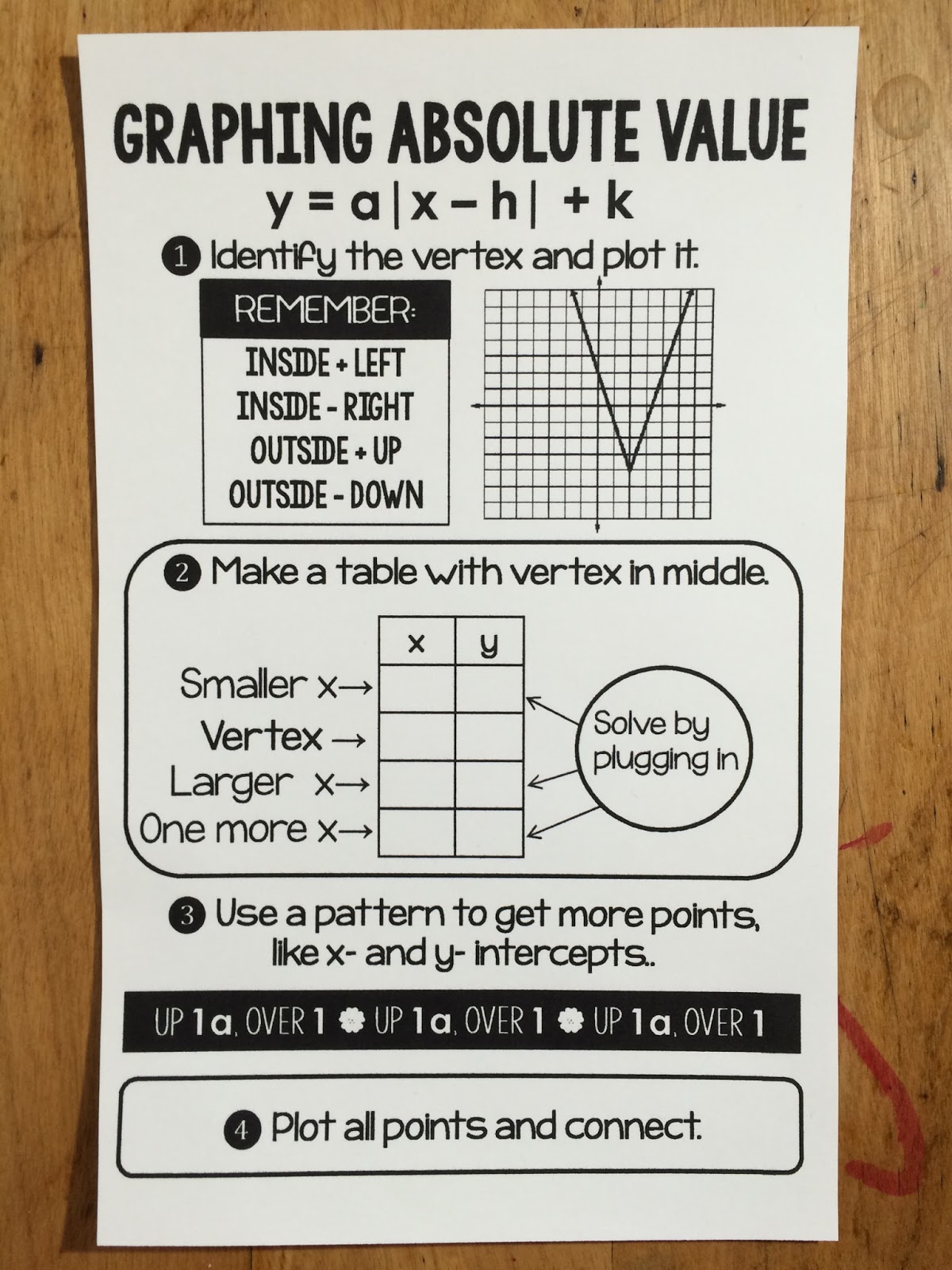
Absolute Value Function Transformations Worksheet offers a hands‑on way for students to explore how shifting, stretching, and reflecting a basic V‑shaped graph creates a rich family of functions, and the worksheet format makes those concepts concrete through practice problems that build confidence step by step.
Understanding Absolute Value Transformations
At its core, the absolute value function \(f(x)=|x|\) produces a V‑shape that opens upward with its vertex at the origin. This simple shape becomes a powerful teaching tool because any linear transformation—horizontal shifts, vertical shifts, stretches, compressions, or reflections—can be visualized instantly on the graph. When students see how a single change to the equation reshapes the whole picture, they develop a deeper intuition for function behavior that transfers to quadratic, exponential, and trigonometric families later on.
Key terminology to master before tackling a worksheet includes:
- Horizontal shift: Replacing \(x\) with \(x-h\) moves the vertex \(h\) units right (if \(h>0\)) or left (if \(h<0\)).
- Vertical shift: Adding \(k\) to the whole function, \(f(x)+k\), lifts the graph \(k\) units up (or down when \(k\) is negative).
- Reflection: Multiplying the entire function by \(-1\) flips the V upside down, while multiplying the inside by \(-1\) mirrors it across the y‑axis.
- Stretch/compression: Multiplying the outside by a factor \(a\) stretches the graph vertically if \(|a|>1\) or compresses it if \(0<|a|<1\). Multiplying the inside by \(b\) does the opposite horizontally.
Understanding these four transformation types equips students to decode any absolute value equation of the form \(f(x)=a|b(x-h)|+k\) quickly, a skill that the worksheet reinforces through progressive challenges.
Key Transformations Explained
Horizontal Shifts in Detail
When the expression inside the absolute value changes from \(x\) to \(x-h\), the entire V moves without altering its shape. For example, the function \(g(x)=|x-3|\) has its vertex at \((3,0)\). On a worksheet, a typical problem asks students to sketch the graph after a shift, then write the transformed equation from a given picture. This back‑and‑forth activity cements the link between algebraic notation and visual representation.
Vertical Shifts in Detail
Adding a constant \(k\) outside the absolute value raises or lowers the graph. The equation \(h(x)=|x|+4\) places the vertex at \((0,4)\). Worksheets often include “find the vertex” sections where students plug the shift values directly into the vertex formula \((h,k)\), reinforcing the idea that the vertex coordinates are simply the shift parameters.
Reflections and Their Impact
Multiplying the entire function by \(-1\) creates a downward‑opening V: \(p(x)=-|x|\). If the negative sign is placed inside, as in \(q(x)=| -x |\), the graph mirrors across the y‑axis but still opens upward, because the absolute value removes the sign. A common worksheet exercise pairs these two cases side by side, asking students to predict which transformation will flip the graph and which will simply reposition it.
Stretching and Compressing
Consider \(r(x)=2|x|\) — the V becomes twice as tall, creating a steeper slope. Conversely, \(s(x)=\tfrac12|x|\) flattens the V. Horizontal stretches/compressions work oppositely: \(t(x)=|2x|\) compresses the graph horizontally by a factor of \(½\), while \(u(x)=|\tfrac12x|\) stretches it. Worksheets frequently combine these with shifts, such as \(f(x)=3|2(x+1)|-5\), prompting learners to decompose the equation step by step.
Step‑by‑Step Worksheet Strategies
Effective worksheet use hinges on a clear, repeatable process that students can follow without getting lost in algebraic manipulation. The following systematic approach works for most absolute value transformation problems:
- Identify the outer coefficient \(a\). Determine if the graph will be stretched, compressed, or reflected vertically.
- Locate the inner coefficient \(b\). This tells you whether the graph is horizontally stretched/compressed.
- Find the horizontal shift \(h\). Look for the expression \(b(x-h)\); the sign of \(h\) indicates direction.
- Determine the vertical shift \(k\). The constant added outside the absolute value moves the vertex up or down.
- Plot the vertex using \((h,k)\). This point anchors the V‑shape.
- Sketch the basic V using the slopes derived from \(a\) and \(b\). The slope on each side equals \(\pm a/b\).
- Label key points such as the vertex, intercepts, and any points of interest the worksheet asks for.
- Check the work by substituting a few x‑values into the original equation and confirming the y‑values match the sketch.
Each worksheet problem can be solved by walking through these eight steps, and teachers can reinforce the routine by providing a short checklist on the worksheet margin. Consistency reduces cognitive overload, allowing students to focus on conceptual understanding rather than procedural confusion.
Real‑World Applications of Absolute Value Transformations
While absolute value functions often appear in pure math textbooks, they model many real‑world phenomena, making the worksheet relevant beyond the classroom.
Distance and Error Analysis
Absolute value measures distance from a reference point, so \(|x-h|\) represents how far a variable deviates from a target value \(h\). In manufacturing, a quality‑control chart might plot \(|\textmeasurement – \textspecification|\) to visualize tolerances. Students can practice by creating a worksheet scenario where a factory wants to keep a part’s length within ±0.2 inches, and they graph the acceptable region using a transformed absolute value function.
Financial Break‑Even Points
Profit or loss relative to a break‑even point can be expressed with absolute value: \(P(x)= -|x-5000| + 2000\) shows profit decreasing symmetrically as sales move away from the optimal 5,000 unit mark. A worksheet could ask learners to determine the sales range that yields at least $1,000 profit, reinforcing both algebraic solving and business intuition.
Signal Processing
In electronics, the absolute value function is used to rectify alternating current (AC) signals, turning negative voltage portions positive. A transformed version, \(V(t)=A| \sin(\omega t) |\), models a full‑wave rectifier. A worksheet that asks students to sketch the rectified sine wave using absolute value transformations links math to engineering concepts.
Common Mistakes and How to Fix Them
Even diligent students stumble on typical pitfalls when working with absolute value transformations. Identifying these errors early helps prevent misconceptions that could linger into advanced courses.
Confusing Horizontal and Vertical Shifts
Students sometimes treat \(|x-2|+3\) as a shift right 2 and up 2, mixing the vertical constant with the horizontal one. To correct this, encourage learners to write the vertex explicitly as \((h,k)=(2,3)\) before drawing. Practice problems that ask for the vertex first, then the graph, reinforce the separation.
Neglecting the Effect of the Inner Coefficient on the Horizontal Scale
When \(b\neq1\), many students forget that the graph compresses or stretches horizontally by \(1/|b|\). A quick mental check—“what value of \(x\) makes the inside zero?”—helps. For \(|3(x+1)|\), the zero occurs at \(x=-1\), confirming the vertex location, while the slopes become \(\pm a/b = \pm a/3\). Worksheets that explicitly ask for slope calculations after plotting the vertex cement this habit.
Overlooking Reflections
Placing a negative sign outside the absolute value flips the V, but students sometimes keep the original upward opening. Visual cues, such as shading the region above the x‑axis for \(|x|\) and below for \(-|x|\), can be added to worksheet prompts. Seeing the shaded area helps internalize the direction of opening.
Incorrectly Applying Both Inside and Outside Negatives Simultaneously
The combination \(-| -x |\) simplifies to \(-|x|\) because the inner negative disappears inside the absolute value. However, learners may mistakenly think the double negative results in a positive. A worksheet tip: “Simplify the expression before graphing” reminds students to reduce redundancies first.
Tips for Teachers and Parents
Facilitating mastery of absolute value transformations requires more than just handing out worksheets; it demands purposeful scaffolding and feedback.
- Start with the basic V on a blank coordinate plane before introducing any transformations. This visual anchor makes later changes easier to perceive.
- Use manipulatives such as graph paper overlays or digital graphing tools that allow students to slide the V horizontally and vertically, observing real‑time effects.
- Encourage verbal explanation—have students describe each transformation in their own words before writing the equation. Teaching the concept aloud reinforces retention.
- Integrate technology by assigning a short activity on a graphing calculator or free online plotter to verify worksheet sketches.
- Provide immediate feedback through answer keys that not only give the final graph but also highlight each step of the transformation process.
- Differentiate practice by offering tiered worksheets: a basic set for novices focusing on single transformations, and a mixed‑challenge set that combines multiple shifts, stretches, and reflections for advanced learners.
When parents are involved, they can use the same checklist approach at home, guiding their child through the eight‑step process and celebrating correct vertex identification as a milestone.
Creating Your Own Absolute Value Transformations Worksheet
Custom worksheets allow educators to align problems with specific learning objectives or student interests. Follow these steps to design an engaging, standards‑aligned worksheet:
- Select a theme (e.g., sports statistics, environmental data) to contextualize the absolute value scenarios.
- Choose a range of difficulty by varying the number of simultaneous transformations. Start with single‑parameter changes, then progress to equations like \(f(x)= -2|4(x-3)|+5\).
- Write clear prompts that ask for both the transformed equation and the corresponding graph. Example: “Given the vertex (‑2, 3) and a vertical stretch of factor 3, write the function and sketch its graph.”
- Include real‑world word problems that require students to model a situation using an absolute value function, then interpret the graph.
- Provide a systematic answer key that mirrors the eight‑step solution process, so students can self‑grade and understand where they erred.
- Test the worksheet by solving a few problems yourself or having a colleague review them for clarity and accuracy.
By customizing the worksheet, teachers can keep the material fresh, maintain student motivation, and directly address any gaps observed during instruction.
Conclusion
The Absolute Value Function Transformations Worksheet serves as a versatile bridge between abstract algebraic concepts and concrete visual understanding, empowering students to manipulate and interpret V‑shaped graphs with confidence. By mastering horizontal and vertical shifts, reflections, and stretches/compressions, learners unlock the ability to model distance, error margins, financial thresholds, and signal rectification—all while honing problem‑solving skills that transfer to higher‑level mathematics. Structured strategies, real‑world examples, and targeted feedback transform a simple worksheet into a powerful instructional tool, and teachers or parents who apply the outlined tips will see measurable growth in student mastery. With practice, reflection, and purposeful worksheet design, absolute value transformations become an intuitive part of every student’s mathematical toolkit, ready to be applied across disciplines and everyday life.