2 3 Digit Multiplication Worksheets serve as the cornerstone for students transitioning from basic multiplication to more advanced arithmetic. These carefully structured practice materials challenge learners to multiply a two‑digit number by a three‑digit number, reinforcing place value, carryover strategies, and mental calculation skills. By integrating these worksheets into a regular study routine, educators and parents can cultivate confidence and accuracy that will carry into algebra, statistics, and beyond.
Understanding the Challenge of 3‑Digit by 2‑Digit Multiplication
Multiplying a three‑digit number by a two‑digit number involves several layers of cognitive demand. Students must first manage the hundreds, tens, and units of the larger factor, then align each digit of the smaller factor with proper place values, and finally perform addition of partial products. This complexity often leads to errors in carry‑over, positional misplacement, or incomplete addition. Recognizing these pain points allows teachers to target specific misconceptions through targeted worksheet design.
Key Cognitive Hurdles
- Place Value Misalignment: Misplacing partial sums by one column.
- Carry‑Over Neglect: Forgetting to shift digits correctly after each multiplication step.
- Speed vs. Accuracy Trade‑Off: Rushing leads to pattern recognition errors.
- Conceptual Understanding: Treating the problem as a series of single‑digit multiplications without seeing the long multiplication structure.
Why Mastery Matters
Beyond rote calculation, proficiency in 3‑digit by 2‑digit multiplication forms the foundation for fraction multiplication, algebraic expressions, and real‑world problem solving such as estimating costs, measuring distances, or handling financial calculations. Early mastery reduces cognitive load in later grades, enabling students to tackle more abstract concepts with greater ease.
Why 2 3 Digit Multiplication Worksheets are Essential for Mastery
Worksheets that focus on this specific multiplication type allow for deliberate practice, immediate feedback, and incremental difficulty progression. When students engage with structured problems, they internalize the systematic approach necessary to avoid common pitfalls.
Benefits for Students
- Consistent Practice: Repetition builds muscle memory for carry‑over and positional accuracy.
- Self‑Assessment: Color‑coded answers or checklists help learners identify recurring mistakes.
- Confidence Building: Clear progression from simple to complex problems reduces anxiety.
Benefits for Teachers and Parents
- Diagnostic Tool: Analyze completed worksheets to pinpoint specific weaknesses.
- Customizable Difficulty: Adjust the range of digits or add time constraints to match learner proficiency.
- Efficient Feedback: Pre‑graded answer sheets save grading time and provide instant corrections.
Crafting Effective Worksheets: Key Elements to Include
An engaging worksheet is more than a list of problems. It must be thoughtfully structured to support learning objectives and keep students motivated.
Problem Variety
Include a mix of:
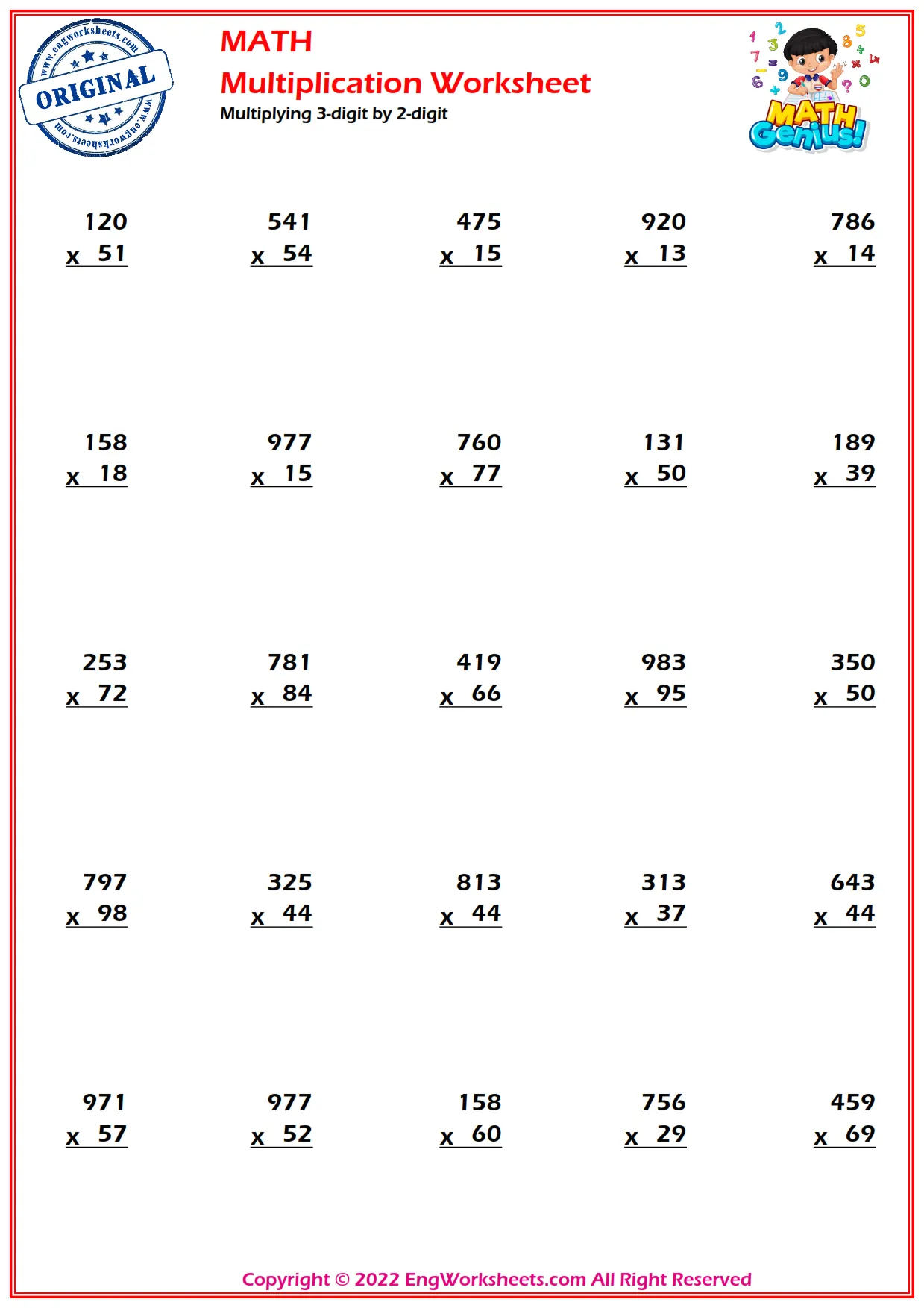
- Standard long‑multiplication problems (e.g., 487 × 56).
- Word problems that embed multiplication (e.g., “A store sells 234 packs of pencils in groups of 12.”).
- Skip‑count or estimation challenges that test conceptual understanding.
Clear Instructions and Examples
Begin each worksheet with a concise step‑by‑step guide and a fully worked example. Use bold or italicized text to emphasize critical steps such as “Write the partial product of the units digit below the first line.”
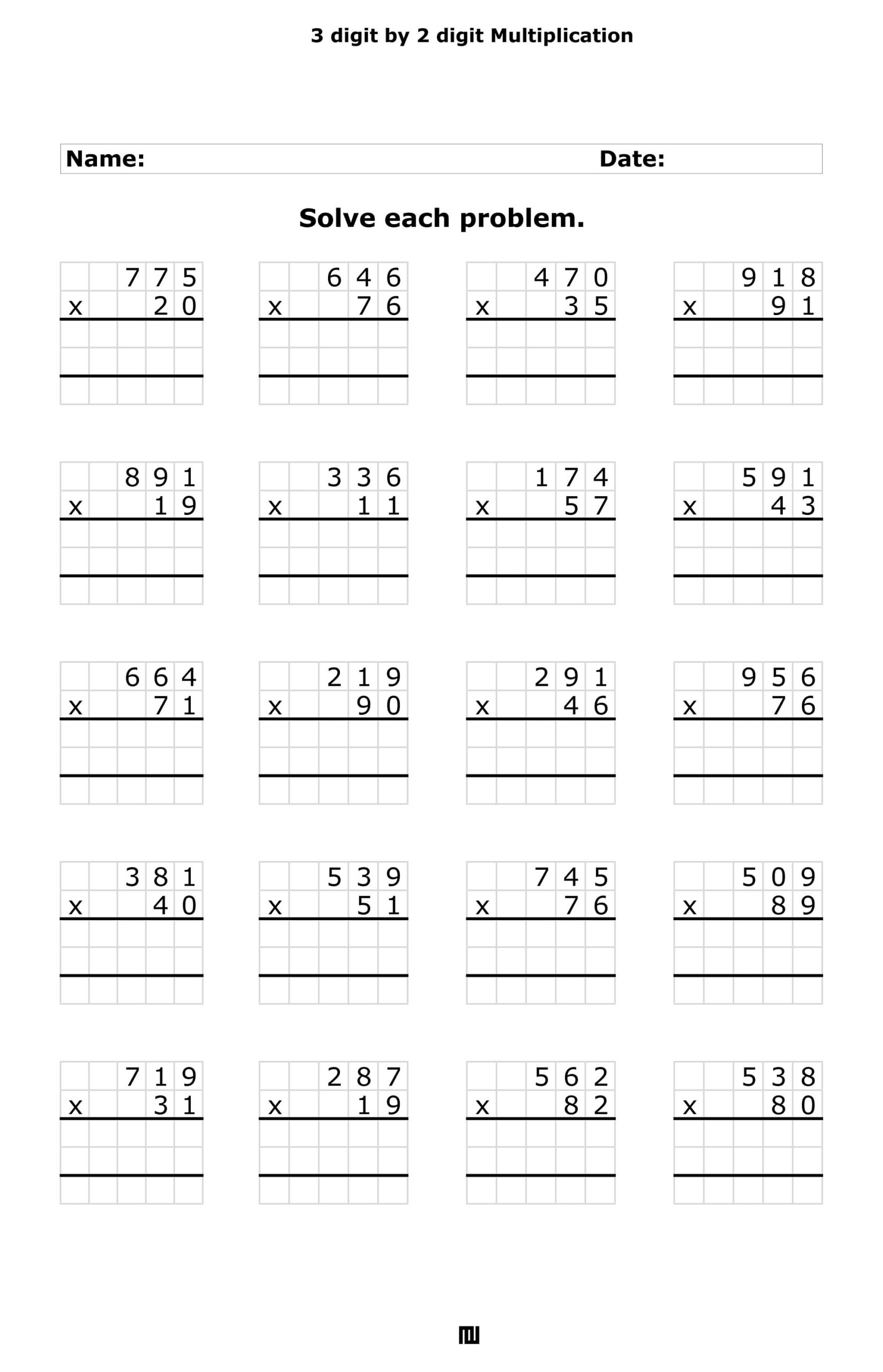
Space for Work and Answers
Provide ample margin space for students to show each calculation step. A separate answer column or a colored answer key enhances self‑checking habits.
Progressive Scaffolding
Arrange problems so that each successive row increases in difficulty—starting with a three‑digit number multiplied by a single digit, then a two‑digit multiplier, and finally a full 3‑by‑2 problem.
Visual Aids
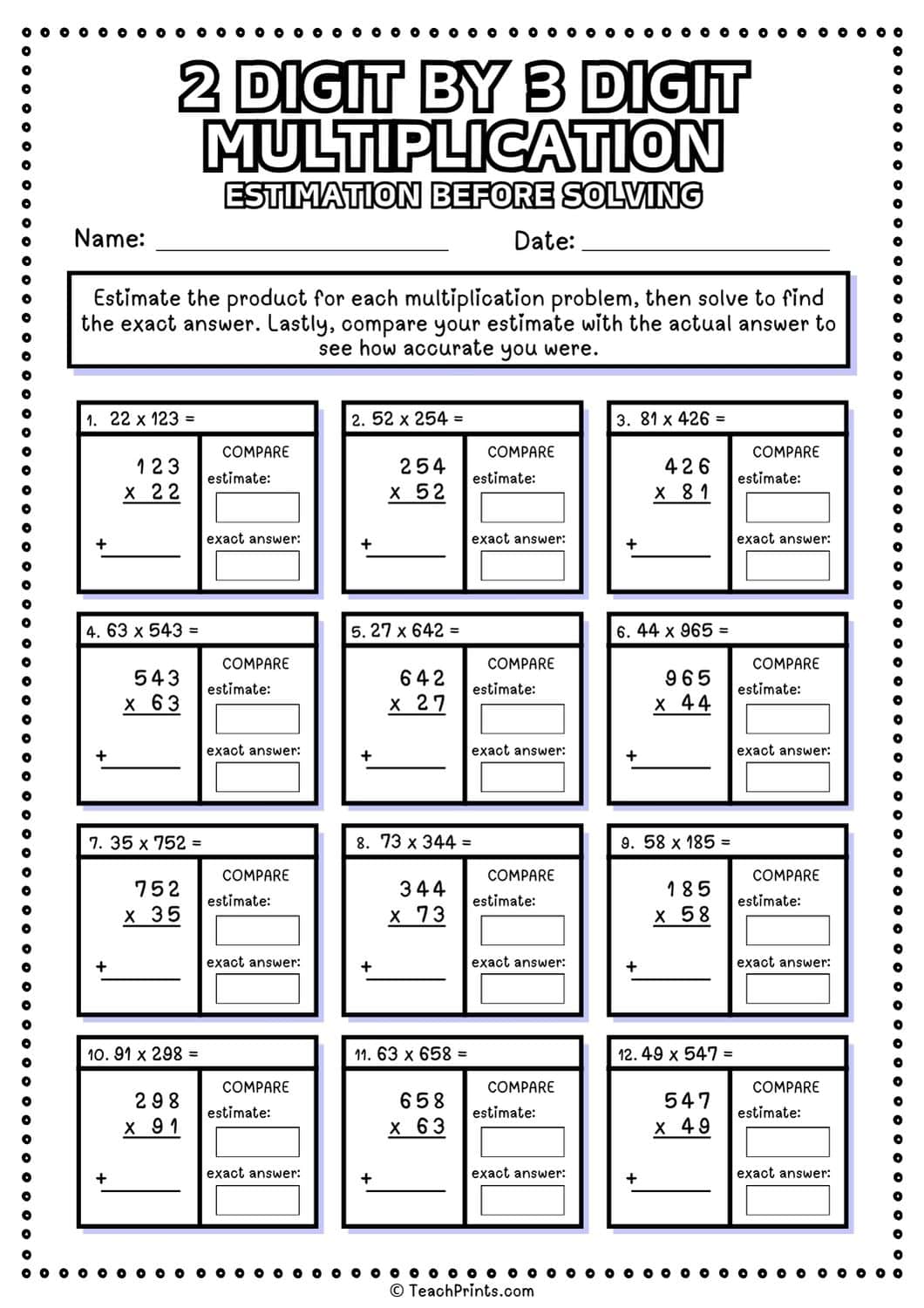
Optional visual tools like dotted lines for carrying, or color‑coded columns for place values, can assist visual learners without overwhelming the layout.
Step‑by‑Step Guide: Building Your Own Worksheet
For teachers or parents who want to create custom worksheets, follow this streamlined process.
1. Define Learning Objectives
Decide whether the focus is on speed, accuracy, or conceptual understanding. This will guide problem selection and grading criteria.
2. Select Number Ranges
- Easy: 100–199 × 10–99.
- Intermediate: 200–399 × 50–199.
- Advanced: 400–999 × 100–999.
3. Generate Problems
Use a spreadsheet or a simple script to randomly create multiplication pairs within chosen ranges. Ensure a balanced mix of even and odd numbers to expose students to varied carry scenarios.
4. Design the Layout
- Create a table with two columns: Problem and Space for Solution.
- Reserve a footer row for an answer key if desired.
- Include a header with the title, date, and student name.
5. Add Instructional Prompts
Insert a brief paragraph at the top: “Remember to write each partial product on its own line and carry over any values greater than 9.”
6. Proofread and Test
Run a sample calculation yourself to confirm all answers and formatting are correct before printing or distributing.
Sample Problems and Solutions
Below is a curated set of sample problems that illustrate common patterns and include solutions for self‑checking.
Problem Set 1: Basic Long Multiplication
- 124 × 34 = 4216
- 256 × 47 = 12032
- 389 × 56 = 21784
Problem Set 2: Word Problem Context
- “A bakery baked 312 cupcakes in groups of 12. How many cupcakes were made in total?” – 312 × 12 = 3744
- “A farmer harvested 459 apples and sold them in packs of 18.” – 459 × 18 = 8262
Problem Set 3: Estimation Challenge
- Estimate 378 × 65 by rounding to nearest tens: 380 × 70 = 26,600. Actual answer is 24,570.
- Estimate 295 × 49 by rounding: 300 × 50 = 15,000. Actual answer is 14,455.
Integrating Worksheets into Classroom and Home Learning
Effective use of worksheets depends on thoughtful implementation. Below are strategies for both settings.
In the Classroom
- Start a lesson with a brief demonstration of a single problem.
- Assign a small set of worksheets as in‑class practice.
- Encourage peer review by pairing students to check each other’s work.
- Allocate a “worksheet corner” where students can access a variety of problems for extra practice.
At Home
- Set a consistent time slot for multiplication practice, e.g., 15 minutes after dinner.
- Use a timer to introduce a “speed round” once accuracy stabilizes.
- Track progress with a simple chart: number of correct answers, speed, and errors.
- Rotate between printable PDFs and interactive apps to keep engagement high.
Digital vs. Printable: Choosing the Right Format
Both formats have unique advantages. Digital worksheets can auto‑grade, provide instant feedback, and adapt difficulty in real time. Printable versions allow tactile interaction and can be useful where internet access is limited.
Digital Advantages
- Automatic scoring and instant error highlighting.
- Dynamic problem generation based on user performance.
- Compatibility with learning management systems for tracking.
Printable Advantages
- Hands‑on practice fosters deeper engagement.
- No reliance on devices or battery life.
- Easy to distribute in resource‑constrained settings.
Common Mistakes and How to Avoid Them
Understanding typical error patterns helps teachers design targeted interventions.
1. Missing a Carry‑Over
Solution: Teach the “carry over” rule by using a visual cue—draw a small arrow above the column where the carry will go.
2. Placing Partial Products in Wrong Columns
Solution: Encourage the use of a vertical alignment template, ensuring each new line shifts right by one column relative to the previous.
3. Forgetting to Add the Final Row
Solution: Include a reminder step in the instructions: “After adding all partial sums, write the final total.”
4. Over‑Simplifying Using Estimation Only
Solution: Pair estimation problems with exact calculations to reinforce that estimates are a tool, not a substitute.
Assessment and Tracking Progress
Effective assessment turns practice into measurable growth. Use the following techniques.
Time‑Based Quizzes
Record how long students take to complete a set of 10 problems. Track improvements over weeks.
Accuracy Scales
- 90–100% – Mastery
- 70–89% – Good
- 50–69% – Needs Practice
- Below 50% – Targeted Remediation
Self‑Reflection Journals
Have students write one sentence about what strategies worked or where they struggled after each worksheet.
Resources and Further Reading
While this article covers essential aspects of 2 3 Digit Multiplication Worksheets, continuous learning can deepen mastery. Explore curriculum guides from state educational boards, join teacher forums focused on math instruction, or enroll in professional development workshops that emphasize procedural fluency.
Conclusion
Mastery of 3‑digit by 2‑digit multiplication is a pivotal milestone in a student’s mathematical journey. By leveraging well‑designed worksheets that incorporate progressive difficulty, clear instruction, and immediate feedback, teachers and parents can build a robust foundation. Whether using digital platforms for instant grading or printed sheets for hands‑on practice, the key lies in consistent, deliberate practice that addresses common pitfalls and celebrates incremental gains. With these tools, learners will move confidently from simple calculations to complex problem solving, turning every multiplication challenge into an opportunity for growth.









Related posts of "2 3 Digit Multiplication Worksheets"
